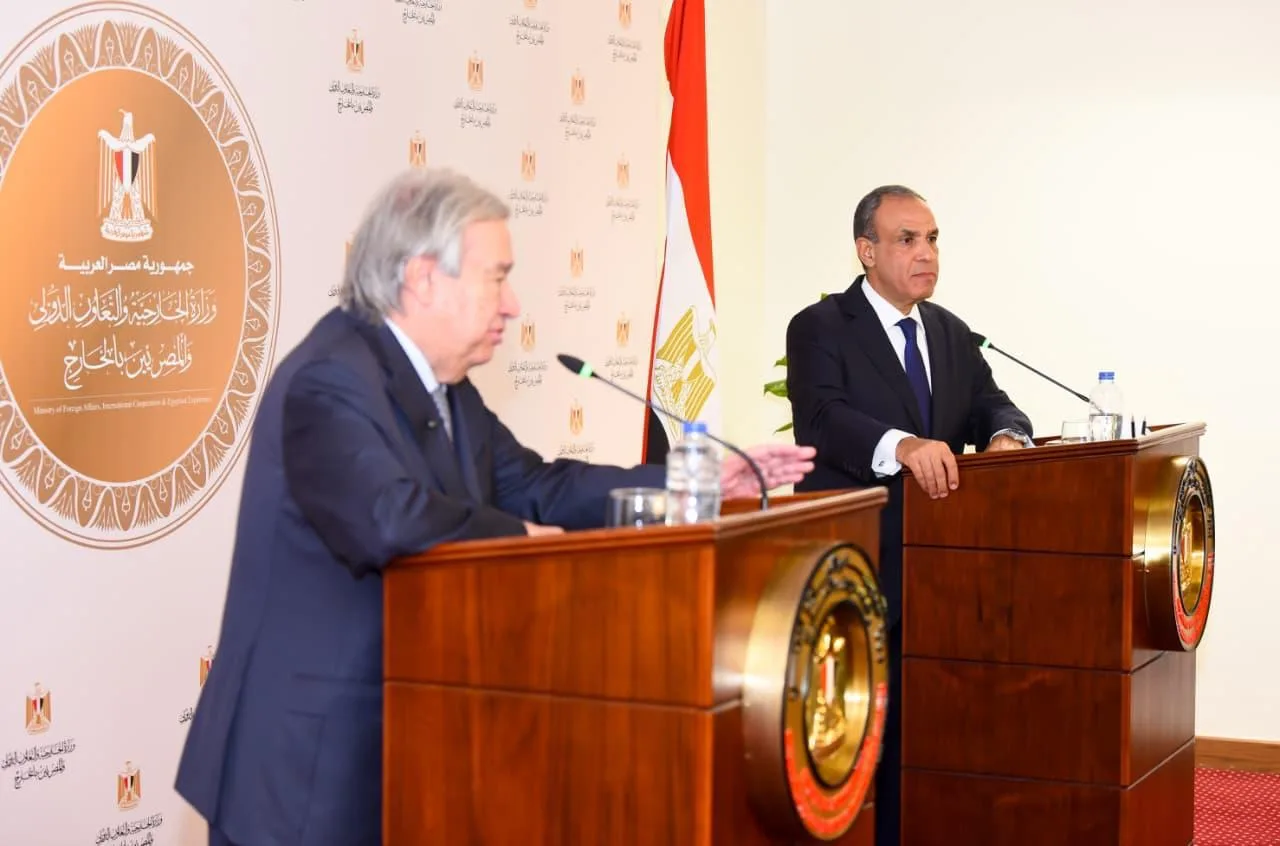





Minister of Foreign Affairs, International Co-operation and Egyptian Expatriates Badr Abdelatty received UN Secretary-General António Guterres on Monday during his visit to Egypt and in conjunction with the celebration of United Nations Day. The talks covered ways to strengthen co-operation, regional and international developments, and joint efforts to de-escalate tensions and resolve conflicts.
Foreign Ministry Spokesperson Ambassador Nader Zaki said Guterres expressed appreciation for Egypt’s pivotal role in supporting UN efforts at the regional and international levels. He praised Egypt’s active contributions to conflict resolution and the promotion of peace and stability, describing the country as a cornerstone of stability in the Middle East and a key partner in supporting multilateralism.
Abdelatty reaffirmed Egypt’s support for efforts to reform the UN system, improve its efficiency and strengthen its responsiveness. He stressed that reform must be comprehensive, grounded in international law, and based on full ownership of the negotiation process by member states, while taking into account the concerns of developing countries. He also underscored the need to align these efforts with reform of the UN Security Council to ensure fair representation for Africa, in line with the Ezulwini Consensus and the Sirte Declaration.
The Foreign Minister stressed the importance of the UN’s central role in advancing the Sustainable Development Goals, providing affordable and sustainable development finance, addressing the debt crisis and the growing debt burden on developing countries, reforming the international financial system and facilitating climate finance. Such efforts, he said, should reflect the priorities of developing countries and strengthen their capacity to achieve development and improve living standards.
In this context, Abdelatty highlighted the Egyptian initiative launched at COP27 to address climate-related loss and damage, as well as Egypt’s efforts to establish a Borrowers’ Platform aimed at strengthening coordination among developing countries and unifying their positions on debt-related challenges.
The two sides also discussed escalating tensions in the region and their regional and international repercussions. Abdelatty stressed the importance of continued consultation and close co-ordination to contain tensions, de-escalate the situation and prioritise diplomatic solutions to achieve comprehensive and sustainable settlements.
He called for stronger international cooperation to address the serious consequences of regional crises, particularly those affecting food security and freedom of navigation. He also emphasised the need to intensify international co-ordination to ensure the continued flow of grain and essential food commodities and mitigate the impact of crises on the countries most affected, particularly Egypt and African states.
The talks also addressed the catastrophic humanitarian situation in the Gaza Strip. Abdelatty outlined Egypt’s ongoing efforts to ensure the full and sustained delivery of humanitarian aid and stressed the importance of preserving the essential and irreplaceable role of the UN agency in its five areas of operation.
Regarding Sudan, Abdelatty emphasised the need to preserve the country’s unity, sovereignty and territorial integrity, rejecting the establishment of any parallel entities. On Libya, he reiterated Egypt’s firm position in support of a comprehensive political settlement that safeguards the country’s unity, sovereignty, territorial integrity and national institutions.

