




Egypt’s Minister of Planning and Economic Development Ahmed Rostom said the Egyptian economy has demonstrated exceptional resilience in the face of regional and international challenges, noting that the growth rate rose to 5.1 per cent in fiscal year 2025/2026, up from 4.4 per cent in the previous fiscal year and exceeding forecasts by major international institutions.
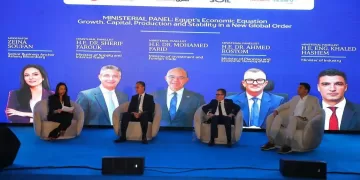
Minister Rostom made the remarks during a high-level ministerial session held as part of the fourth edition of the Egyptian Entrepreneurship Sector Summit (2026 SDR Summit), organised by Entlaq under the theme “Data × Innovation: Reimagining Egypt’s Entrepreneurship Landscape.”
The session was also attended by Minister of Supply and Internal Trade Sherif Farouk and Minister of Industry Khaled Hashem.
He stressed that “the real strength of this performance lies not merely in the overall figure, but in the quality and sources of this growth,” explaining that the industrial, trade, and information and communications technology (ICT) sectors collectively contributed around 48 per cent of total growth.
Rostom highlighted the strong performance of non-oil manufacturing industries, saying it reflected the success of government efforts to strengthen the country’s productive base.
He noted that Egypt’s growth is being driven by a diverse range of sectors, including industry and service sectors such as ICT, stressing the need to maintain efforts to curb inflation and create more job opportunities.
He said the annual inflation rate declined to 12.7 per cent in August 2026, compared with 13 per cent in August 2025.
Rostom also highlighted the quality of Egypt’s data, saying it has received recognition from international institutions.
He noted that Egypt had benefited from the economic shocks it faced in previous years and dealt with them effectively, adding that international institutions have confidence in government figures and data issued in accordance with international standards.
He pointed in particular to the recently announced growth figures for the fourth quarter of the previous fiscal year and for the fiscal year as a whole.
The minister said the government aims to raise the share of private investment from 59 per cent to 64 per cent by 2030, with investment expected to come from a diverse range of sectors, including ICT and logistics, particularly in the Suez Canal Economic Zone.
He also highlighted the government’s efforts to settle outstanding dues owed to foreign companies, saying these measures had helped restore investment by those companies and contributed to positive growth in the petroleum sector.
Rostom said Egypt needs to develop new financing instruments capable of assuming greater risks and providing greater opportunities for expansion.
In this regard, he said the government is working to restructure the National Investment Bank and restore its development role in partnership with the private sector through its subsidiaries, including NI Capital and Ayady, as well as through cooperation with the World Bank on a financing guarantee mechanism for infrastructure projects.
Regarding the entrepreneurship ecosystem, Rostom said the government views startups and innovators as key drivers of digital transformation and future job creation.
He added that the Ministerial Group for Entrepreneurship is currently working to establish a flexible and enabling regulatory and institutional environment aimed at expanding private-sector partnerships, strengthening the venture capital ecosystem and providing financing mechanisms suited to the needs of startups.

