




From Beijing to Cairo
By Deng Yushan
At daybreak one recent morning, the first light was gilding the Red Sea when my colleagues and I reached its shore. A container ship from China had just nosed into Ain Sokhna Port, and soon a convoy of trucks began to rumble out from the docks.
Not far away, in the China-Egypt TEDA Suez Economic and Trade Co-operation Zone, where factory roofs cut across the desert horizon, production lines hummed without pause.
Established in 2008, the TEDA co-operation zone has grown into a flagship project synergising China’s Belt and Road Initiative and Egypt’s Suez Canal Economic Zone strategy.
Over the years, Chinese companies in sectors ranging from textiles and building materials to home appliances and renewable energy have taken root there, weaving themselves into Egypt’s evolving industrial landscape. Following its first expansion in 2016, the zone secured an additional 2.86 square kilometres last year.
“We are working to build an industrial park with the best overall business environment, the highest investment density, the greatest output per unit of land, and the largest concentration of Chinese companies in Egypt,” Zhang Yixiang, director of industrial real estate investment promotion at China-Africa TEDA Investment Co., Ltd., told us, his pride unmistakable.
Particularly, TEDA is now focused on attracting high-quality Chinese companies capable of filling gaps in Egypt’s industrial base and reinforcing local supply chains, he added.
Yet to me, the park’s most compelling growth story is not found in gleaming machines or shuttling autonomous mobile robots, but in the careers and dreams of the Egyptians who work there.
Ahmed Soliman was among the first Egyptian employees at China Jushi Egypt for Fiberglass Industry Co., Ltd. Starting as a production-line technician, he has worked his way up to become the company’s deputy general manager.
“I keep learning and improving myself,” Soliman told us in his office. “After all these years of working here, I can see progress not only in my technical skills, but also in my management abilities. I believe I will continue to grow together with the company.”
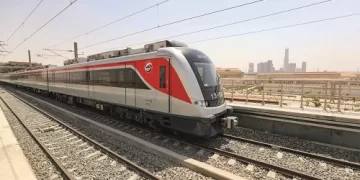
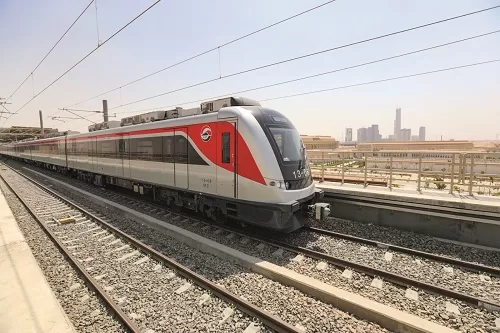
Leaving TEDA, we followed the desert highway west until, beneath the blazing sun, a striking skyline emerged on the horizon: Egypt’s New Capital. Once inside the new city, we pulled over near a station just as a Cairo Light Rail Transit (LRT) train was gliding in.
Built by a consortium led by China Railway Group Limited and Beijing-based AVIC International Holding Corporation, the Cairo LRT, Egypt’s first electrified light-rail system, runs as another flagship Belt and Road co-operation project between China and Egypt.
For Cairo resident Mohamed Hussein, the rail has transformed an exhausting commute. “Before, we mostly relied on private cars or minibuses. The journeys were long, and we often had to change vehicles several times,” he recalled. “Since the light rail opened, getting around has become way much easier.”
In the eyes of Guo Kaixiang, general manager of AVIC International’s Egypt branch, the project’s value extends far beyond the tracks themselves. “More importantly, we have introduced a complete Chinese rail transit system to Egypt. It has not only made daily travel more convenient for local residents, but also given them a firsthand sense of the quality behind Chinese manufacturing,” he said.
The Chinese companies’ performance during construction and subsequent maintenance has earned recognition from the Egyptian people, and that trust has helped pave the way for Chinese participation in the later phases of the project, he told me.
“We believe,” he said, “genuine sincerity is the foundation of trust, and that trust is the true essence of China-Egypt co-operation.”
At the heart of the New Capital, the Central Business District (CBD) has already taken shape. The nearly 400-metre Iconic Tower soars above ranks of high-rises, while ribbons of greenery thread their way between the buildings in a city carved from the desert.
Jia Fengling, the CBD project’s chief engineer from China, told us that he will never forget the transformation. “I came here with the blueprints in 2017,” he said. “When I first arrived, there was nothing but barren desert as far as I could see.”
Over the years, Chinese builders have brought in steel, finishing materials, mechanical and electrical equipment, and digital-control systems. More significantly, they have helped train a generation of Egyptian engineers.
Yasser Sayed, deputy manager of the project’s engineering department, has witnessed the change from the front line. “When I see the landmark tower and the other high-rises rising from the ground, I feel very proud because I have been part of this marvel,” he said.
To him, the skyline records more than construction progress. “What I see,” he said, “is years of hard work, the challenges we overcame one after another, and thousands of Chinese and Egyptian workers standing side by side to turn this project into reality.”
On our way back to Cairo, the sun slipped toward the horizon, casting a warm golden glow over the Egyptian landscape. As dusk settled, the promise of tomorrow seemed already to be unfolding.
Deng Yushan is deputy director of the Middle East Regional Bureau of China’s Xinhua News Agency and a senior researcher at Xinhua Institute.

