










Hermes fleet uses artificial intelligence for targeting, intelligence gathering, and mission management
Behind the closed doors of military operations rooms, life-or-death battlefield decisions are no longer made solely by senior staff. Instead, they are increasingly framed and executed by silent algorithms operating high in the sky.
In a rare intelligence leak unveiling operational tactics on the ground, official internal documents from the Israeli military show an unprecedented shift in aerial warfare doctrine, where key decisions regarding operational targeting and threat identification have been handed over to artificial intelligence installed aboard its unmanned aerial vehicle (UAV) fleet. Drones are no longer limited to simple reconnaissance or solitary strike missions; driven by a major technological leap known as the “Increasing Algorithm”, they have been transformed into automated, round-the-clock “target factories” operating over Gaza, Lebanon, and Iran.
Amid the noise of aircraft and the echo of explosions, onboard software such as “Server in the Sky” and threshold filters run a parallel war collecting data, sorting information, and designating human beings and residential homes as targets to be eliminated, despite acknowledged margins of error. This strategic analysis examines the secrets behind this technological push, its legal and ethical ramifications for international rules of engagement, and a central question facing the international community: Have humans in modern warfare been reduced to mere data points processed by machines before an automated verdict of destruction is passed?
Internal military documents, battlefield testimonies, and specialized press reports including coverage by journalist Omer Benjakob in Haaretz and surveys by the organization Breaking the Silence reveal a massive leap in drone fleet operations. During recent military confrontations in Gaza and Lebanon, flight hours for the drone fleet increased fivefold, subjecting urban and rural battlefields to total and continuous aerial surveillance.
This operational intensity could not have been sustained by human analysts alone, as the sheer volume of visual and electronic data creates an analytical bottleneck for intelligence agencies. To resolve this, the “Increasing Algorithm” was introduced, converting the drone fleet into an operational information engine that automatically processes, filters, and formats massive streams of raw data into strike-ready targets. AI-driven architecture, led by network formations such as “Storm Clouds”, serves as the backbone for gathering data and relaying live tactical maps to combat forces in real time.
The strike capabilities of the drone fleet rely on integrated, highly complex computer software and hardware packages that move data processing off the ground and straight into the aircraft itself.
Server in the Sky (SITS): An advanced computer mounted directly onto the drone. SITS runs autonomous intelligence-processing algorithms to operate sensors, automatically identify and classify targets, and determine whether to track them or transfer data to command centers, air force pilots, or ground troops. It also handles autonomous fleet management, automatically transferring mission tasks between drones if visibility is obscured by cloud cover or ground-to-air missile threats.
Wide Area Persistent Surveillance (WAPS): Consisting of an electro-optical payload with 10 high-resolution cameras mounted underneath Hermes drones, this system documents an area of up to 80 square kilometres in real time—equivalent to nearly a quarter of the Gaza Strip with a single aircraft. It enables “intelligence forensics”, allowing operators to rewind video footage to trace object movements and historically reconstruct sequences of events after they occur.
Threshold Guard Mechanism and Target Integration: Airborne systems integrate directly with ground-based intelligence software like “Lavender”, which analyzes demographic and behavioral data to estimate the likelihood of individuals belonging to armed groups. “Threshold Guard” filters control the outward flow of data, determining which variables are passed along to human operators.
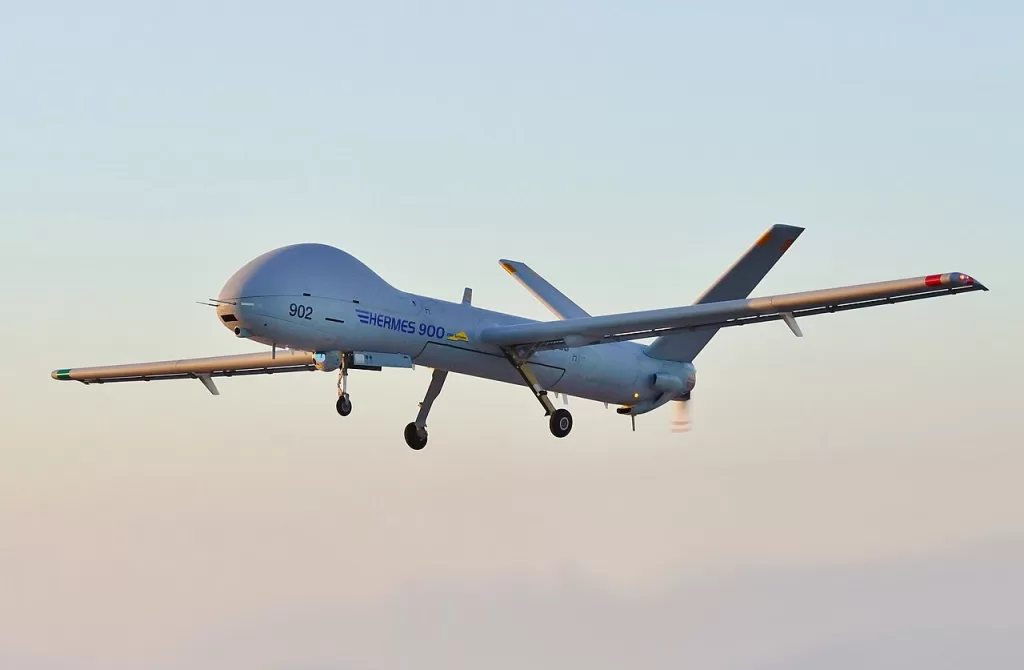
The fleet includes two primary Hermes models carrying out these operations. The Hermes 450 (“Zik”), serving as the backbone of the system, features a 150 kg payload capacity and is equipped with advanced cameras, night-imaging radar, communications interception gear, and electronic eavesdropping equipment, while carrying up to four air-to-ground missiles. The larger Hermes 900 (“Kochav”) doubles the flight duration with up to 35 hours of flight time, accommodates a 350 kg payload, integrates both WAPS and SITS technologies, provides close air support, and carries eight air-to-ground missiles.
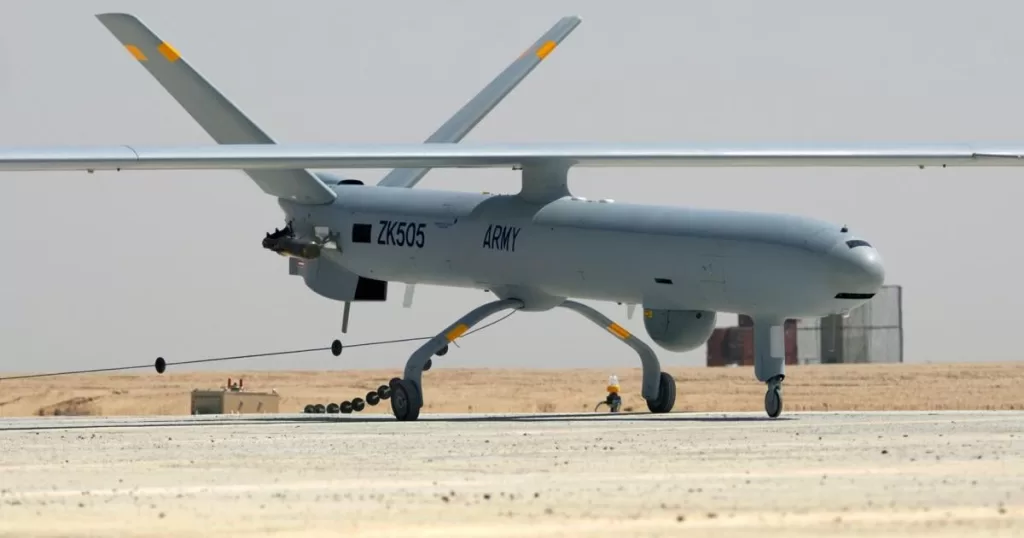
The leaked records also point to a major tactical shift: assigning air defense and counter-drone intercept missions directly to the Hermes fleet. Following failures in traditional early-warning networks such as the destruction of the “Sky Dew” (Tal Shamayim) surveillance balloon by a Hezbollah drone advanced electro-optical systems like “Spectro” were adapted to work with SITS to detect and destroy enemy UAVs over Lebanon and Syria. This fusion of signals intelligence (SIGINT), electronic warfare, and targeting sensors establishes an end-to-end combat loop summarized by a single operational sequence: gathering data, identifying targets, generating targets, and striking.
While the official military establishment maintains that artificial intelligence is used strictly as an “assistive tool” and that final strike decisions remain subject to human review under international law, field reports and officer accounts present a starkly different reality. Intelligence personnel report structural pressure to rely directly on algorithmic outputs such as those produced by the “Lavender” system without detailed manual verification, despite an acknowledged 10 per cent error rate in target classification. Relying on automated target generation and threshold filtering creates a phenomenon of “moral and legal responsibility displacement”. Human operators risk becoming rubber stamps for machine-generated decisions, leading to higher civilian casualties and widespread damage to urban infrastructure.
The technological evolution of the drone fleet is also linked to broad economic and international interests. Official figures show that Israeli defense exports reached approximately $20 billion in 2025 (a 30 per cent year-on-year increase), with drone sales accounting for $800 million. Major arms manufacturers use active battlefields as live testing laboratories to develop and refine their systems. Data indicates that these AI-driven military systems are marketed to over 20 countries worldwide. This commercial dimension embeds ongoing military operations into a broader global defense marketing strategy.
However, while the military aims to rely on AI-driven drone fleets to reduce direct field casualties and sustain heavy fire coverage, this technological reliance faces growing fiscal pressures caused by prolonged, multi-front conflicts. Under the headline “Differing Estimates Outline Economic Growth Prospects for 2026”, the website of Israeli business publication Globes reported conflicting figures regarding the economic trajectory particularly given the ongoing military action in Lebanon and potential escalation involving the United States amid uncertain diplomatic negotiations.
The Israeli Ministry of Finance projects economic growth reaching 4 per cent in 2026 and 4.8 per cent in 2027, contingent on developments regarding Iran and Hezbollah. However, international financial organizations warn that the government budget deficit will climb to 5.3 per cent of GDP surpassing the government’s official target of 4.9 per cent despite earlier quarterly figures. While international institutions forecast a deficit reduction to 4.2 per cent by 2027 based on anticipated drops in military spending and stabilizing fuel prices, they highlight severe downside risks: renewed heavy fighting would worsen fiscal health and disrupt economic recovery.
Ultimately, while the integration of AI into drone operations provides intelligence and targeting capabilities, it does not offer a cost-free solution isolated from broader economic attrition. Automated military systems face an economic and societal defense line strained by prolonged combat and growing budget deficits, demonstrating that high-tech warfare alone cannot insulate an economy from the spillover effects of an open-ended war of attrition.
Integrating artificial intelligence into unmanned aerial fleets has unlocked unprecedented offensive and intelligence-gathering capabilities, but it introduces deep structural risks. Automating warfare into a system of “data processing” lowers the ethical threshold required to authorize lethal force, presenting the international community with a challenge regarding the framework governing Lethal Autonomous Weapons Systems (LAWS). The key issue for global public oversight remains bridging the gap between cautious official statements and operational practices that deploy AI as a lethal force multiplier, reshaping norms of international peace and security.
By Mohamed Fahmy
Editor-in-Chief of The Egyptian Gazette and Egyptian Mail

