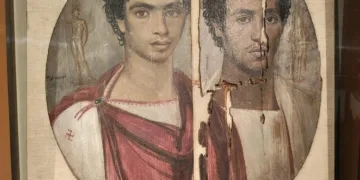




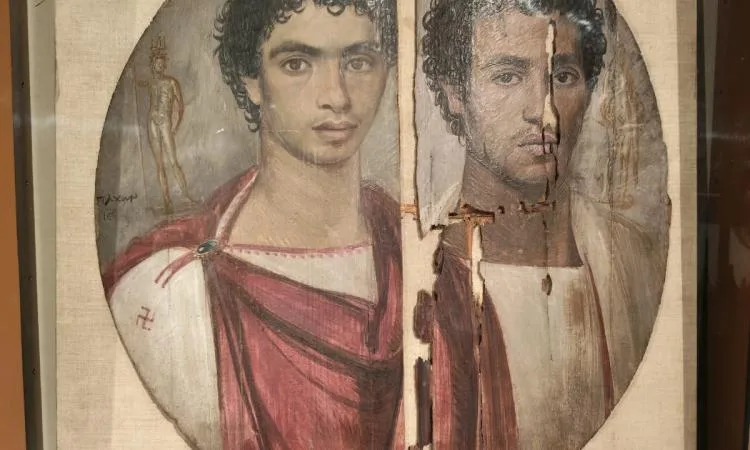
Two young men gaze out from a circular wooden panel no thicker than a finger, their faces painted nearly two millennia ago for a journey into the afterlife.
Now, after three weeks of painstaking work by Egyptian and Italian conservators, the rare portrait known as the “Two Brothers” is ready for a new journey: its first trip out of Egypt, to an exhibition in Rome.
The panel will be a centrepiece of “The Power of Portraiture: Egypt and Rome — Faces of the Fayum,” opening at Rome’s Ara Pacis Museum on Nov. 5 and running until May 2, 2027.
At about 62 centimetres (24 inches) across and less than a centimetre thick, it is unusually large and circular for a Fayum portrait. It depicts two men side by side, painted in encaustic — a technique that uses pigments mixed with hot wax.
Fayum portraits are among the most striking painted images to survive from the ancient world. Usually made on thin wooden panels, they were placed over the faces of mummies, bringing together Egyptian funerary customs and artistic traditions shaped by Greek and Roman influence.
The “Two Brothers” portrait was in fragile condition before the latest work. Wood-boring insects had damaged its wooden support, parts of the paint layer were unstable, and an earlier repair had left sections of one man’s mouth and chin in the wrong position.
Conservators stabilised weakened areas, treated insect tunnels beneath the paint and carefully repositioned the misplaced fragments using fine supports. They said they followed a minimal-intervention approach intended to preserve the painting’s authenticity and evidence of its history.
Ultraviolet examinations also revealed traces in the men’s hair that may point to the use of a transparent varnish to deepen dark tones, officials said — a clue to painting techniques used in Roman-era Egypt.
The restoration brought together staff from Cairo’s Egyptian Museum and specialists from Rome-based Fabrica Conservazione e Restauro. Egyptian Tourism and Antiquities Minister Sherif Fathy described the project as an example of cultural cooperation and an opportunity to share expertise in preserving heritage.
For the Rome exhibition, the portrait will join nearly 60 painted portraits from Egyptian museum collections, including works from the Egyptian Museum in Cairo, Kom Oshim and Hurghada. The show will feature more than 110 objects in all, among them funerary shrouds, masks, marble portraits, plaster casts and jewellery.
Egyptian works will be displayed alongside objects from international collections including the Louvre, the J. Paul Getty Museum and the Metropolitan Museum of Art. Organisers say the exhibition will place Fayum portraits within the broader cultural world in which they emerged, rather than treating them as an isolated artistic phenomenon.
The “Two Brothers” portrait’s unusual double composition makes it especially distinctive among the works. Its upcoming appearance in Rome will offer visitors a close look at the faces — and the artistic exchanges — of Roman-era Egypt.

