





The Golden Triangle Economic Zone is emerging as a major investment and logistics gateway for unlocking Egypt’s mineral wealth, attracting domestic and foreign investment, creating jobs and promoting sustainable development through integrated industrial hubs and upgraded infrastructure, the Cabinet’s Media Centre has said.
Infographics published on the centre’s official social media platforms highlight the region’s geographical and logistical advantages, development milestones, investment incentives and recently signed agreements.
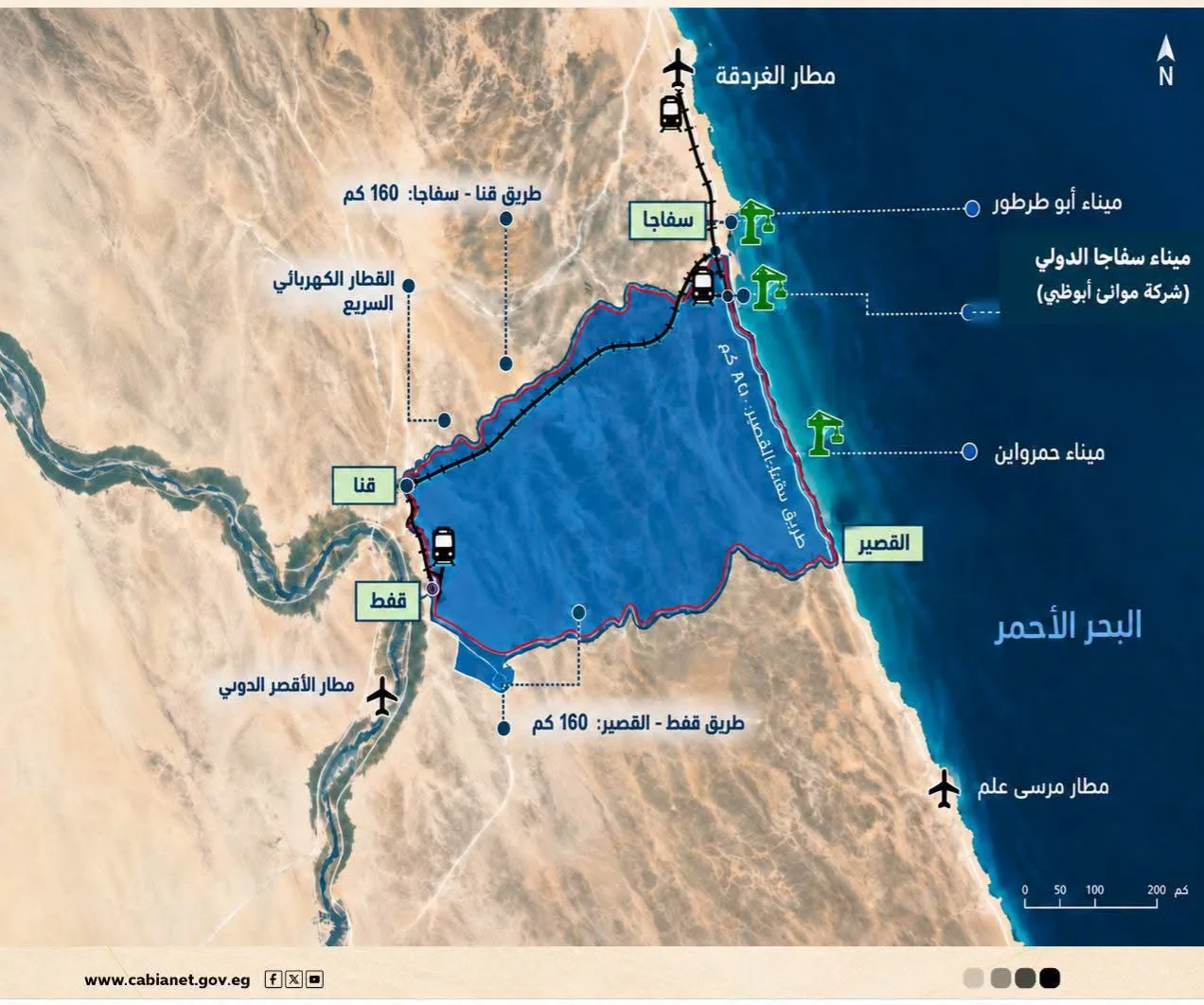
The zone is strategically located near three airports – Hurghada, Luxor International and Marsa Alam – and three ports: Safaga, Abu Tartour and Hamrawein.
In 2015, Italian firm D’Appolonia was commissioned to prepare the project’s master plan, while the Golden Triangle Economic Zone and its governing authority were established in 2017, the centre said in a statement.
Covering approximately 2.2 million feddans in the Eastern Desert, the zone encompasses Al-Qusayr, Safaga, Qena and Qift, and includes seven industrial zones spanning 468 square kilometres.
Direct investment incentives include customs exemptions on imported construction and operational materials, with duties applying to foreign components only when sold in the domestic market.
They also include VAT exemptions on imported and locally sourced manufacturing and operational supplies, while domestic sales are subject to 14 per cent VAT.
Investors are also eligible for a seven-year tax deduction equivalent to 50 per cent of investment costs, capped at 80 per cent of paid-in capital.
Indirect incentives include reduced energy costs, full or partial reimbursement of utility connection expenses and technical training for local workers, subject to alignment with the zone’s development strategy.
Among the agreements signed are a LE500 million logistics project in Safaga with Logistics House, concluded in October 2025 and covering 64,300 square metres; an April 2026 usufruct agreement with Al-Nahda Cement to establish a 27-megawatt solar power plant in Qena on a 280,000-square-metre site; and a July 2026 agreement with Elsewedy Industrial Development to establish a three-phase industrial and logistics zone spanning 6.3 million square metres.
The first phase of the latter project involves a usufruct agreement valued at $3.45 million, the centre noted.
The Golden Triangle Authority’s next priorities include mapping available land and investment opportunities, upgrading infrastructure through private-sector partnerships, attracting developers, improving investor services and incentives, supporting project expansion and targeting sectors suited to Upper Egypt.
They also include integrating land, investor, project, contract and infrastructure data into a unified digital system.
The zone’s green development vision focuses on efficient energy and water use, renewable energy, lower emissions and sustainability standards.
It also seeks to promote investment in solar and wind power and support competitive, resource-efficient industries to improve access to markets.