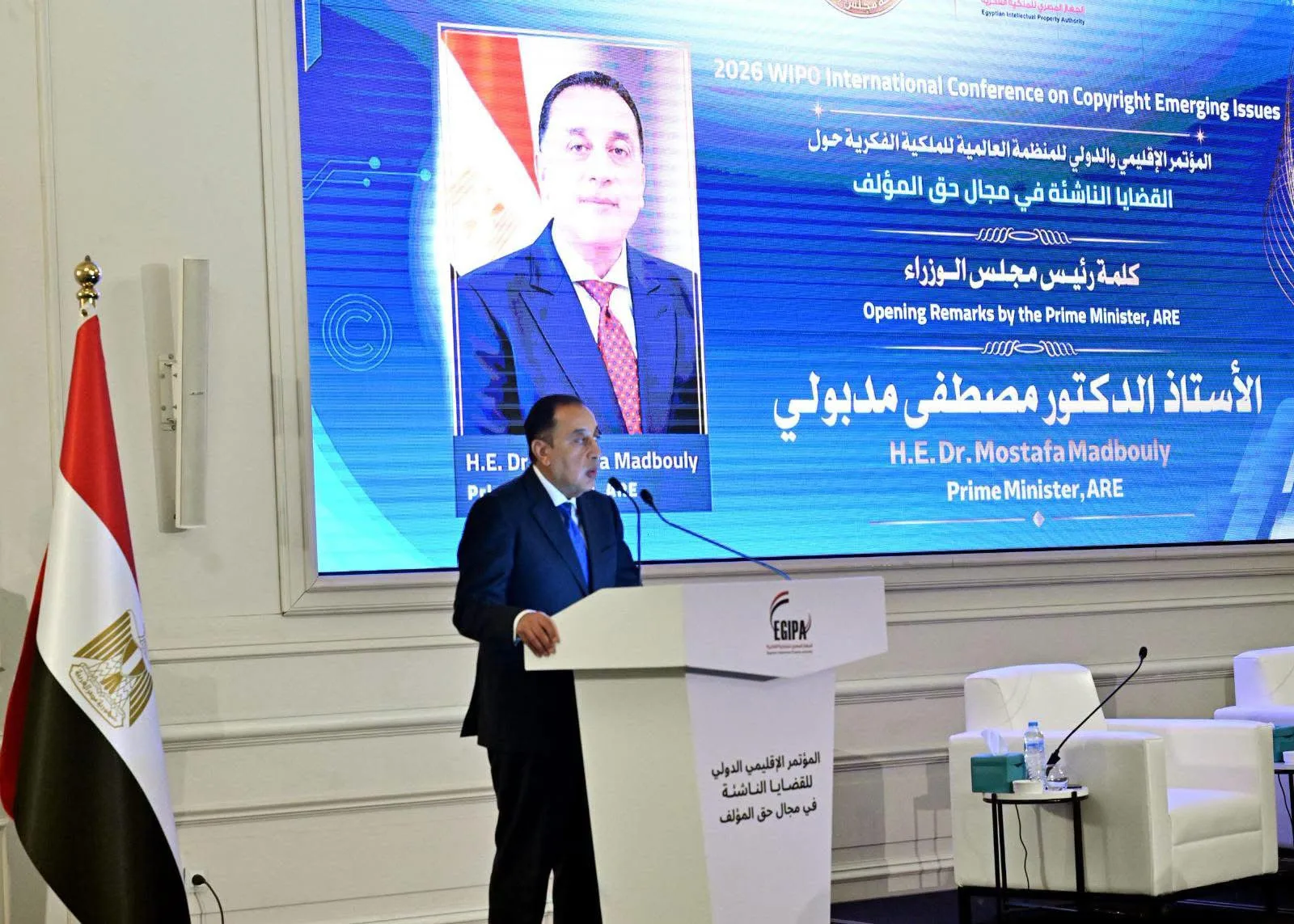





Prime Minister Mostafa Madbouly reaffirmed Egypt’s commitment to advancing its national intellectual property (IP) system and updating its legislative framework to keep pace with artificial intelligence and rapid technological change.
Speaking on Monday evening at the opening session of the World Intellectual Property Organization (WIPO) International Conference on “Copyright: Emerging Issues” in the New Capital, Madbouly emphasised that IP protection must serve as a catalyst for creativity rather than a barrier to innovation.
In his address, the Prime Minister noted that digital transformation and the growing adoption of AI have fundamentally altered patterns of cultural production and content distribution. While AI opens vast horizons for innovation, he stated that it simultaneously raises complex legal, economic, cultural, and ethical questions regarding data sources, the use of protected works, attribution, and fair economic distribution.
“The challenge here does not lie in choosing between protecting rights and encouraging technology, but in building a balanced framework that allows technological progress to flourish while safeguarding the legitimate rights of creators and ensuring they receive a fair return for their output,” Madbouly said.
The Prime Minister highlighted that Egypt views its IP system not merely as a legal safeguard, but as a vital driver of economic competitiveness, investment, and sustainable job creation. He pointed to the National Intellectual Property Strategy (2022–2027), launched in September 2022 under the directives of President Abdel-Fattah El-Sisi, which rests on four interconnected pillars: strengthening governance, developing the legislative environment, maximising the economic return of intellectual property, and raising public awareness.
He added that the establishment of the Egyptian Intellectual Property Authority represents a major institutional step towards unifying national efforts and improving policy co-ordination. The government is actively working to ensure upcoming legislative updates balance the interests of authors, artists, publishers, and producers alongside the needs of scientific research and the public interest.
Drawing attention to Egypt’s rich cultural heritage and creative talent across literature, music, cinema, and the arts, Madbouly stressed that protecting intellectual assets is both a cultural duty and a direct investment in the national economy.
He commended Egypt’s longstanding partnership with WIPO, calling for continued co-operation in capacity building and knowledge exchange. Furthermore, he underscored the necessity for developing nations to have an influential voice in shaping international debates on AI and IP to ensure a balanced and inclusive global framework.
Concluding his remarks, the Prime Minister expressed hope that the conference would yield practical recommendations to foster a sustainable creative economy, reiterating Egypt’s readiness to work with international partners towards a future where technology expands opportunities for knowledge and prosperity.

