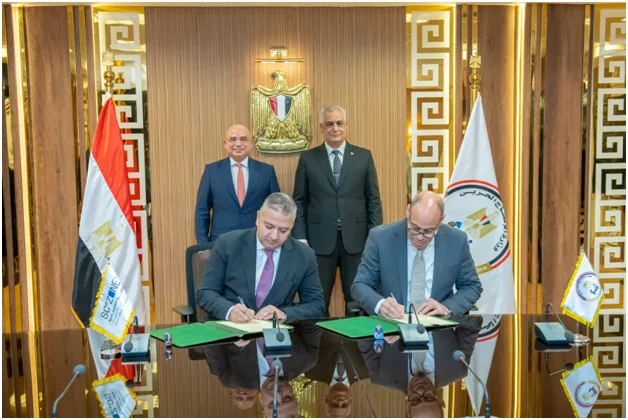










Minister of State for Military Production Salah Soliman Gomblat and Chairman of the General Authority for the Suez Canal Economic Zone (SCZone) Moustafa Shaikhon have witnessed the signing of a co-operation protocol to expand joint work on public utilities and infrastructure across the economic zone.
Signed at the Ministry of Military Production’s headquarters in the New Administrative Capital, the agreement between the National Authority for Military Production and SCZone covers water desalination plants, wastewater treatment facilities, power stations, and broader utility networks.
The deal aligns with state efforts to deepen domestic manufacturing, localise technology, and maximise national industrial capacity in major development projects.
Gomblat stated that the protocol fulfils President Abdel Fattah El-Sisi’s directives to strengthen institutional integration and support sustainable economic development.
Under the agreement, military production facilities will manufacture and supply key infrastructure components — particularly for the electricity sector, including cables, transmission lines, and related engineering equipment.
Highlighting the ministry’s extensive industrial base, skilled workforce, and technical expertise, Gomblat noted that the core objective is to replace imported goods with locally manufactured alternatives wherever feasible.
He emphasised that this import-substitution strategy will curb Egypt’s import bill, conserve foreign currency, and increase domestic value added. He also reaffirmed the ministry’s commitment to upgrading production lines and adopting advanced technologies to boost the export competitiveness of Egyptian goods.
For his part, Shaikhon said SCZone is upgrading its utilities and infrastructure to meet international standards and accommodate rising investor demand across its industrial, logistics, and service sectors. Tapping into the National Authority for Military Production’s engineering capacity, he added, will ensure efficient project delivery and strengthen SCZone’s standing as a global investment hub — leveraging its integrated ports, industrial zones, and network of free trade agreements.
Shaikhon also underscored the value of linking the ministry’s affiliated companies with SCZone’s E-Tabadul digital platform, which connects factories inside the economic zone with manufacturers nationwide to increase local content and streamline industrial supply chains.

