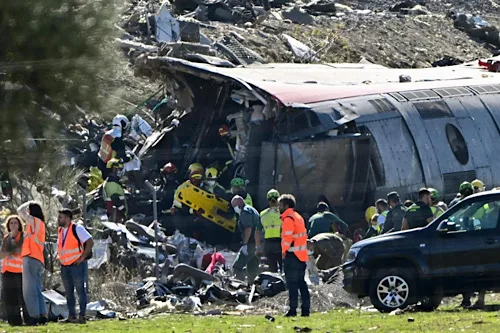










The Spanish train that smashed into a second stationary one, killing at least 69 people on Wednesday, was travelling at a speed of at least 160 kph (99 mph), according to a preliminary report about the accident.
The Civil Guard said it has received reports of 64 people missing in what is already Spain’s deadliest train accident since 2013.
Authorities have carried out 49 autopsies so far and identified five people, three women and two men, Esther Padilla, spokesperson for the Castilla-La Mancha regional government, said on state television network TVE.
“Testing is proceeding slowly, although families will be contacted throughout the day so that they can come and collect their results,” Padilla said on Friday.
It’s unclear how many of the missing were among the bodies still to be identified.
The crash, which happened near the town of Urda in central Spain, followed another fatal accident in January involving the same rail companies on the same line. It has reopened a debate about safety and maintenance on Spain’s high-speed rail network, the most extensive in Europe.
The collision occurred after several trains were automatically stopped due to the failure of the automatic signalling system, after which the central control centre in Madrid took over. A train operated by state-owned Renfe was authorised to proceed, even though there was a stationary Iryo-operated train ahead, according to Transport Minister Oscar Puente.
Audio of communications between the control centre and the train drivers obtained by El Pais showed how a controller authorised the Renfe train to continue on its journey at a normal speed, which Puente said disregarded a protocol to travel at no more than 40 kph in such circumstances.
The audio also showed the controller authorised the Renfe train, carrying 379 passengers and seven crew, to renew its journey when it should have been the Iryo train in front, which carried 147 passengers and five crew, to proceed first, according to protocol.

