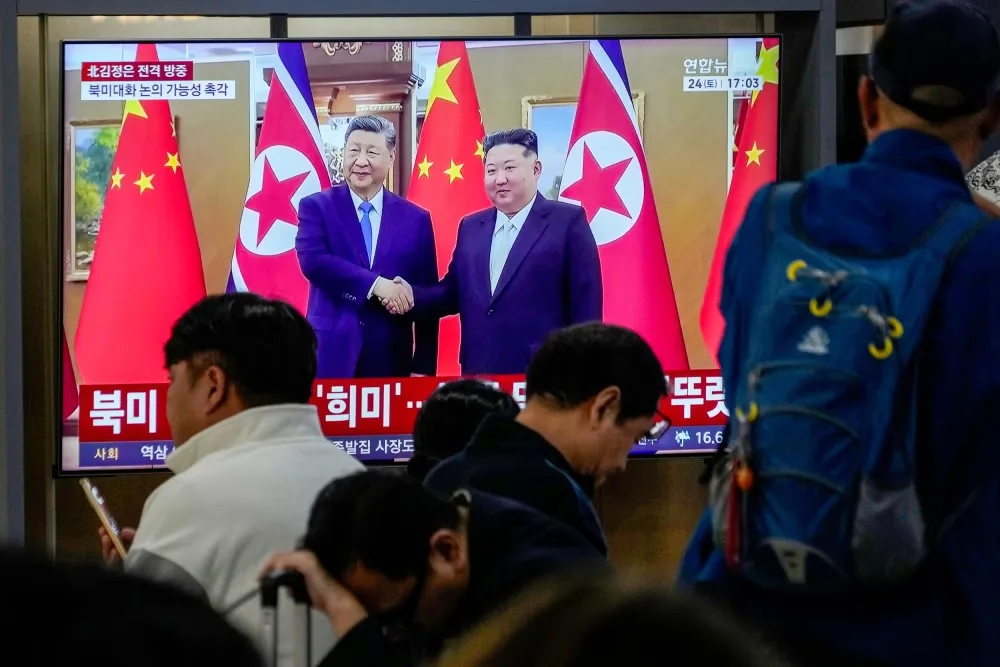


North Korean leader Kim Jong Un is in China, his first visit to the country in a year, South Korea’s government said Saturday.
Kim’s visit to China is his latest move in an increasingly assertive foreign policy as he seeks to align Pyongyang with Beijing and Moscow in a united front against the United States under what he portrays as a “new Cold War.”
Kim appears to have arrived in the Chinese border city of Dandong Saturday after crossing a newly opened bridge linking the two countries, according to South Korea’s Unification Ministry, which handles affairs related to North Korea.
The ministry didn’t immediately provide other details.
Experts said the opening of the New Yalu River Bridge this month was a key symbol of strengthening ties between the two countries and reflected their intent to expand trade, as it is expected to accommodate two-way traffic around the clock, including container shipments and heavy cargo trucks.
North Korean state media did not immediately report on Kim’s visit and China’s Foreign Ministry press office did not respond to a request for confirmation.
Kim has recently sought to strengthen ties with China, the North’s traditional main ally and economic lifeline, after years of prioritising ties with Russia.
He sent thousands of troops and conventional weapons to support President Vladimir Putin’s war in Ukraine, possibly in exchange for military and economic assistance.
Kim’s latest visit to China is his sixth since taking power in late 2011 following the death of his father.
The visit appears timed to underscore the strength of his ties with Beijing ahead of the Oct. 25 anniversary of China’s first major victory in the Korean War, which was days after Chinese troops crossed the Yalu River into North Korea in October 1950.
The war began with North Korea’s surprise attack on the South in June 1950, prompting a UN-led coalition headed by the United States to intervene and push back the offensive. North Korea was backed primarily by Chinese forces, with assistance from the then-Soviet Union’s air force, before fighting ended with a 1953 armistice that left the peninsula technically at war.

