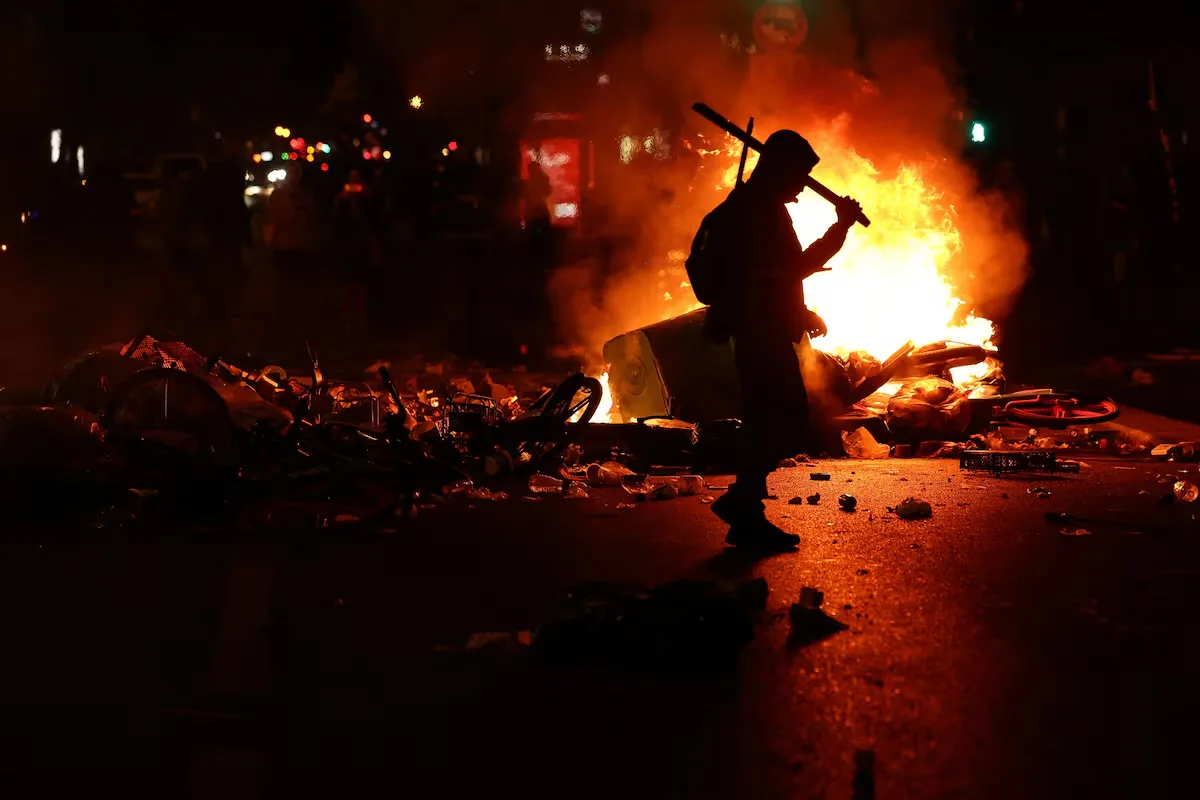




PARIS (Reuters) – France’s central government asked some local authorities to impose curfews and faced pressure over security failings on Monday after a weekend of riots and looting borne out of nationwide anti-government protests.
Prime Minister Sebastien Lecornu did not rule out declaring a state of emergency but said it was more appropriate for now to apply partial and localised curfews, without providing details of which cities would be affected.
“My determination to restore order is absolute,” he said in a press conference, ruling out, however, a blanket curfew in Paris.
The weekend of looting and violence between some protesters and police followed weeks of student demonstrations, rocking France six months ahead of its next presidential election and highlighting pressures from a weak economy and surging debt.
Lecornu blamed far-left groups for some of France’s worst unrest in years. “There is, after all, a far-left movement that wants to cause — we can’t put it any more strongly — profound unrest in the country in the run-up to the presidential election,” he said.
Hard-left presidential candidate Jean-Luc Melenchon urged him to provide evidence.
“Otherwise, he should apologise, keep quiet and stop fanning the flames of unrest,” he said on X.
The Federation of Trade and Retail said almost 3,000 shops had been affected over the weekend.
“Once again, the retail sector finds itself on the front line, at a time when it is already weakened by a succession of crises,” it said.
“Behind every ransacked shop are business owners, employees and families who have seen years of work and effort wiped out in a matter of hours,” it added, calling for relief from social security contributions and tax for those businesses affected.
Lecornu said the government would provide furlough measures from Tuesday.
Some 2,400 people were arrested and one protester died from a cardiac arrest on Saturday while nearly 1,000 officers were injured.
French assets were underperforming broader European markets on Monday, though moves were more contained than at some other moments of recent political friction.
Tensions in President Emmanuel Macron’s fragile government over apparent security shortcomings — coming just as the government needs to pass a much-needed budget bill to rein in its finances — could further unsettle investors.
Macron’s office said on Monday he had turned down his Interior Minister Laurent Nunez’s offer to resign, telling him instead to put an end to barricades and looting and be transparent over what Macron called “intelligence and foresight failings”.
Nunez told reporters that Tuesday evening’s Champions League soccer match between Paris Saint-Germain and Barcelona would go ahead as planned, even though the capital was one of the worst-hit areas.

