



By Chen Yu
“You’ll never guess where I’ve been assigned for my overseas posting,” I said excitedly to my elder sister over the phone. “Cairo!”
I was in Beijing, and had just learned that I would soon be posted to Egypt for work.
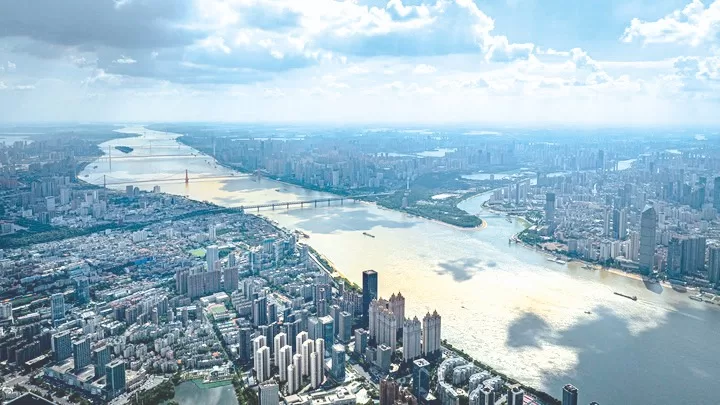
My sister lives with her family in a medium-sized city in central China’s Hunan Province, where the Yangtze River flows through the province much as the Nile runs through Cairo.
She rarely travels abroad, and overseas trips remain an occasional luxury for her family. So I expected the news of my posting to Egypt to take her by surprise.
Her response, however, caught me off guard. “We just came back from Egypt,” she said, with a calmness I had not expected.
“My sister had actually beaten me to the country I had long dreamed of visiting,” I told my husband, still somewhat amazed.
What surprised me even more was what he said next: several of his friends and relatives had also chosen Egypt for their holidays.
“Has travelling to Egypt really become so common now?” I exclaimed.
For many Chinese people, myself included, Egypt was once a place known more through images than experience. It existed in our imagination as a land of pyramids rising from the desert, the Nile carrying the weight of millennia of history, and an ancient civilisation that was world-famous yet distant from everyday life.
Today, however, Egypt is becoming an increasingly popular destination for Chinese tourists. My family is part of a much broader trend: the number of Chinese visitors to Egypt has risen rapidly in recent years, reaching about 360,000 last year.
“What is it about Egypt that makes it so captivating?” With that question in mind, I boarded my flight to Cairo.
Now, after nearly six months in Cairo, I am starting to understand the answer.
For many Chinese travellers, particularly younger generations drawn to cultural experiences, Egypt offers a rare blend of the familiar and the unknown.
Its ancient civilisation resonates with visitors from China, itself home to thousands of years of history. At the same time, social media and easier access to travel information have brought more of Egypt into view, while more convenient travel options, from additional direct flights to simpler visa procedures, have made the country easier to reach. Together, these changes have revealed an Egypt that extends far beyond the pyramids and mummies dominating the popular imagination.
During my time in Egypt so far, I have discovered exactly that. Beyond the iconic pyramids, I was captivated by the crystal-blue waters of the Red Sea, the otherworldly landscape of Wadi Al-Hitan (Whale Valley), and the vast desert stretching around Aswan.
These experiences have revealed an Egypt that transcends both its ancient history and the images I had long associated with the country.
Yet even as Egypt keeps surprising me with new and unfamiliar experiences, it has also offered me an unexpected sense of familiarity.
At Cairo’s major attractions, I often found myself amid large groups of Chinese visitors, with Mandarin all around me. Some of my Egyptian colleagues speak fluent Chinese, and a few even studied the language in Beijing.
During a trip to Port Said, our Egyptian guide introduced himself by his Chinese name, “Yi Zhongtian,” borrowed from a Chinese scholar known for his popular lectures on history and culture.
These visible connections to China make the distance between Egypt and China feel much smaller than it appears on a map.
What has struck me more deeply, however, is something less tangible: the values and ways of looking at life that I have found I share with my Egyptian friends and colleagues.
Last week, an Egyptian colleague invited me to his family’s home in the countryside for a barbecue.
There, over a meal of traditional Egyptian dishes, his family welcomed me with warm greetings and laughter. As we sat around the table, our conversation turned naturally to familiar subjects: family, children’s education, the rising cost of college, and our hopes for the next generation.
The food was different, the language was different, and everything around me was unmistakably Egyptian. Yet for a moment, it felt less like visiting a foreign country than spending an afternoon with relatives back home.
By now, I have grown accustomed to navigating Cairo’s heavy traffic and maze-like streets after work, stopping for groceries and discovering the many threads that connect Egypt and China, woven into the fabric of everyday life.
In the evenings, I often head up to the rooftop of my office building, and watch the Nile wind through the city in the glow of the setting sun. In some fleeting moments, the river before me seems to become the Yangtze back home, winding through my hometown thousands of kilometres away.
Chen Yu is a senior editor at the Middle East
Regional Bureau of China’s Xinhua News Agency and a researcher at the Xinhua Institute.

