




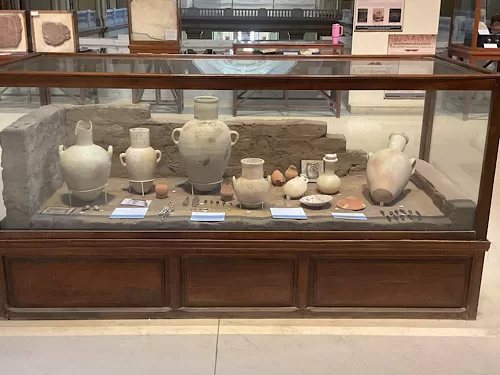
For thousands of years, Egypt’s security and prosperity rested on a slender corridor of sand, forts and trade routes that ran from the Nile Delta to the edge of Asia.
A new exhibition at the Egyptian Museum now brings that long-overlooked frontier vividly back to life.
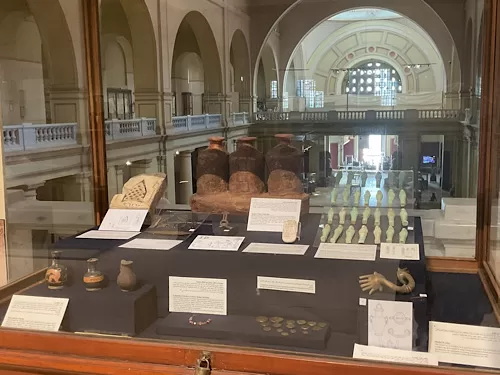
Entitled “Supreme Council of Antiquities Excavations: Egypt’s Eastern Gate”, the show explores the strategic zone that linked Egypt to the Levant, a carefully tended network of strongholds, supply centres and military elites that successive rulers treated as their first, and most vital, line of defence.
Drawing on decades of fieldwork and a remarkable surge of discoveries over the past five years, the display reveals the Eastern Gateway not as empty desert, but as a living, administered landscape of roads, fortresses and magazines stretching from the Wadi Tumilat through northern Sinai.
From the earliest dynasties, Egyptian kings understood the stakes. They secured the routes that led to the turquoise and copper mines of Sinai and onward towards Asia.
Already the inscriptions of Sneferu, Khufu and Sahure speak of monitoring posts and carefully organised expeditions.
By the New Kingdom, the system had matured into a formidable chain of fortresses along the Ways of Horus, the great military highway.
Sites, such as Tell Hebua and Tell el-Maskhuta, served as garrisons, magazines and administrative hubs, projecting royal power while quietly regulating the movement of goods and armies.
Among the objects on view is a limestone relief of Ramses II from Tell Hebua. One face shows the king in the nemes headdress and uraeus, his cartouches hovering protectively above him; the reverse depicts him in the Red Crown, embracing the goddess Hathor.
Nearby stands a fragment of a column inscribed with the same king’s proud titles, “Strong Bull”, “Beloved of Maat”, and “Protector of Egypt”, thought to have once stood at the entrance to the great temple at the site.
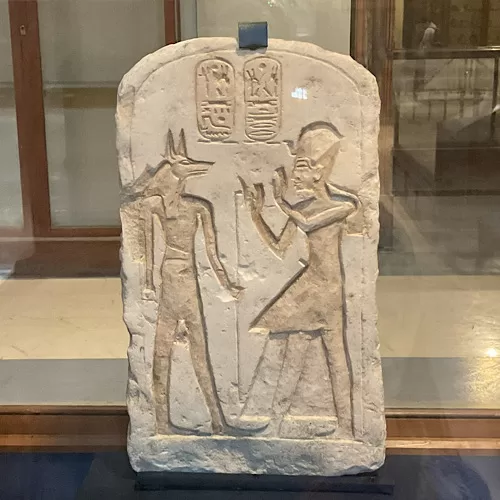
A stela of Setnakht, recovered from the fortress temple at Tell el-Retaba, shows the short-reigned king adoring Anubis, a quiet reminder that even brief reigns left their mark on this military landscape.
Recent seasons have added striking new chapters to the story. At Tell el-Farama, excavators uncovered a Roman-period water cult structure dedicated to the local deity Pelusios.
At Darawish, grain silos were carefully re-examined and a cartouche of Thutmose II appeared on an amphora handle, small details that suddenly illuminate larger patterns.
A substantial New Kingdom fortress has emerged at Tell el-Kharuba, complete with walls, towers and soldiers’ quarters.
At Tell Abu Seifi, teams exposed the eastern gateways of two successive fortresses, a limestone-paved road more than a hundred metres long, a defensive ditch and lime kilns, tangible traces of lives once lived on the edge of empire.
One of the exhibition’s most moving finds is a newly excavated tomb at Rod Eskander, north of Tell el-Maskhuta.
The mud-brick structure, sealed with the name of the city Per-Atum, belonged to an adult man of about 40 who lived in the reign of Ramses III. His burial contained a painted and gilded wooden coffin, a gold signet ring of royal character, scarabs, an ivory-inlaid box, pottery and alabaster vessels, arrowheads and dagger blades.
Some objects still carried the names of earlier kings, Amenhotep III and Horemheb, clear evidence of heirloom reuse among the military elite who once stood guard on this frontier.
Other highlights include six joining fragments of a Proto-Sinaitic stela from the mining region of Serabit el-Khadim, among the earliest alphabetic inscriptions known, and a trilingual stela of Ptolemy IV Philopator that records the Raphia Decree of 217 BC.
Celebrating the king’s victory over Antiochus III, it reminds visitors that the Eastern Gate remained a theatre of international contest long after the New Kingdom had passed.
Taken together, the exhibition presents Egypt’s eastern gateway, not as a single wall or a frontier belonging to one period, but as a constantly rebuilt system of forts, granaries, tombs and temples. It is also a quiet tribute to a new generation of Egyptian archaeologists patiently bringing the region’s long-hidden history into the light.
The exhibition is in the museum’s Hall 13 and runs until 11 November. It is open daily from 9 am to 4 pm.