



Asian nations hit hard by the Iran war’s price shocks are rushing to diversify and strengthen their energy security, potentially undermining their commitments to curb climate change.
As negotiations on ending the war drag on, countries in energy hungry Southeast Asia are exploring nuclear power and promising renewable rollouts. But they are also investing in coal power to provide a buffer during times of crisis.
The Iran war has not shaken coal’s status as a pillar of Southeast Asia’s energy security, said Sandeep Pai at Duke University’s Nicholas Institute for Energy, Environment and Sustainability.
Until recently, coal was slowly being phased out to reduce climate change-causing emissions and address air quality concerns. But the conflict has complicated that scenario.
“At the end of the day, energy security triumphs any other climate considerations,” Pai said.
In East Asia, South Korea and Japan began burning more coal to keep national energy grids powered while the closure of the Strait of Hormuz due to the war disrupted flows of oil and gas to Asia.
Southeast Asian nations like Thailand, Vietnam and the Philippines did the same.
This emergency response has led to longer-term policies that have given coal an extension of life, Pai said.
Coal investments are predicted to rise globally to $180 billion in 2026, according to the International Energy Agency, which is the highest its been since 2012.
In 2021, the United Nations declared coal had been consigned to history after nearly 200 countries agreed to phase out coal power. After Russia’s 2022 military operation in Ukraine disrupted gas supplies, European nations burned more coal and built more fossil fuel pipelines and import terminals.
Now, this second energy shock in less than a decade is reinforcing coal’s value to energy security in Asia, according to Michelle Manook of FutureCoal, a group backed by the fossil fuel industry that was formerly known as the World Coal Association.
Global coal-fired power generation declined by 0.6% last year, according to the Global Energy Monitor, but new coal power capacity increased 3.5%.
Indonesia, the world’s largest thermal coal exporter and a bellwether for the fossil fuel industry, is overhauling its trade rules and imposing new taxes after coal prices hit multi-year highs.
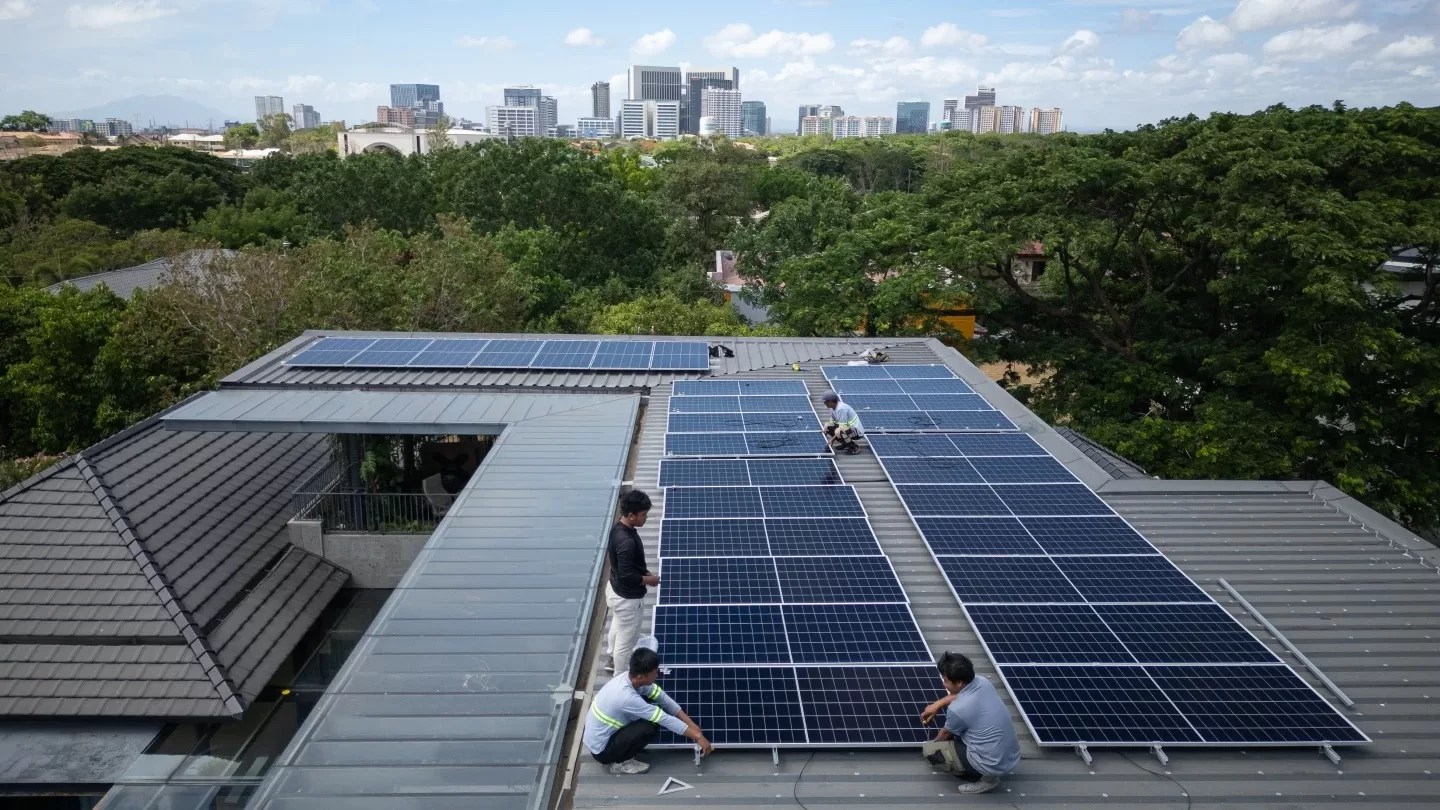
But it’s also chasing new solar goals, planning to install 100 gigawatts of rooftop solar by 2034, up from 1.3 gigawatts of capacity now.
“Indonesia’s obviously tied to coal in so many ways, but it’s seen beyond that,” said Dave Jones, with the energy think tank Ember.
Renewables still dominate growth in regional power generation, he noted.
Likewise, Vietnam has increased its use of coal but also has committed to installing rooftop solar on 10% of public offices and homes nationwide by 2030.
After the war began, the Philippines burned more coal and declared a national energy emergency. It considered lifting a ban on new coal plants but decided not to. Earlier approved projects will still be built.
In the meantime Philippine consumers have been putting up rooftop solar in record rates.
“This really doesn’t cancel out any of the green energy gains,” said Brenda Valerio of the nonprofit New Energy Nexus in the Philippines. “But it does really show that the energy transition is non-linear and contested.”
Much of the liquified natural gas going through the Strait of Hormuz went to South Korea and Japan, countries that import nearly all their energy needs.
Facing a shortfall, South Korea delayed the retirement of three coal plants, potentially slowing progress toward its climate goals. It raised power generation at its active nuclear plants and sped up maintenance at five offline reactors.
Japan has been pushing ahead with restarts of nuclear power plants that were idled after the 2011 Fukushima meltdown, said Michiyo Miyamoto with the Institute for Energy Economics and Financial Analysis. That disaster led Japan to step up use of coal as those plant closures temporarily cut its total generating capacity by about a third.

