



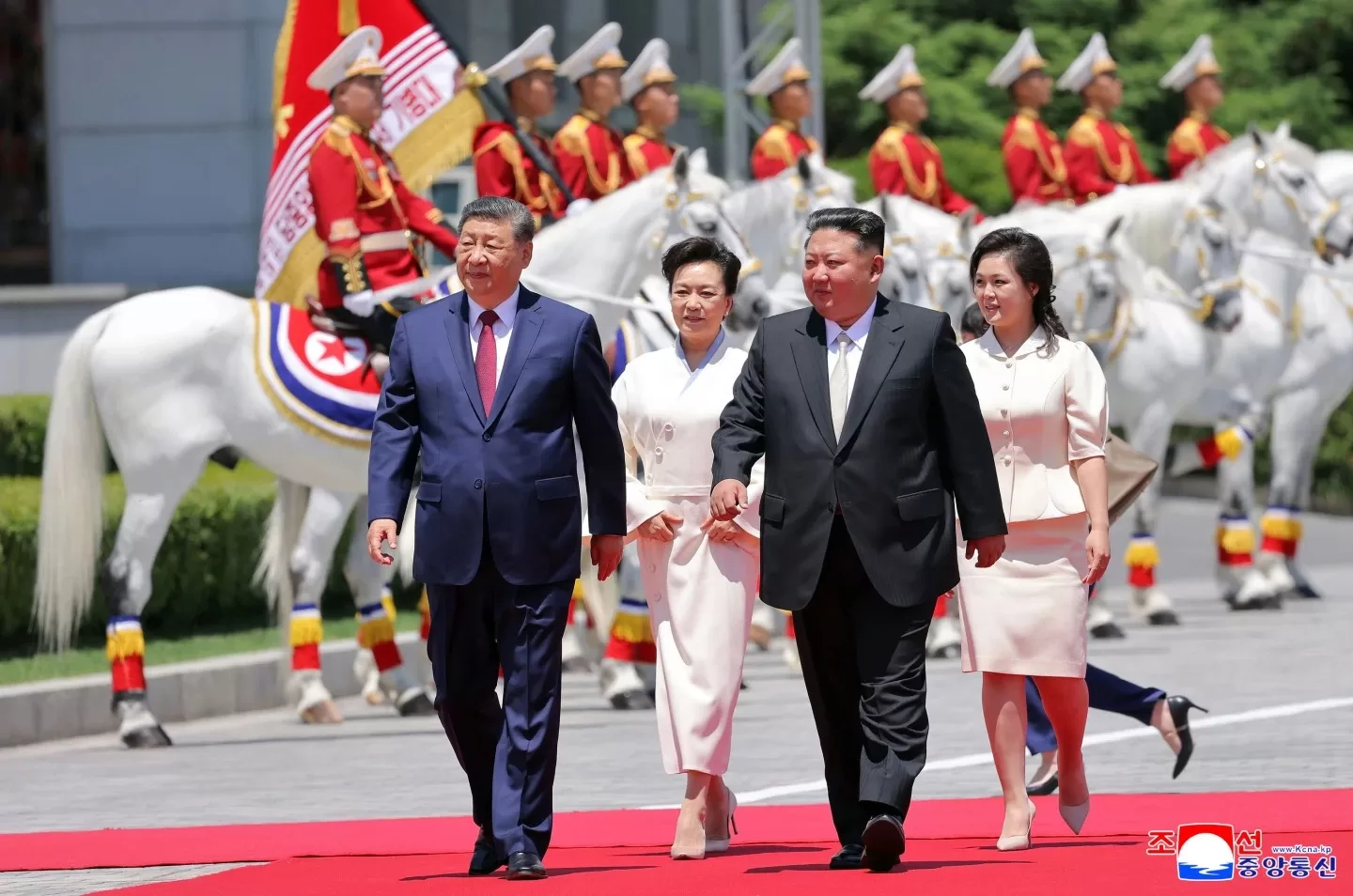
Chinese President Xi Jinping returned home on Tuesday after a rare visit to North Korea, where he held bilateral talks and made public appearances with leader Kim Jong Un, demonstrating a shared effort to reinvigorate their countries’ alliance.
Xi arrived in Pyongyang on Monday, marking his first trip there in seven years. During their summit, Xi voiced China’s readiness to broaden co-operation across sectors such as trade, agriculture, construction, and technology. Kim, meanwhile, emphasised that maintaining their nations’ friendship remains “the most important top-priority strategic work,” according to reports from Chinese and North Korean state media.
On Tuesday, Xi and Kim visited a North Korea‑China friendship monument commemorating Chinese troops who fought alongside North Korea in the 1950–53 Korean War. Chinese state media said both leaders highlighted the need to uphold their long-standing relationship and shared spirit of resistance against the United States.
The two leaders, who most recently met in Beijing in September, also toured a Workers’ Party training facility and planted a fir tree to symbolise their bilateral ties. Xi then attended a luncheon and farewell event before departing for Beijing, state media reported.
Analysts believe Xi’s trip was likely aimed at reasserting China’s dominant influence over North Korea, which has increasingly shifted its foreign policy focus towards Russia in recent years. They note that Kim, in turn, is seeking economic and political benefits.
State media reports from both countries on Monday’s summit highlighted Xi and Kim’s commitment to expanding co-operation and included Kim’s renewed backing of China’s “one-China” stance regarding Taiwan.
However, the reports did not indicate whether the leaders addressed North Korea’s nuclear program, a major regional security concern. During his 2019 visit to Pyongyang, Xi said China was willing to play a constructive role in denuclearizing the Korean Peninsula.
This omission may represent a diplomatic gain for Kim, who wants international recognition of North Korea as a nuclear weapons state, status experts say he hopes to leverage in pushing for the removal of global sanctions.
By sidestepping the denuclearization issue, China may be leaving space for interpretations that it is edging towards acceptance of North Korea’s potential nuclear status, according to Ban Kil Joo, an assistant professor at the Korea National Diplomatic Academy in Seoul.
In return, North Korea reaffirmed its support for China on the Taiwan question, Ban noted.
Kim Gyubeom, an analyst at the Institute for National Security Strategy in Seoul, said China appears to be taking a “managerial approach,” neither fully backing nor heavily pressuring Pyongyang, while keeping strategic communication open and prioritizing regional stability.
Reestablishing dominant influence over North Korea could strengthen Xi’s position in dealings with US President Donald Trump, who has repeatedly stated his interest in reviving diplomacy with Kim.

