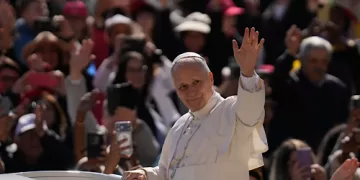





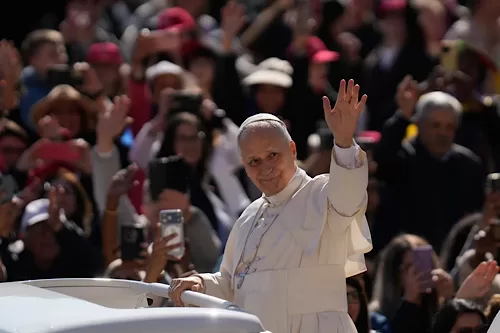
Tensions between the White House and Pope Leo XIV continue to rise, and recent surveys suggest that many US Catholics are increasingly distancing themselves from President Donald Trump.
This shift appears linked not only to Trump’s policies but also to the pope’s repeated critiques, including his recent remark, made in relation to the war in Iran, that God “does not listen” to leaders who launch conflicts and have “hands full of blood.”
International attention has also focused on reports of a strained January meeting between senior Pentagon officials and the Vatican’s ambassador.
Newsweek reached out to the Holy See for comment via email on Thursday.
During the 2024 presidential race, Pope Francis—an outspoken critic of Trump and a strong advocate for migrants’ rights—urged American Catholics to choose “the lesser evil” at the ballot box. A majority, 55 percent, ended up voting for Trump, according to the Pew Research Center. Most white Catholics supported him (62 percent versus 37 per cent for Kamala Harris), while most Hispanic Catholics (58 per cent) backed the Democratic candidate.
But Catholics’ support for the president now appears to be waning.
A February Pew Research Center poll conducted before the Middle East conflict shows that approval of the president has dropped across most religious groups, including evangelicals, Catholics, and non-evangelical Protestants, compared with the early days of his second term.
Among white Catholics, approval of Trump’s performance has fallen from 59 percent in February 2025 to 52 percent. Among Hispanic Catholics, it has declined from 31 per cent to 23 per cent. Support for most or all of his agenda has also slipped, from 51 to 46 per cent among white Catholics and from 20 to 18 percent among Hispanic Catholics.
Perceptions of Trump’s ethical conduct in office have likewise fallen across all religious groups, dropping from 39 to 34 per cent among white Catholics and from 22 to 14 per cent among Hispanic Catholics.
The poll surveyed 8,512 people between January 20 and 26, 2026, with a margin of error of plus or minus 1.4 percentage points.

