


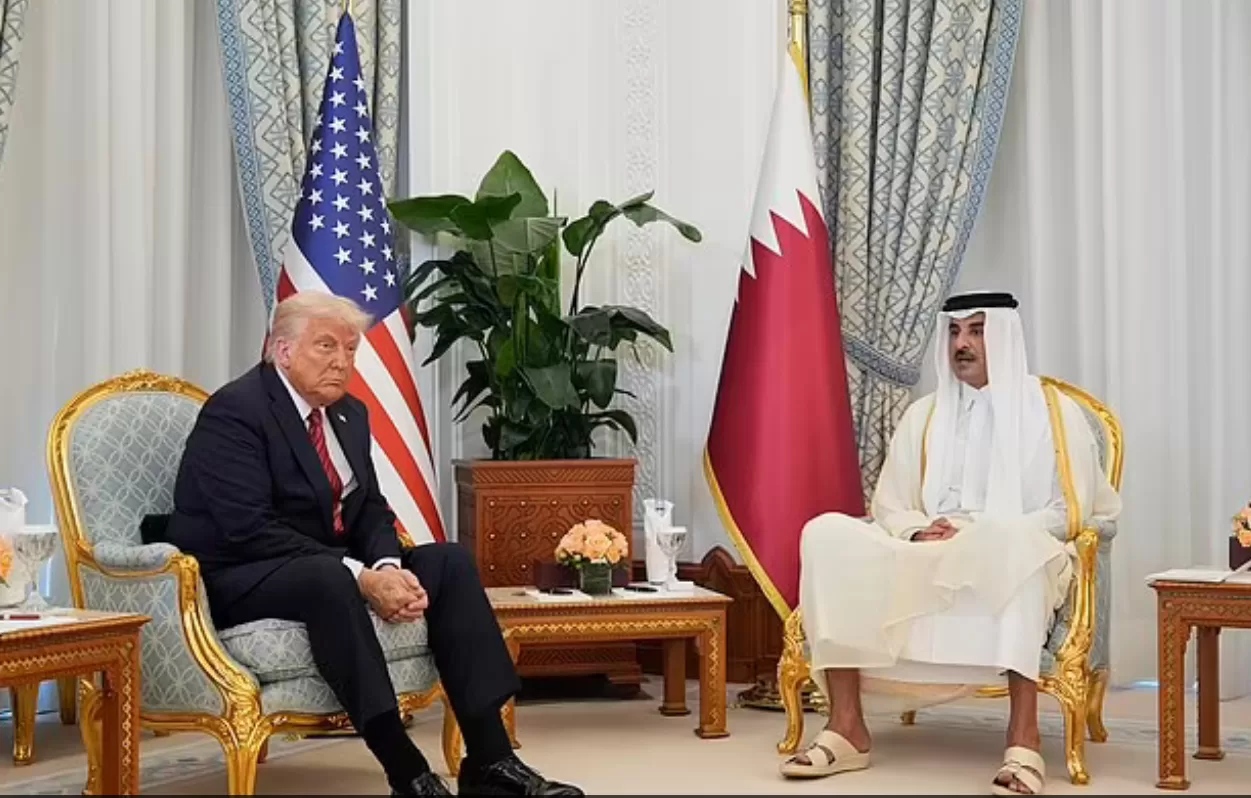
President Donald Trump touched down in Doha on Wednesday, his arrival marking a critical juncture in his four-day Middle Eastern tour. The primary focus of his visit: to leverage his influence in brokering a ceasefire between Israel and Hamas, a conflict that has gripped the region.
The Qatari capital welcomed the former president with a display of diplomatic grandeur. Emir Sheikh Tamim bin Hamad al-Thani extended a state visit, anticipated to yield billions in Qatari investments into the United States. Trump, visibly impressed, lauded the architectural splendor of the Amiri Diwan, particularly its pristine white marble. “The job you’ve done is second to none,” Trump remarked, adding, “As a construction person, I’m seeing perfect marble. This is what they call perfecto.”
The ceremonial welcome was a spectacle, featuring a cavalry of red Tesla Cybertrucks leading the presidential motorcade – an apparent nod to Tesla CEO Elon Musk, a senior advisor. Camels and horses greeted the procession, and guards bearing swords escorted the two leaders into their official meeting. Fighter jets from the Qatari air force also provided an escort for Air Force One as it entered Qatari airspace.
Beyond the pageantry, the core of Trump’s visit centered on the Israeli-Palestinian conflict. Prior to his arrival, high-level discussions involving American, Israeli, and Palestinian officials were held in Doha, aimed at forging a peace agreement. US special envoy Steve Witkoff and US hostage envoy Adam Boehler participated in these crucial talks.
Trump addressed concerns regarding the implications of his engagement with Arab nations on the U.S.-Israel relationship. “This is good for Israel,” he asserted to reporters aboard Air Force One, “having a relationship like I have with these countries; Middle Eastern countries, essentially all of them. I think it’s very good for Israel.”
However, the trip also spotlighted Qatar’s influential royal family, notably their gift of a “flying palace” to the president, raising questions about potential conflicts of interest. The lavish welcome and the promise of substantial investments underscore the complex dynamics of U.S. diplomacy in the region.
Trump’s visit to Qatar represents a high-stakes diplomatic endeavor, balancing the pursuit of a ceasefire with the forging of economic ties. The success of his mission hinges on his ability to navigate the intricate political landscape and secure a lasting peace, while maintaining the delicate balance of U.S. alliances in the Middle East.
