



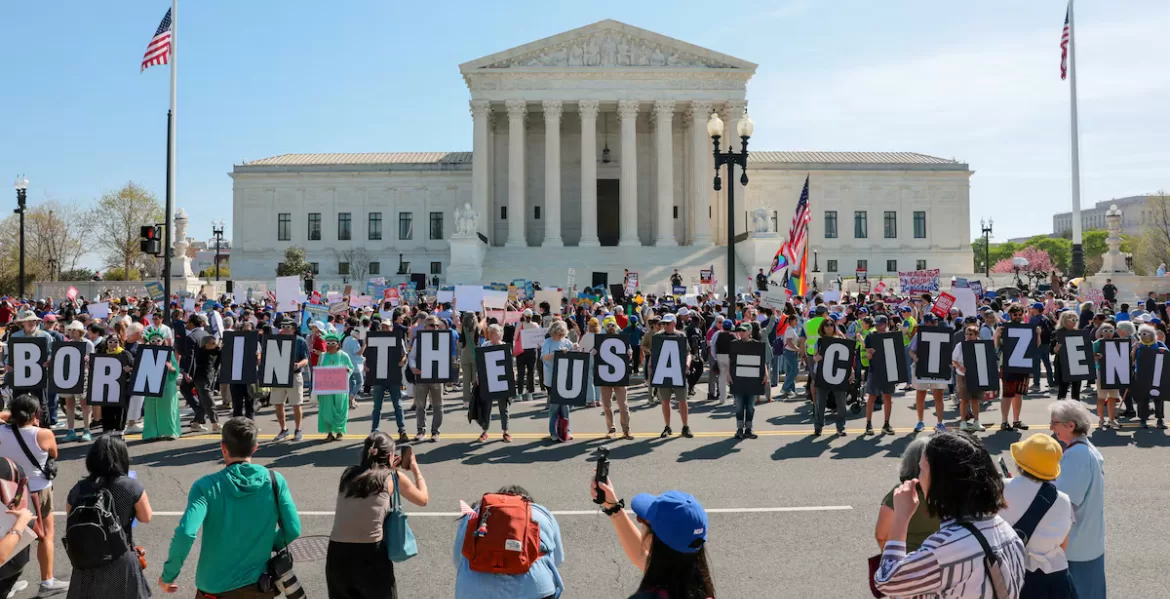
WASHINGTON (Reuters) – Handing President Donald Trump a stinging defeat, the U.S. Supreme Courton Tuesday rejected his audacious attempt to restrict birthright citizenship in the United States — a right long woven into the fabric of American society — scuttling one of his top priorities in his crackdown on immigration.
The 6-3 ruling marked the second time this year that the court has invalidated a major Trump initiative, following its February decision to strike down his sweeping global tariffs.
The justices upheld a lower court’s decision that blocked Trump’s executive order directing U.S. agencies not to recognize the citizenship of children born in the United States if neither parent is an American citizen or legal permanent resident, also called a “green card” holder.
Challengers to Trump’s order argued that it violates language in the U.S. Constitution’s 14th Amendment that confers citizenship to those born in the United States who are “subject to the jurisdiction thereof.”
Conservative Chief Justice John Roberts, who authored the decision, said Trump’s directive violates language in the U.S. Constitution’s 14th Amendment that guarantees citizenship to virtually anyone born in the United States, with a few narrow exceptions.
“Citizenship, then and now, was the right to have rights – to freely participate in our political community,” adding that the authors of the 14th Amendment extended that promise to every free-born person in the land.
“We keep that promise today,” Roberts wrote.
Trump, who has repeatedly tested the limits of presidential power in domestic and foreign policy, issued the order last year on his first day back in office as part of a suite of policies to crack down on legal and illegal immigration. Critics have accused the Republican president of racial and religious discrimination in his approach to immigration.
The challengers said the Supreme Court already had settled the question of birthright citizenship in an 1898 case called United States v. Wong Kim Ark, which recognized that the 14th Amendment grants citizenship by birth on U.S. soil, including to the children of foreign nationals.
Roberts pointed to that 1898 ruling.
“Not surprisingly, then, in the 128 years since, we have repeatedly understood the rule of Wong Kim Ark to guarantee citizenship to all children born in the United States and subject to its power,” Roberts wrote. “We see no reason to depart from that view today.”
Roberts said there was “scant evidence” to support the Trump administration’s “dramatically revisionist view” of how to interpret the citizenship language of the 14th Amendment to limit birthright citizenship.
“If Congress intended to limit American citizenship to the children of those domiciled in the United States, nothing in the succinct language of the Citizenship Clause conveyed that design,” Roberts wrote.
Conservative Justice Brett Kavanaugh agreed with the ruling to reject Trump’s directive, but disagreed with the rationale. He said in a concurring opinion that the order contravenes a separate federal law codifying birthright citizenship rights but not the 14th Amendment itself.
The Supreme Court weighed in on what it means to be an American citizen just ahead of the July 4 holiday when the United States marks the 250th anniversary of its founding.
Ahead of the ruling, some experts had estimated that Trump’s directive could affect the legal status of as many as 250,000 babies born each year and could require the families of millions more to prove the citizenship status of their newborns.

