










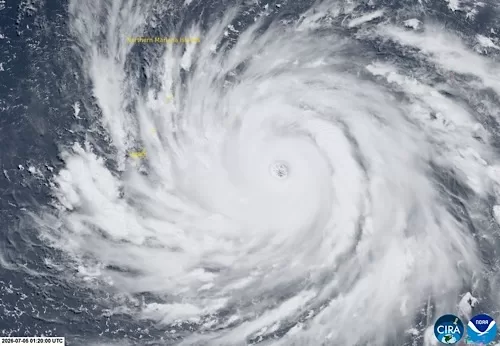
Residents of Guam and the Northern Marianas sought refuge in emergency shelters and made last-minute preparations on Sunday as a “super typhoon” approached, expected to sweep across the US Pacific territories within hours.
Super Typhoon Bavi was predicted to barrel westward over the region around 10am tomorrow (6pm Malaysian time), packing sustained winds of 260 kilometres per hour — equivalent to a category 5 hurricane — and gusts reaching 315 kph.
The National Weather Service (NWS) described the storm as “very dangerous,” warning that tropical storm–force winds could begin Sunday afternoon or evening, with “catastrophic” damage likely near the center of the system.
“Significant flooding from torrential rains and coastal inundation are expected,” the NWS said, forecasting waves up to 35 feet (10.7 meters) high — roughly the height of a 10‑storey building — and “extremely dangerous” sea conditions.
By Sunday, Guam’s roads were nearly empty as heavy rain and powerful winds swept across the island.
Pinky Cubacub, 55, said she had boarded up the windows of her eatery after lining up early Saturday to spend $500 on plywood at a lumber store.
“I cannot afford to lose so many days. It hurts,” she told AFP. “Because I just started, whatever we’re making now is only for rent, utilities, my people, and supplies. I don’t even pay myself yet.”
Call center worker Arabella Paulino, 48, said her daughters were frightened. “But it will be okay,” she assured them.
“My house is concrete, so the worst that can happen is a window could blow in,” she told AFP.
Super Typhoon Sinlaku, which struck the area in mid-April, cut power to tens of thousands, toppled trees, flipped cars, and tore metal roofs from buildings.
Another major storm, Typhoon Mawar in 2023 — the strongest in decades — also caused widespread destruction.
On Sunday morning, forecasts showed Bavi passing closest to Rota, a small island roughly halfway between Guam and Saipan, home to about 1,500 people.
“By working together and taking necessary precautions, we can help protect our families, neighbors, and community. We pray for the safety of our people,” Rota mayor Aubry Hocog said.
FEMA teams were already on the ground in Guam, with a distribution center stocked with 1.1 million liters of water, 1.2 million meals, 6,700 cots, and 90 generators.
The NWS warned that “the window to evacuate or seek shelter is closing,” prompting Guam to open five school-based evacuation centers with space for 1,900 people, mainly those in vulnerable housing.
Local official Damon Michael Borja said authorities had “learned a lot of lessons that came from Mawar” and were better prepared when Sinlaku hit, especially in areas such as electricity, water supply, and overall public safety.
He noted that while it took nearly three months to restore power and water to all areas after Mawar, Sinlaku recovery took “almost three weeks.”

