

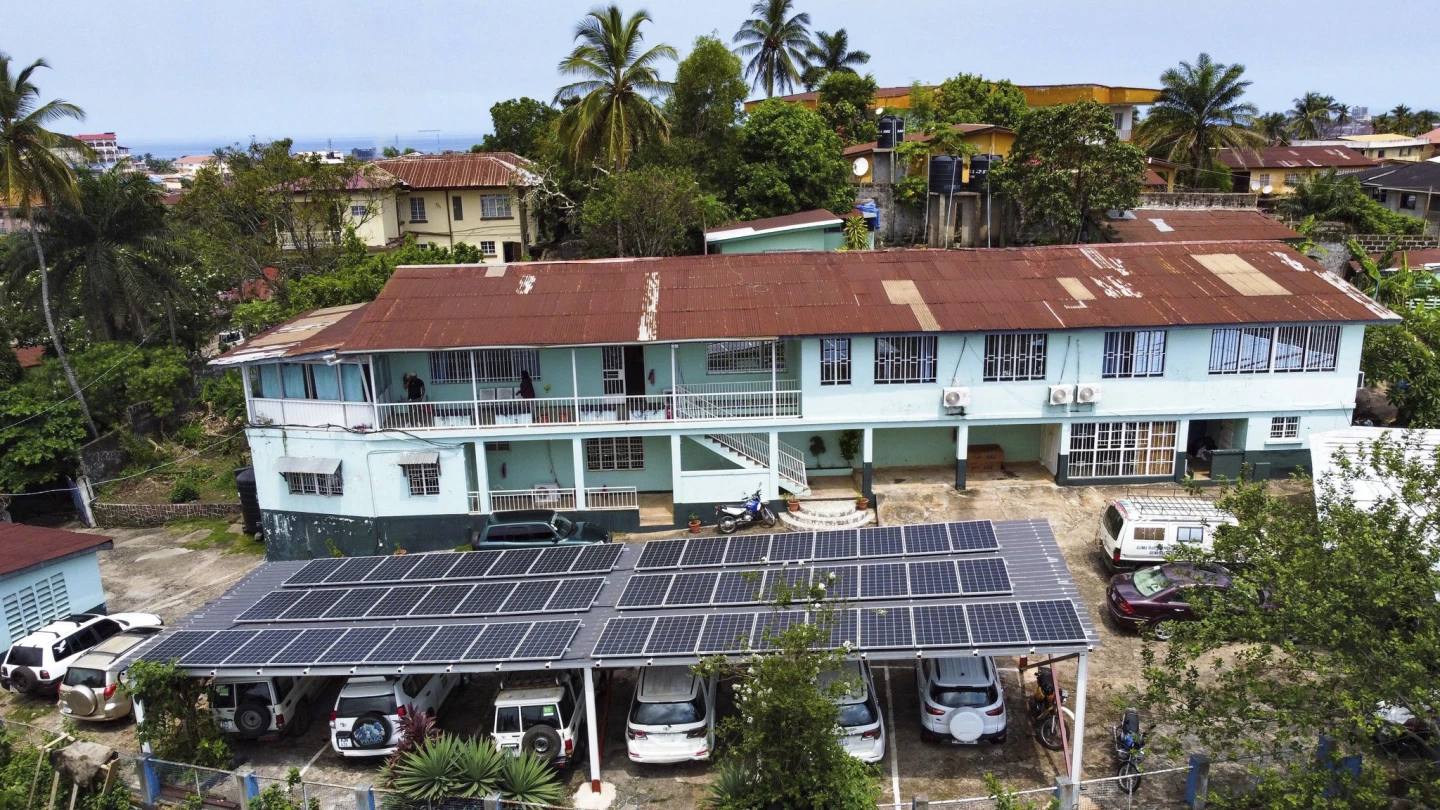
FREETOWN, Sierra Leone — Companies that bring solar power to some of the poorest homes in Central and West Africa are said to be among the fastest growing on a continent whose governments have long struggled to address some of the world’s worst infrastructure and the complications of climate change, AP reported.
The often African-owned companies operate in areas where the vast majority of people live disconnected from the electricity grid, and offer products ranging from solar-powered lamps that allow children to study at night to elaborate home systems that power kitchen appliances and plasma televisions. Prices range from less than $20 for a solar-powered lamp to thousands of dollars for home appliances and entertainment systems.
Central and West Africa have some of the world’s lowest electrification rates. In West Africa, where 220 million people live without power, this is as low as 8%, according to the World Bank. Many rely on expensive kerosene and other fuels that fill homes and businesses with fumes and risk causing fires.
At the last United Nations climate summit, the world agreed on the goal of tripling the capacity for renewable power generation by 2050. While the African continent is responsible for hardly any carbon emissions relative to its size, solar has become one relatively cost-effective way to provide electricity.
The International Energy Agency, in a report earlier this year, said small and medium-sized solar companies are making rapid progress reaching homes but more needs to be invested to reach all African homes and businesses by 2030.
About 600 million Africans lack access to electricity, it said, out of a population of more than 1.3 billion.
Among the companies that made the Financial Times’ annual ranking of Africa’s fastest growing companies of 2023 was Easy Solar, a locally owned firm that brings solar power to homes and businesses in Sierra Leone and Liberia. The ranking went by compound annual growth rate in revenue.
Co-founder Nthabiseng Mosia grew up in Ghana with frequent power cuts. She became interested in solving energy problems in Africa while at graduate school in the United States. Together with a U.S. classmate, she launched the company in Sierra Leone with electrification rates among the lowest in West Africa.
“There wasn’t really anybody doing solar at scale. And so we thought it was a good opportunity,” Mosia said in an interview.
Since launching in 2016, Easy Solar has brought solar power to over a million people in Sierra Leone and Liberia, which have a combined population of more than 14 million. The company’s network includes agents and shops in all of Sierra Leone’s 16 districts and seven of nine counties in Liberia.
Many communities have been connected to a stable source of power for the first time. “We really want to go to the last mile deep into the rural areas,” Mosia said.
The company began with a pilot project in Songo, a community on the outskirts of Sierra Leone’s capital Freetown. Uptake was slow at first, Mosia said. Villagers worried about the cost of solar-powered appliances, but once they began to see light in their neighbors’ homes at night, more signed on.


Discussion about this post