










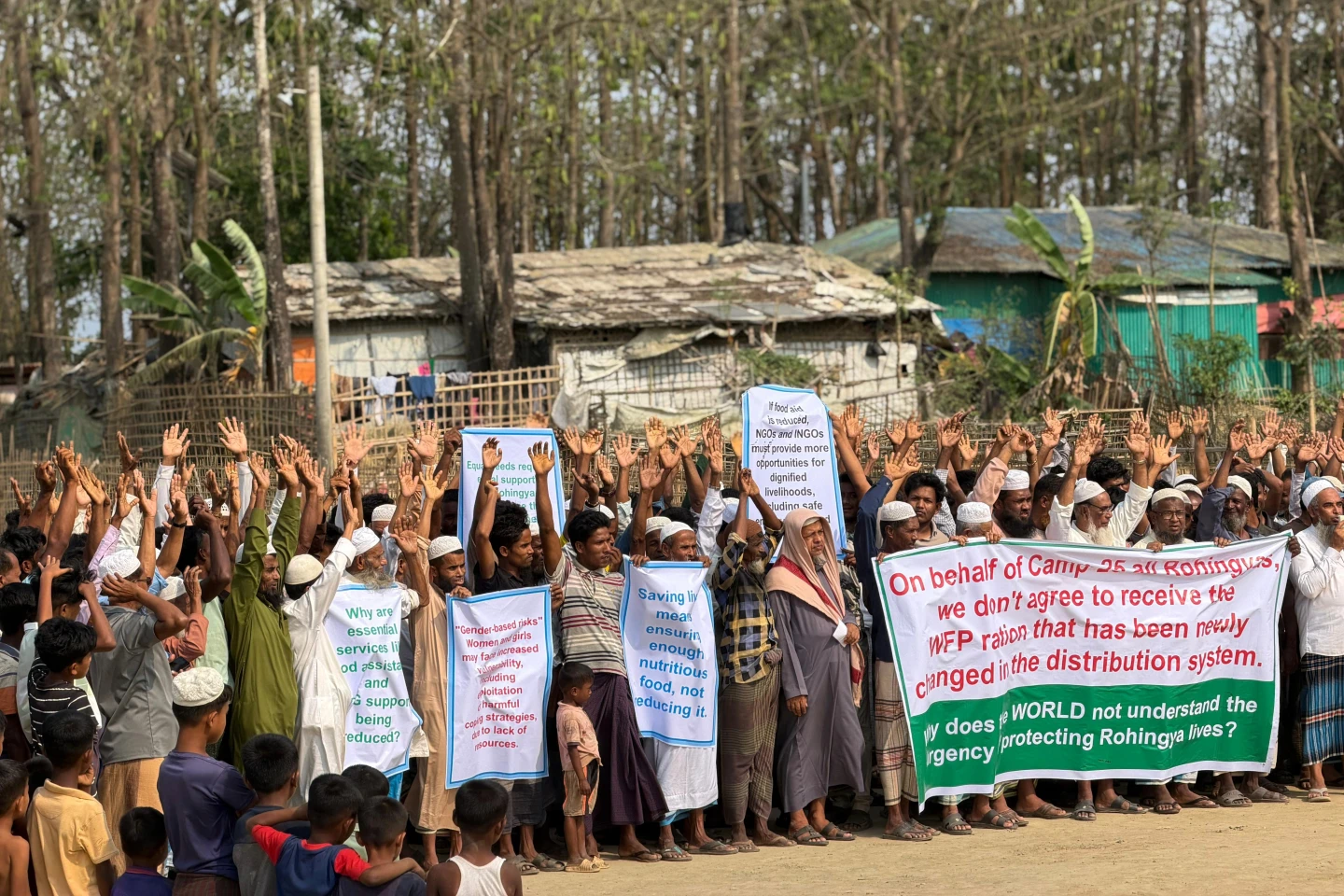
Hundreds of thousands of Rohingya refugees struggling to survive in Bangladesh’s overcrowded camps will see their food assistance slashed starting on Wednesday, raising alarm throughout the increasingly desperate community.
Currently, the 1.2 million Rohingya trapped in the squalid camps receive $12 a month per person, an amount the persecuted minority from Myanmar has long warned is barely sustainable. Most of the Rohingya in the camps fled brutal attacks by Myanmar’s military in 2017 and they are legally barred from working in Bangladesh, leaving them largely reliant upon humanitarian aid to survive.
Under the United Nations’ World Food Programme’s new tiered system, the amount each person receives will vary based on the severity of their family’s needs, with around 17% of the population getting as little as $7 per month. A third of the population that has been classified as “extremely food insecure,” such as households headed by children, will continue receiving $12.
“It is very difficult to understand how we will survive now with only $7. Our children will suffer the most,” said camp resident Mohammed Rahim, who said he and his wife were already struggling to feed their three children before the reduction. “I am deeply concerned that people may face severe hunger and some may even die due to lack of food.”
The WFP has repeatedly warned that rations in the camps could be slashed as a result of last year’s steep foreign aid cuts by the United States and other countries, which saw the agency lose a third of its funding. But WFP spokesperson Kun Li said Wednesday’s change in food distribution was unrelated to the funding cuts, and it should not be described as a “ration cut,” despite two-thirds of the population receiving fewer rations as a result.
The agency said a ration cut implies food assistance is being reduced below 2,100 calories a day, the recommended minimum standard for emergency food aid. But the WFP said even those who will now receive just $7 per month will still be able to meet that threshold.
The plan “ensures that even with differentiated ration sizes, all Rohingya continue meeting their minimum food needs, strengthening fairness, transparency, and equity in food assistance,” the agency said in a statement.
But a ration cut is precisely what the change means for the Rohingya, said Bangladesh’s Refugee Relief and Repatriation Commissioner Mohammad Mizanur Rahman.
With desperation already running high, Rahman told The Associated Press that the Rohingya will attempt to flee in search of food and work.
“Law and order will be deteriorated,” he said.

