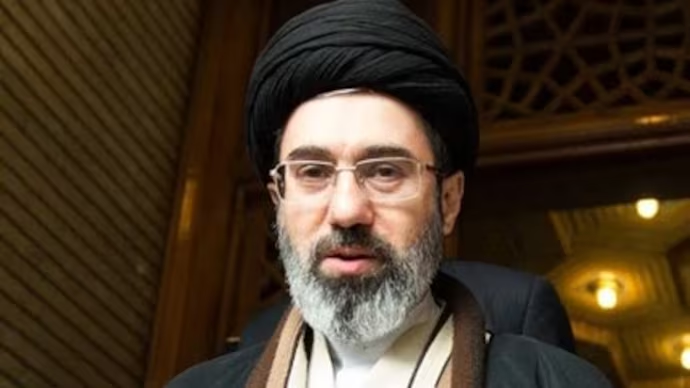







Iran’s new Supreme Leader Mojtaba Khamenei is recovering from severe facial and leg injuries sustained in the airstrike that killed his father, Ayatollah Khomeini, at the start of the war, people familiar with his inner circle told news agency Reuters.
The strike hit the Supreme Leader’s compound in central Tehran on February 28, the first day of the conflict launched by the United States and Israel.
Mojtaba Khamenei’s face was left disfigured and he suffered serious injuries to one or both legs, the sources said. His wife, brother-in-law and sister-in-law were among family members killed in the same attack.
Despite the injuries, he is said to be mentally alert and actively involved in governance. Two of the sources said he participates in meetings with senior officials through audio conferencing and continues to take part in decisions on major issues, including the war and negotiations with Washington.
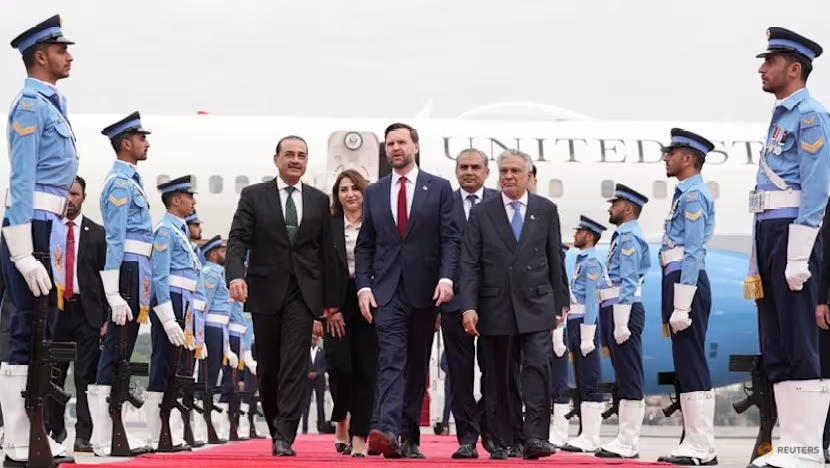
His condition came at a sensitive moment for Iran, as high-stakes peace talks with the United States opened in Islamabad today amid heightened regional tensions.
There has been no official Iranian statement detailing the extent of his injuries. Since the airstrike and his appointment as Iran’s Supreme Leader on March 8, no photo, video or audio recording of Mojtaba Khamenei has been released, deepening public uncertainty about his condition and role.
According to Reuters, Iran’s United Nations mission did not respond to queries on his health or the absence of public appearances.
One source familiar with US intelligence assessments told the news agency that Khamenei is believed to have lost a leg. US Defence Secretary Pete Hegseth had earlier said on March 13 that he was “wounded and likely disfigured”.
Iran’s state media has offered only limited acknowledgement. A television newsreader previously described him as a ‘janbaz’, a term used for those severely wounded in war. A senior Iranian official said images of the new leader could be released within one or two months, and that a public appearance might follow if health and security conditions allow.
Inside Iran’s political system, ultimate authority rests with the Supreme Leader, who oversees the elected President and commands key parallel institutions, including the Revolutionary Guards.
Analysts told Reuters that Mojtaba Khamenei’s authority is still taking shape.
Alex Vatanka of the Middle East Institute said that even if he represents continuity, he is unlikely to immediately command the same control exercised by his father over decades.
“Mojtaba will be one voice, but it will not be the decisive one. He needs to prove himself as the credible, powerful, overriding voice,” Vatanka said.
He added that the Revolutionary Guards have emerged as a dominant force in strategic decision-making during the war, shaping the internal balance of power as the new leadership consolidates itself.

