




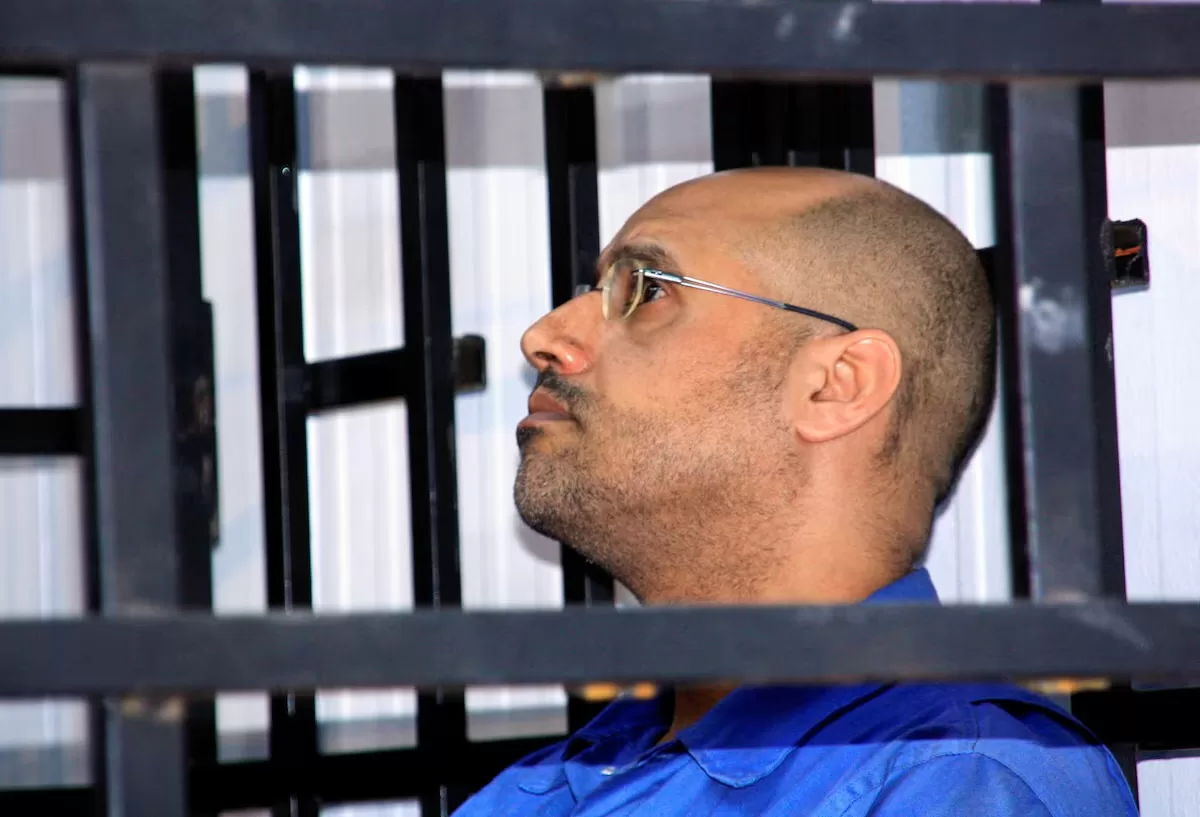
Libya’s Saif al-Islam Gaddafi went from his father’s heir apparent to a decade of captivity and obscurity in a remote hill town before launching a presidential bid that helped derail an attempted election.
Saif al-Islam’s office said in a statement on Tuesday that he had been killed during a “direct confrontation” with four unknown gunmen who broke into his home. Further details were not made public.
Despite holding no official position, Saif al-Islam was once seen as the most powerful figure in the oil-rich North African country after his father Muammar Gaddafi, who ruled for more than four decades.
Saif al-Islam shaped policy and mediated high-profile, sensitive diplomatic missions.
He led talks on Libya abandoning its weapons of mass destruction and negotiated compensation for the families of those killed in the bombing of Pan Am Flight 103 over Lockerbie, Scotland, in 1988.
Determined to rid Libya of its pariah status, he engaged with the West and championed himself as a reformer, calling for a constitution and respect for human rights.
Educated at the London School of Economics and a fluent English speaker, he was once seen by many governments as the acceptable, Western-friendly face of Libya.
But when a rebellion broke out against Gaddafi’s long rule in 2011, Saif al-Islam immediately chose family and clan loyalties over his many friendships to become an architect of a brutal crackdown on rebels, whom he called rats.
Speaking to Reuters at the time of the revolt, he said: “We fight here in Libya, we die here in Libya.”
He warned that rivers of blood would flow and the government would fight to the last man and woman and bullet.
“All of Libya will be destroyed. We will need 40 years to reach an agreement on how to run the country, because today, everyone will want to be president, or emir, and everybody will want to run the country,” he said, wagging his finger at the camera in a TV broadcast.
After rebels took over the capital Tripoli, Saif al-Islam tried to flee to neighbouring Niger dressed as a Bedouin tribesman.
The Abu Bakr Sadik Brigade militia captured him on a desert road and flew him to the western town of Zintan about one month after his father was hunted down and summarily shot dead by rebels.
“I’m staying here. They’ll empty their guns into me the second I go out there,” he said in comments captured in an audio recording as hundreds of men thronged round an old Libyan air force transport plane.
Saif al-Islam was betrayed to his rebel captors by a Libyan nomad.
He spent the next six years detained in Zintan, a far cry from the charmed life he lived under Gaddafi when he had pet tigers, hunted with falcons and mingled with British high society on trips to London.
Human Rights Watch met him in Zintan. Hanan Salah, its Libya director, told Reuters at that time that he did not allege ill treatment. “We did raise concerns about Gaddafi being held in solitary confinement for most if not all of the time that he had been detained,” she said.
Saif al-Islam was missing a tooth and said he had been isolated from the world and that he did not receive visitors.
He was, however, granted access to a television with satellite channels and some books, she added.
In 2015, Saif al-Islam was sentenced to death by firing squad by a court in Tripoli for war crimes.
He was also wanted by the International Criminal Court at The Hague, which issued an arrest warrant against him for “murder and persecution”.
- Latest
- Trending

