


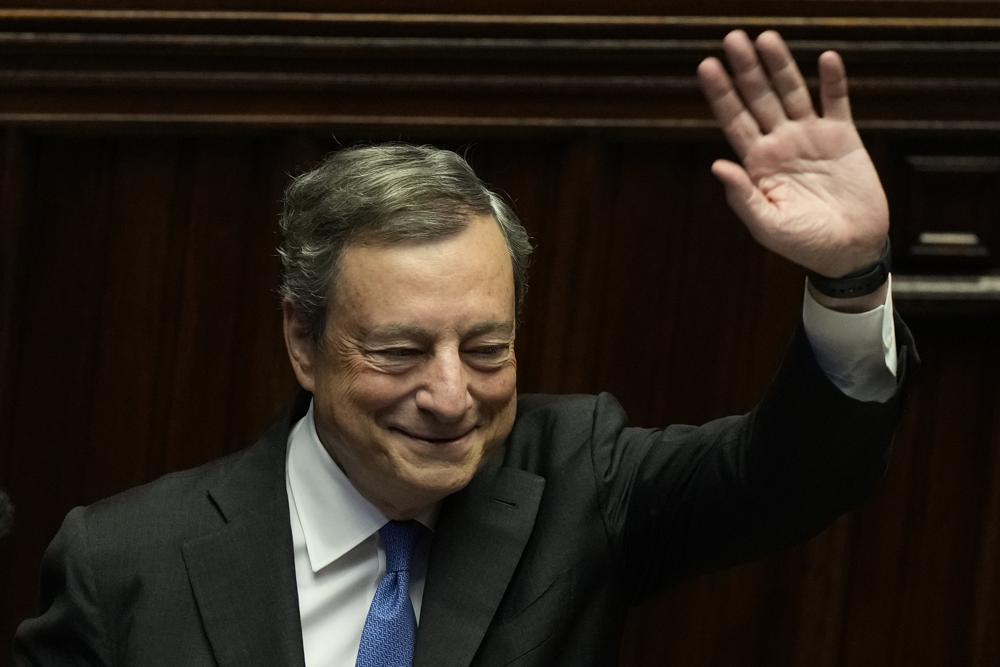
ROME — Italian Premier Mario Draghi resigned Thursday after his ruling coalition fell apart, dealing a destabilising blow to the country and Europe at a time of severe economic uncertainty brought on by the coronavirus pandemic and Russia’s war in Ukraine, according to AP.
Draghi tendered his resignation to President Sergio Mattarella during a morning meeting at the Quirinale Palace. Mattarella, who rejected a similar resignation offer from the premier last week, “took note” of the new one and asked Draghi’s government to remain on in a caretaker capacity, the president’s office said. While the president could see if a new parliamentary majority was possible, his office indicated that he would dissolve the body and call early elections.
The turmoil couldn’t have come at a worse time for the eurozone’s third-largest economy. Like many countries, Italy is facing soaring prices for everything from food to household utilities as a result of Moscow’s attack. On top of that, it is also suffering through a prolonged drought that is threatening crops and struggling to implement its EU-financed pandemic recovery programme.
Draghi, who is not a politician but a former central banker, was brought in 17 months ago to navigate the economic downturn caused by COVID-19. But his government of national unity imploded Wednesday after members of his uneasy coalition of right, left and populists rebuffed his appeal to band back together to finish the Italian Parliament’s natural term.
Instead, the centre-right Forza Italia and League parties and the populist 5-Star Movement boycotted a confidence vote in the Senate, a clear sign they were done with Draghi.
“Thank you for all the work done together in this period,” Draghi told the lower Chamber of Deputies on Thursday morning before going to see Mattarella. Clearly moved by the applause he received there, he repeated a quip that even central bank chiefs have hearts.
Dubbed “Super Mario” for helping to lead the eurozone out of its debt crisis when he was head of the European Central Bank, Draghi played a similar calming role in Italy in recent months. His very presence helped reassure financial markets about the debt-laden nation’s public finances, and he managed to keep the country on track with economic reforms that the EU made a condition of its 200 billion-euro (-dollar) pandemic recovery package.
He was a staunch supporter of Ukraine and became a leading voice in Europe’s response to Russia’s invasion — one of the issues that contributed to his downfall since the 5-Stars rankled at Italian military help for Ukraine.
Domestic concerns also played a role. The 5-Stars, the biggest vote-getter in the 2018 national election, chafed for months that their priorities of a basic income and minimum salary, among others, were ignored. The final straw? A decision to give Rome’s mayor extraordinary powers to manage the capital’s garbage crisis — powers that had been denied the party’s Virginia Raggi when she was mayor.
Meloni, who has been gunning for an early election since before the crisis erupted, was triumphant.
“The will of the people is expressed in one way: by voting. Let’s give hope and strength back to Italy,” she said.
Some commentators noted that Draghi’s government, which has been among Europe’s strongest supporters of Ukraine, collapsed in large part thanks to political leaders who previously had ties with Russian President Vladimir Putin.
Berlusconi has vacationed with Putin and considered him a friend; Salvini opposed EU sanctions against Russia after its 2014 annexation of the Crimean Peninsula; and then there’s 5-Star leader Giuseppe Conte’s opposition to Italian military aid to Ukraine.
After 5-Star senators boycotted last week’s vote, Italian Foreign Minister Luigi Di Maio accused Conte of giving Putin a gift.


Discussion about this post