







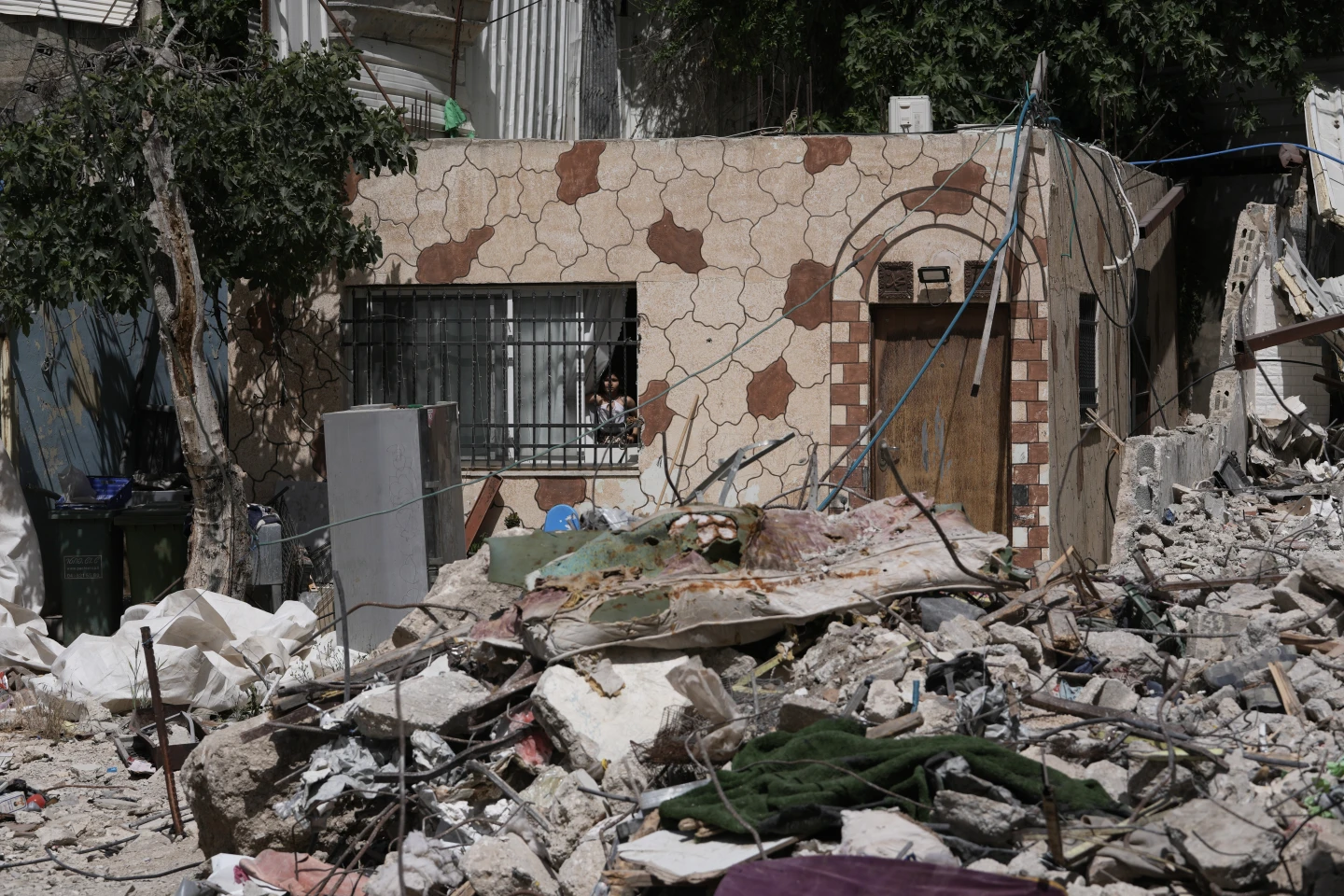
Fakhri Abu Diab fought for decades to save his home. But when Israeli authorities arrived with bulldozers two years ago, he was powerless to stop them.
He and his wife now live among shards of memory: a bicycle where his bedroom stood; the garden where he planted tomatoes as a boy; a portrait of his late mother painted on a wall, based on a photograph lost in the demolition. Their mobile home, set up amid the rubble, is also marked for removal.
They are “trying to erase my memories, my childhood, my history,” he said, wiping away tears.
For decades, Israel has worked to expand the Jewish presence in annexed east Jerusalem — the heart of the Israeli-Palestinian conflict and home to major Jewish, Christian and Muslim sites. Settlers have exploited discriminatory policies and archaeological claims to evict Palestinians far from the region’s war zones.
Activists say those efforts have gone into overdrive in recent years, as Israel is no longer constrained by US pressure and attention has shifted to Gaza, Lebanon and Iran.
Over 260 homes and other structures were demolished in 2025, a 70% increase from three years earlier, with some neighborhoods seeing the most evictions in decades, according to Ir Amim, an Israeli anti-settlement group that closely tracks such policies. There have been at least 116 demolitions so far this year, it said.
It’s “an intensity and scope that we have never seen,” said Aviv Tatarsky, a researcher at Ir Amim. “Israel can decide, yes, this neighborhood, we want to erase it … No one is going to stop us.”
Israel captured east Jerusalem, along with the West Bank and Gaza, in the 1967 Mideast war. The Palestinians want all three territories for their future state, and the UN and much of the international community consider them to be illegally occupied.
Israel considers all of Jerusalem to be its unified capital and says residents are treated equally by law.
Palestinians in annexed east Jerusalem are eligible for Israeli citizenship, but unlike Jews, they must apply for it — a long, uncertain process. Most choose not to because it would recognize Israel’s claims to the city. That leaves them with few ways to challenge housing policy, largely set by Israel’s Parliament.
Rights activists say that in addition to supporting the development of major Jewish settlements — which many Israelis view as ordinary neighborhoods — authorities have severely limited the growth of Palestinian neighborhoods, making it virtually impossible to obtain housing permits.
Last year, nearly 9,000 permits were approved for Jerusalem’s Jewish residents and fewer than 700 for Palestinians, according to Bimkom, an Israeli rights group. Palestinians make up some 40% of Jerusalem’s population and are concentrated in the east.
Israeli officials say the discrepancy exists because Palestinians rarely apply for permits. Many Palestinians say it’s futile.
When Palestinians build without permits, they face the threat of demolition. Settler groups meanwhile exploit an array of laws to purchase or take over Palestinian properties.
Previous US administrations have pressed Israel to slow or suspend settlement projects, viewing them as an obstacle to resolving the conflict. US President Donald Trump broke with that tradition in his first term, recognizing Jerusalem as Israel’s capital.
The US State Department said in a statement that it’s up to Israeli authorities to set policy in Jerusalem, and that it expects them to respect due process and the rule of law.

