


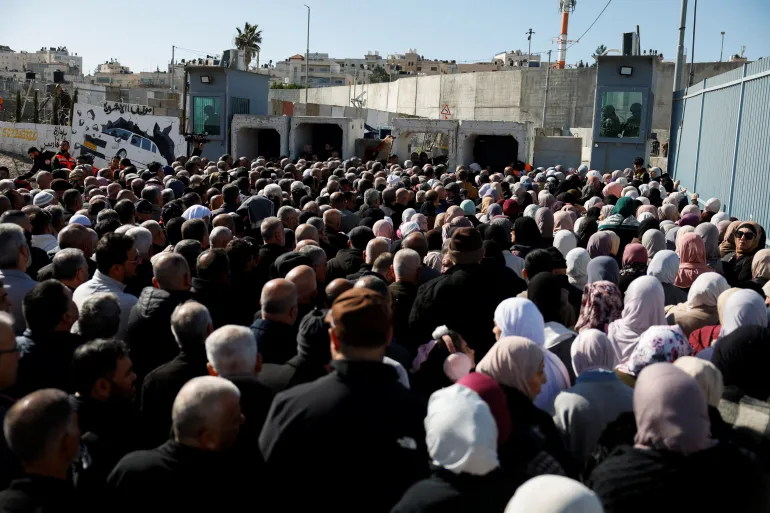
Israeli authorities imposed sweeping entry restrictions on Palestinian worshippers on Friday, limiting access from the occupied West Bank into occupied East Jerusalem for prayers at the Al‑Aqsa Mosque on the first Friday of Ramadan.
Hundreds of Palestinians gathered before dawn at checkpoints surrounding Jerusalem, hoping to reach the compound, but many were turned back despite holding previously issued permits, according to local officials and witnesses.
Israeli forces reinforced crossings with large troop deployments and senior commanders on site, enforcing a reported cap of 10,000 worshippers from the occupied West Bank.
Palestinian authorities said thousands remained stranded at the Qalandiya checkpoint after the quota was reached.
The tightened measures come as Israel raised its security alert level across the occupied West Bank and Jerusalem at the start of Ramadan, amid escalating tensions linked to Israel’s war on Gaza.
Rights groups say Israeli authorities have also increased arrests and expulsion orders in occupied East Jerusalem in recent weeks, while violence, illegal settlement expansion and military raids across the occupied West Bank have surged since the Gaza war started in October 2023.
Palestinians view occupied East Jerusalem as the capital of a future Palestinian state, while Israel considers the city its undivided capital — a dispute that continues to make access to its holiest sites a flashpoint each Ramadan.
Meanwhile, Israel’s Channel 12 reported that only about 2,000 Palestinians were able to cross through the Qalandiya checkpoint towards Jerusalem by the morning, amid a state of Israeli military high alert at checkpoints separating the West Bank and East Jerusalem.
“There are 3.3 million people in the occupied West Bank … so allowing only 10,000 to pray on this first Friday or Ramadan is a drop in the ocean, and only a trickle have been able to make it in,” Al Jazeera’s Nour Odeh reported from the Qalandiya checkpoint.
“In previous years, we’ve seen up to 250,000 worshippers in that holy site, and now only a fraction of that is expected. And it will be from the occupied West Bank, from occupied East Jerusalem itself and Palestinian-Israeli citizens from inside Israel proper.”
In the meantime, she added, “hundreds of people are still stuck at the checkpoint trying to get inside, trying to make it to the holy mosque, but are being barred.”
Odeh said the new restrictions are attempting to break bonds between communities.
“Getting to the Al-Aqsa Mosque compound is part of the Palestinian tradition, which has been going on for generations, for hundreds of years. Spending the day there is extremely important; it’s part of the heritage of Palestinians,” she said.
But this year, she added, many “will not be allowed to break their fast in Jerusalem as they’re used to, and that is just one more way that Israel is severing ties between occupied East Jerusalem and the rest of the occupied West Bank”.

