


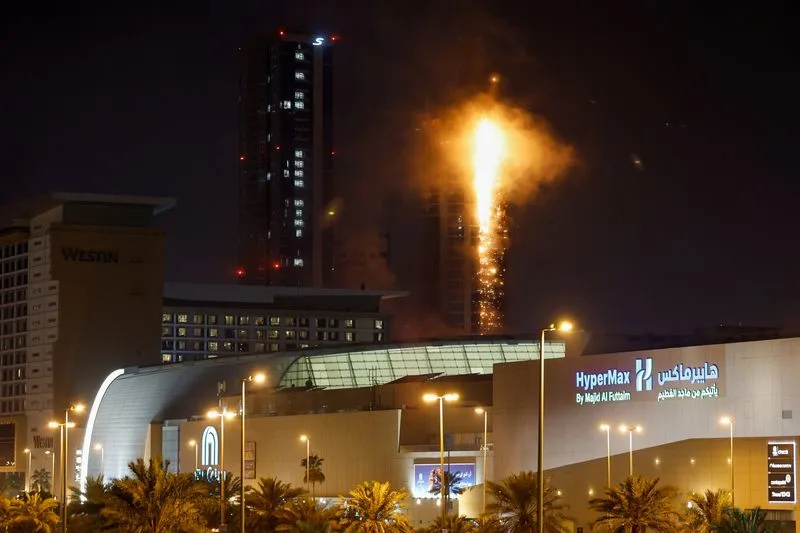
Thunderous blasts and towering fireballs from Iranian missiles streaking across Gulf states vindicated their leaders’ long-held fears that Tehran can bring war to their doorstep, likely to harden Arab rulers’ support for U.S.–Israeli strikes.
Even in the Palm, Dubai’s swankiest resort, explosions rattled buildings and hit a luxury hotel, sending panicked residents running for cover as missiles and interceptors tore across the sky. It was a stark sign that the conflict had spilled beyond Iran’s borders – just as Tehran had warned it would.
“What has now been proven is that we – not the United States – are in the line of fire,” said Dr Ebtesam Al-Ketbi, President of the Emirates Policy Center. “When Iran struck, it struck the Gulf first under the pretext of targeting U.S. bases.”Analysts say Iran’s strikes on Gulf countries are meant to demonstrate that no U.S. ally in the region is beyond reach, and to raise the cost of backing Washington’s campaign.”The danger is that any miscalculation could push the region from an exchange of signals into an open war,” added al Ketbi.
Gulf sources say that by targeting oil-rich Gulf states, Tehran is “internationalising the battlefield” and threatening global oil flows, not just regional security.
For fast-growing economies such as Saudi Arabia, Qatar and the United Arab Emirates — dependent on open airspace, secure shipping lanes and trade — a broader conflict would be deeply disruptive.In framing the war as a push for regime change in Iran, Trump has made it existential, raising the risk that Tehran lashes out, said Mohammed Baharoon, director-general of the Dubai Public Policy Research Center (B’huth).
“If Iran miscalculates and carries out an act of war against Gulf Cooperation Council countries, the conflict will change fundamentally. People can’t stand by while lives are being lost and assets destroyed and do nothing.”Gulf analyst Abdelkhaleq Abdulla said Iran was making a strategic mistake by targeting its closest neighbours.
“It is foolish of Iran to alienate the people nearest to it,” Abdulla said. “Tehran may believe it is targeting U.S. military bases, but Gulf states see this as a blatant act of aggression– a violation of their sovereignty and an attack on their land.”In indirect U.S.–Iran talks in recent weeks aimed at averting war, Tehran agreed to discuss its nuclear programme but insisted its ballistic missiles and support for regional militias were off the table, sources close to the talks said.Iran has indicated that any discussion about its missiles and its allied militias take place only in a regional framework, without Washington, the sources said.But the Gulf Arab states – longtime U.S. partners which have previous experience of being targets of attacks by Iran and its proxies – argue that sidelining Washington would weaken, not stabilise the region’s security architecture.

