





Astana, Kazakhstan – Mohamed Talaat
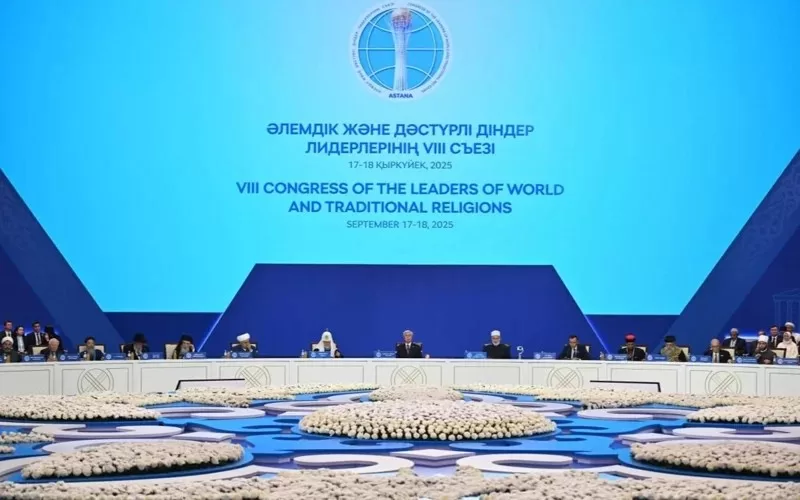
The VIII Congress of Leaders of World and Traditional Religions concluded in Kazakhstan’s futuristic capital, Astana, with a landmark declaration calling for renewed global commitment to dialogue, peace, and shared responsibility in the face of mounting global crises.
For two days, the Palace of Independence hosted an extraordinary gathering of religious leaders – Christians and Muslims, Jews and Hindus, Buddhists and Taoists – from more than 60 countries. They sat together at a single round table under the motto “Dialogue of Religions: Synergy for the Future.”
Kazakh President Kassym-Jomart Tokayev opened the congress by framing it as a unique platform at a time of deepening global tensions, climate change, and the risk of nuclear escalation. “Religions can set an example of unity in diversity under the banner of humanism and peaceful coexistence,” Tokayev said, stressing that Kazakhstan, home to numerous ethnic and religious communities, embodies this principle.
The Congress, first launched by former President Nursultan Nazarbayev in 2003 as a response to the 9/11 attacks, has become a triennial event positioning Kazakhstan as a bridge-builder between civilizations. This year’s meeting reflected the country’s ambition to project itself as a neutral mediator between major powers while continuing rapid modernization and reform.
The proceedings were marked by powerful interventions. Moscow Patriarch Kirill I attended but avoided mention of the war in Ukraine, while Mohammad bin Abdulkarim Al-Issa, Secretary-General of the World Islamic League, sharply condemned Israel’s military campaign in Gaza, calling it “a genocide and a disgrace to humanity.” No Muslim speaker from Turkey to Pakistan refrained from denouncing the war.
In response, Rabbi Kalman Meir Ber of Israel’s Chief Rabbinical Council insisted, “This war is not a religious war,” emphasizing Judaism’s desire for peace and coexistence. Pope Leo XIV, in a message delivered by Cardinal George Jacob Koovakad, urged participants to help “bring healing to our broken and wounded world,” framing faith as a force for reconciliation. UN Secretary-General António Guterres joined via video message, commending the Congress for advancing dialogue.
On the second day, young religious leaders gathered for a special forum, pledging to work against extremism, champion mutual respect, and uphold shared responsibility for humanity’s future. Participants also symbolically planted trees outside the congress venue as a sign of hope.
Observers noted that beyond speeches and formal sessions, the true value of the Congress lay in informal encounters. “The most important thing happens at the lunch table – personal meetings and friendships that would never happen otherwise,” said Anglican Bishop Jo Bailey Wells, Deputy Secretary General of the Anglican Communion, highlighting the trust-building dimension of the gathering.
The event closed with a 34-article final declaration affirming a commitment to fundamental human rights, protection of minorities and refugees, and equal participation of women. Delegates expressed concern over the slow progress toward UN Sustainable Development Goals and urged international action against climate change and the misuse of artificial intelligence. The declaration will be presented to the United Nations General Assembly.
For religious leaders like Michael Hübner, General Secretary of the Martin Luther Federation in Germany, the Congress remains a vital opportunity for building bridges. “We come here for dialogue and for new contacts – it is an investment in peace,” he said.
With its striking skyline and ambitious vision, Astana has once again positioned itself as a meeting place for faith and diplomacy – a modern-day forum where humanity’s search for coexistence takes center stage.

