







Tel Aviv aims to weaken Damascus, not just protect the Druze minority
The latest Israeli military operations in southern Syria, portrayed by some Israelis as a protective measure for the Druze minority, serve a broader, more complex set of objectives.
The question of what truly drives Israeli Prime Minister Benjamin Netanyahu’s actions in Syria requires a closer look at strategic calculations, domestic pressures, and the historical context.
Transitional Syrian President Ahmed al-Sharaa announced Thursday the end of deadly clashes in the southern Syrian province of Suweida between Sunni Bedouins and the Druze minority.
The clashes left approximately 360 people on both sides dead. Al-Sharaa confirmed the withdrawal of government forces from the area and reaffirmed his commitment to protecting the rights and the freedoms of the Druze community within the Syrian society.
However, a significant portion of the transitional Syrian president’s speech on Thursday was directed at Israel, accusing it of exploiting his country’sinternal strife to achieve some of its goals.
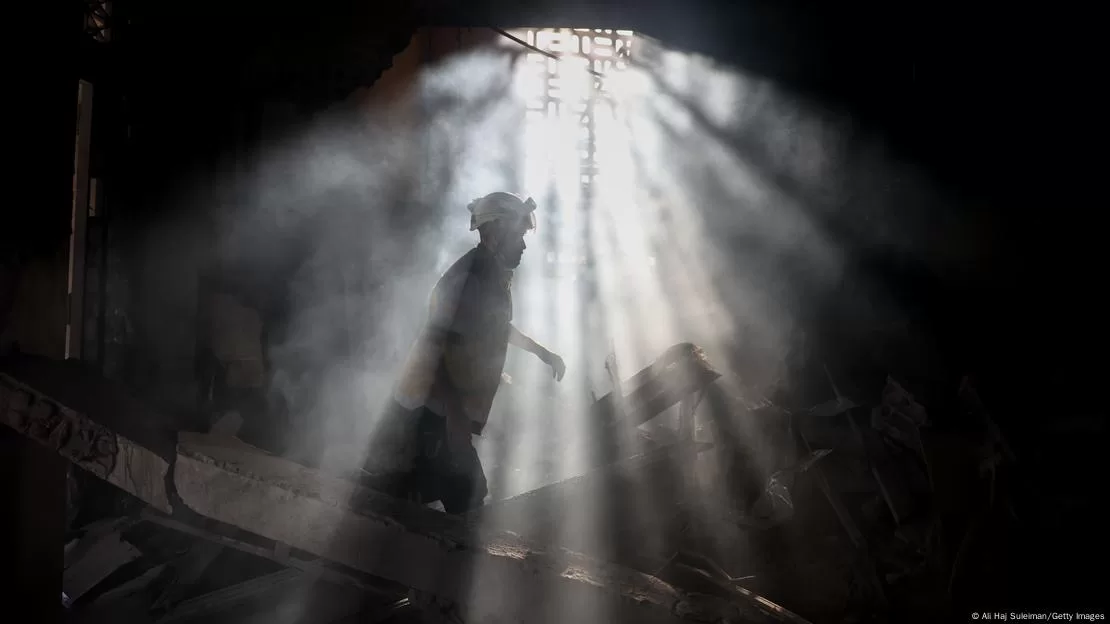
Israel launched a series of strikes in recent days against Syrian government facilities in capital Damascus and Syrian troops in the Suweida region, killing at least 20 people.
Netanyahu insisted that the strikes were essential “to save our Druze brothers and eliminate the gangs of the regime”.
Al-Sharaa countered, however, by saying that Israel was merely exploiting the unrest to target civilian infrastructure and derail Syria’s peace and reconstruction efforts.
He warned against attempts to “drag us into war” and “divide us”, underscoring Syria’s resolve not to be entangled in a conflict that would “fragment our homeland and sow the seeds of destruction”.
These latest strikes on the Syrian capital mark an escalation of Israel’s military campaign in the country.
Following the overthrow of Bashar al-Assad in early December 2024, Israel significantly increased the frequency of its bombings in Syria, ostensibly to prevent Assad’s arms arsenal from falling into the hands of the new government.
Charles Lister, head of the Washington-based Middle East Institute’s Syria initiative, estimated the number of strikes Israel staged on Syria, including the occupied 180 square kilometres of its territory,since December 2024 at approximately 1,000. Significantly, the Syrian government has not retaliated.
Officially, Israel and Syria have been in a state of war since 1967, the year Israel occupied the strategic Golan Heights.
While Israel effectively annexed this plateau in 1981, the international community, including Egypt, considers the Golan Heights to be Syrian territory under Israeli military occupation.
Only the United States and Israel recognize the territory as Israeli.
Following Assad’s downfall, Israeli troops have reportedly moved beyond the demilitarized zone along the Israel-Syria border, which has been monitored by the United Nations since a 1974 ceasefire agreement.
It is clear that Israel is trying to carve out an informal buffer zone in southern Syria. This aligns with Israel’s long-standing security doctrine of establishing strategic depths and preventing the consolidation of forces deemed hostile near its borders.
Consequently, the stated rationale of protecting the Druze minority warrants closer scrutiny.
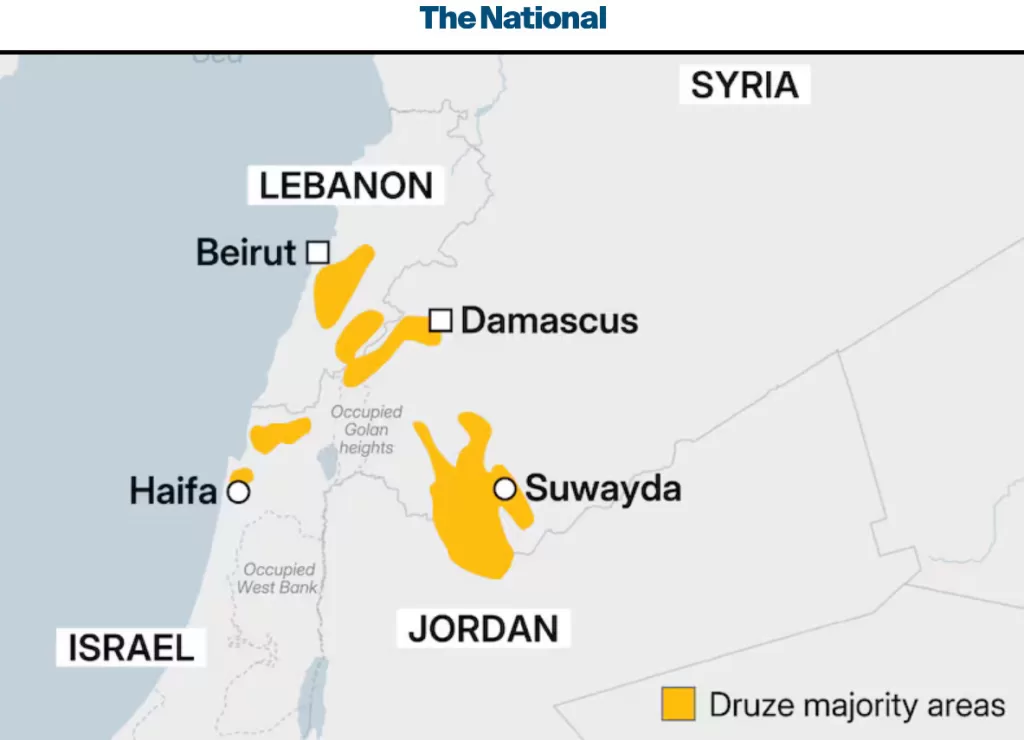
In Israel, the Druze community numbers approximately 150,000 people, and Druze men serve regularly in the Israeli military, fostering a deep-rooted alliance.
In Syria, the members of the Druze community constitute one of the largest minorities, with a population of around 700,000.
While concern for the Druze in Syria can be a genuine sentiment in Israel, the timing of Israeli strikes on appears to be intertwined with Netanyahu’s domestic political struggles.
The Israeli premier faces an ongoing corruption trial, and his coalition government has become increasingly fragile, with two parties having left earlier this month.
This instability could potentially trigger early general elections at the beginning of 2026.
Furthermore, Netanyahu is under significant pressure from the United States and Europe to end the war in Gaza. He faces persistent calls for the return of hostages held by Hamas. His government is also contending with widespread domestic and international condemnation for the humanitarian catastrophe unfolding in Gaza due to Israel’s military campaign there.
Yossi Mekelberg, a professor of international relations at London’s Regent’s University, suggests that Netanyahu’s actions in Syria could be a calculated diversion.
“Considering Netanyahu’s show of unabated cynicism and opportunism, he could be using situations, such as the clashes involving Syria’s Druze minority to deflect from his legal affairs and the crisis within his coalition,” he posited.

Mekelberg elaborated that “keeping at least one front open and portraying himself, despite October 7, as ‘Mr Security,’ especially when he might contemplate early general elections, is the way that he has always operated.”
The upcoming summer break for the Israeli parliament, pausing domestic politics until October, provides a window for such strategic manoeuvres.
Beyond immediate political gain and the stated aim of protecting minorities, a core Israeli objective in Syria appears to be the long-term debilitation of the Syrian state.
Ryan Bohl of Rane Network told Bloomberg that “Israel wants Syria to be a very weak state or to be a broken state so that it is unable to threat Israel”.
Nanar Hawach, senior Syria analyst at the International Crisis Group, concurs, observing that this objective appears to be materializing.
“Damascus came out weakened from the recent clashes, it was forced to retreat militarily and it lost the trust of not only the Druze community but also of different communities that are not aligned with the state,” he stated.
Hawach believes Syria is now even more fragile, having also “lost geopolitically as the government has now less presence in the south, especially in Suweida.”
Israel’s objectives in Syria extend far beyond the immediate protection of the Druze minority.
They encompass a strategic imperative to maintain a weak and fractured Syrian state as a long-term security measure, intertwined with Netanyahu’s domestic political vulnerabilities and his historical tendency to project strength through military action, particularly when facing internal pressures.
This complex interplay of factors contributes significantly to the ongoing instability and humanitarian challenges in Syria and the broader region.