


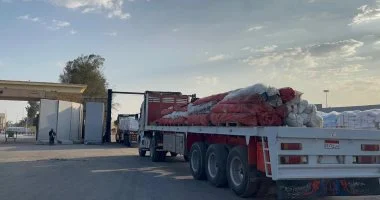
RAFAH – Humanitarian aid trucks began entering Gaza Tuesday through Rafah Border Crossing in North Sinai toward Al-Ouja and Karm Abou Salem crossings, as part of the 75th convoy of “Zad Al-Ezza – From Egypt to Gaza.”
The convoy is carrying more than 6,100 tons of food baskets and flour, over 2,600 tons of essential medical and relief supplies and more than 1,100 tons of petroleum products, according to a statement issued by the Egyptian Red Crescent on Tuesday.
A reliable source at Rafah Border Crossing said that the trucks are inspected by Israeli occupation troops at the Al-Ouja and Karm Abou Salem crossings before entering Gaza.
Israeli occupation forces had closed all crossings to the Gaza Strip on March 2, following the end of the first phase of a Gaza ceasefire agreement and the failure to reach a deal to extend it.
The occupation army violated the truce with heavy airstrikes on March 18, resuming ground incursions into various parts of Gaza from which it had previously withdrawn. It also prevented the entry of humanitarian aid, fuel and shelter materials for displaced Palestinians whose homes were destroyed during the war on Gaza, refusing to allow in heavy machinery needed for debris removal and reconstruction.
In May, the occupation forces allowed in limited quantities of aid, insufficient to meet the minimum needs of Gaza’s residents, under a mechanism implemented in coordination with a US security company – a mechanism rejected by the United Nations and relief organizations, including UNRWA, for violating established international procedures.
The Israeli army announced a “temporary truce” of 10 hours daily, starting Sunday, July 27, 2025, suspending military operations in certain areas of Gaza to allow humanitarian aid delivery, while mediators (Egypt, Qatar, and the US ) continued efforts to reach a comprehensive ceasefire and prisoner exchange deal.
These mediation efforts culminated at dawn on October 9, 2025, in an agreement between Hamas and Israel on the first phase of a ceasefire plan, based on a proposal by US President Donald Trump. The agreement, clinched through Egyptian, US and Qatari mediation, with Turkish support, was later endorsed during Sharm El-Sheikh Peace Summit.

