











As the display industry continues to evolve across the Middle East and North Africa, demand is increasingly shifting towards larger screens, higher refresh rates, improved visual quality, and gaming-focused experiences.
Egypt, in particular, has emerged as one of the region’s most dynamic markets, driven by a growing gaming community, expanding digital transformation initiatives, and a strong demand for value-oriented technology solutions.
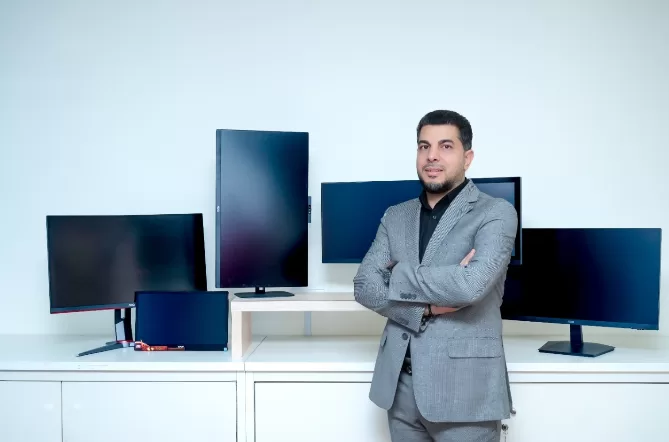
In this interview with the Egyptian Gazette, Hisham Tolba, Sales Manager – MENA at TPV Technology, discusses the latest trends shaping the monitor market, the distinct positioning of Philips and AOC within the region, the growing importance of gaming and OLED technologies, and TPV’s outlook for Egypt and the wider Middle East through 2027.
- Given TPV’s leadership in the display market globally, how would you describe the current health of the monitor market in the Middle East, and specifically in Egypt, compared to 2025?
The monitor market in the Middle East is in a healthier position today than it was in 2025.
Growth is not explosive in units, but the market is improving in value, driven by upgrades toward larger screens, higher refresh rates, and better resolution.
In Egypt, the opportunity is even more interesting. It is a very dynamic but price-sensitive market.
Demand is strong in gaming, education, and basic productivity, but consumers are very focused on getting the best value for money. This makes the mid-range and value segments important.
- When Egyptian customers buy a monitor, what do they look for that is different from buyers in Saudi or the UAE?
Egyptian customers are generally much more price-conscious. They care a lot about durability, value for money, and after-sales support.
In Saudi Arabia and the UAE, customers are more focused on premium features like larger screens, 4K resolution, ultrawide formats, and high-end gaming performance.
In Egypt, the priority is more practical — getting solid performance at an affordable price that lasts.
- From a B2B perspective, which sectors in the Middle East (education, finance, retail) are driving the highest demand for Philips and AOC displays right now?
From a B2B perspective, education is currently the biggest driving factor for monitors in the region.
Schools and universities are investing heavily in digital learning environments.
Finance is next, where there is strong demand for reliable, high-quality displays for trading, operations, and corporate workspaces. Retail is also growing, especially in the customer-facing screens.
Overall, education leads in volume, while finance and retail drive more premium and specialised demand.
- How do you position Philips monitors differently from AOC in the same regional portfolio? What specific value propositions does each brand offer to customers in the region?
Philips is positioned as a premium, productivity-focused brand. It’s designed for professional environments, offering features like ergonomic design, eye-care technologies, energy efficiency, and strong build quality.
AOC, on the other hand, is the value and performance brand. It focuses on delivering strong specifications at competitive prices, especially in gaming and high-volume office segments.
Simply put, Philips is about premium productivity, while AOC is about accessible performance and scale.
- Philips is known for innovations like PowerSensor and SmartErgoBase. How important are these health and ergonomic features for corporate clients in the Middle East compared to pure performance specs?
Philips innovations such as PowerSensor and SmartErgoBase play an important role in differentiating the brand from competitors, especially in professional and enterprise environments.
PowerSensor helps organisations reduce power consumption and operating costs, while SmartErgoBase supports ergonomic working conditions through flexible monitor adjustments.
For enterprise, government, and finance customers, ergonomic and wellness features (like eye-care technologies, adjustable stands, and energy-saving functions) are becoming key decision factors because they directly support employee productivity, comfort, and sustainability goals.
However, pure performance specs (resolution, size, connectivity, reliability) still remain the baseline requirement. In budget-sensitive segments or mass deployments, price and core specs usually dominate the decision.
For businesses in sectors such as finance, government, education, and large enterprises, these innovations add tangible value and strengthen Philips’ positioning as a premium, productivity-focused monitor brand.
- AOC has a strong “Gaming DNA” (especially the AGON series). How fierce is the competition in the MENA gaming monitor space, and what gives AOC the edge over competitor brands?
The gaming monitor market here in MENA is highly competitive. AOC’s AGON series remains competitive due to its strong value proposition.
It offers gaming-focused features such as high refresh rates (200Hz–500Hz), low response times, and Adaptive Sync technology at more accessible price points compared to many premium brands.
This positions AGON strongly within the high-volume mid-tier gaming segment, which represents the largest category in the region.
Its key strengths include an excellent price-to-performance ratio, a broad gaming portfolio, and strong retail and e-commerce availability.
AOC’s competitive advantage lies in delivering esports-ready performance at an accessible price point for mainstream gamers.
- Egypt has a rapidly growing esports and gaming community. Are you seeing a shift in Egyptian gamers moving from budget 60Hz displays to higher refresh rate (144Hz+, 240Hz+) monitors? What price point is the “sweet spot”?
We see a clear shift in Egypt from 60Hz monitors toward higher refresh rates like 144Hz and above, driven by the growth of esports and competitive gaming.
144Hz has now become the standard entry point for gaming monitors, while 165Hz–200Hz is emerging as the mainstream choice.
240Hz+ is still more niche and mainly used by serious esports players or higher-budget gamers.
The sweet spot price range for most Egyptian gamers is roughly $150–$250, where buyers typically get 24–27 inch monitors with 144Hz–165Hz refresh rates and solid IPS/VA panels.
- Does Philips also play in the gaming segment, or is that territory reserved exclusively for AOC in this region?
Both AGON by AOC and Philips Evnia play important roles in TPV’s gaming portfolio, serving different gamer segments.
AGON by AOC focuses on performance-driven gaming and esports-oriented experiences for competitive players with high refresh rates, low response times, and gaming-centric features.
Philips Evnia targets gamers seeking a premium, design-led experience, combining strong gaming performance with immersive visuals, comfort, and lifestyle-focused aesthetics.
In summary, AGON by AOC addresses the competitive gaming segment, while Philips Evnia caters to premium and mainstream gamers, giving TPV a balanced presence across the gaming market in the Middle East.
- Can you walk us through TPV’s latest monitor launched in 2026 so far? Which new Philips or AOC model should retailers in the Middle East be most excited about?
TPV’s 2026 monitor lineup (Philips and AOC) is focused on higher gaming performance, OLED expansion, and clearer brand separation between gaming and professional use.
Key highlights include:
- AOC AGON PRO esports monitors, including ultra-high refresh rate models aimed at competitive gaming and esports growth.
- New QD-OLED and OLED gaming displays across AOC and Philips, targeting high-end gamers and creators with very high refresh rates and better picture quality.
- Hybrid and dual-mode gaming monitors, offering flexibility between high resolution and high refresh performance.
- Philips Evnia expansion, focusing on premium design, immersive gaming, and comfort-oriented features rather than pure esports performance.
- What retailers in the Middle East should focus on:
- AOC AGON PRO OLED / high-refresh esports monitors → strongest gaming volume and performance demand
- Philips Evnia OLED models → premium segment, design-led and lifestyle gaming users
- Mid-range QHD 165–240Hz AOC models → biggest volume and fastest-moving category
In summary: AOC drives the gaming performance and esports innovation, while Philips focuses on premium, design-led gaming and comfort. The strongest retail opportunities in the region are in OLED and mid-to-high refresh gaming segments.
- What emerging display technology (OLED, Mini-LED, 4K vs. high refresh rate) is gaining the fastest traction with consumers in the MENA region right now?
In the MENA region, the fastest-growing trend is high refresh rate gaming monitors (144Hz → 240Hz+), driven by esports and competitive gaming demand. This is the main volume driver across markets like Egypt and Saudi Arabia.
OLED is the fastest-growing premium technology, especially in the UAE and high-end Saudi segment, due to its superior picture quality and gaming performance, but it is still smaller in overall volume.
4K monitors are growing steadily, mainly for productivity and content creation, while Mini-LED adoption remains more niche and slower compared to OLED.
In short: high refresh rate displays lead in mass adoption, while OLED is the fastest-growing premium segment in MENA.
- Philips has unique “Ambiglow” lighting technology. How has consumer feedback been on Ambiglow in the Middle East, especially for immersive gaming and content creation?
Consumer feedback on Philips Ambiglow in the Middle East is generally positive, but it depends on the user segment.
For gamers and home entertainment users, especially in the UAE and Saudi Arabia, Ambiglow is well received as an immersive feature that enhances the visual experience by extending on-screen colors into the surrounding environment.
It is seen as adding a premium, “cinematic” feel, particularly for casual gaming and content consumption.
For content creators and design-focused users, it is appreciated as a visual enhancement that improves ambiance and makes setups more engaging, especially in darker environments.
However, for competitive esports users and performance-focused buyers, Ambiglow has limited importance. These users prioritise refresh rate, response time, and input lag over lighting effects.
Overall, Ambiglow is valued as a premium immersion and aesthetic feature in the region, but it is a secondary consideration compared to core performance specifications.
- Logistics and pricing are always sensitive, especially in Egypt with recent economic fluctuations. How does TPV Technology Gulf manage pricing stability and product availability for the Egyptian market?
TPV Technology Gulf manages pricing stability and product availability in Egypt mainly through its regional supply chain and portfolio strategy.
They typically ensure availability by holding inventory in regional Gulf hubs (mainly UAE) and distributing to Egypt based on demand for fast-moving SKUs, especially AOC’s mainstream monitors.
This helps reduce supply disruptions during import or currency fluctuations.
For pricing stability, TPV works with a controlled pricing approach, where adjustments are made periodically rather than frequently reacting to FX volatility.
The AOC range is used as the main buffer for price-sensitive demand, while Philips is positioned more in stable, premium segments with lower volume sensitivity.
However, TPV maintains stability in Egypt by regional stock management, distributor-based supply, and a value-focused AOC portfolio that helps absorb market volatility while ensuring consistent availability.
- Are the current geopolitical conditions affecting your company’s sales, and to what extent are they impacting demand from retailers?
Geopolitical conditions affect the market more in terms of caution and buying behavior rather than reducing overall demand. Retailers may delay purchases or reduce inventory levels during uncertain periods, and there is a stronger shift toward value products.
However, overall demand remains stable, especially in the mid-range AOC segment, which tends to be more resilient.
- What does TPV offer for warranty or customer support in Egypt and the Gulf that other monitor companies cannot offer?
TPV typically offers a standard 3-year warranty across most monitor products in the region, which is in line with industry standards.
The real strength is not the warranty length itself, but the combination of regional service coverage, strong distributor networks, and faster replacement handling, especially for high-volume AOC products.
- Looking into H2 till next year, 2027, which one big trend will TPV focus on most – for example, monitors with AI, very wide screens for work, or screens designed for cloud gaming?
Looking ahead to 2027, TPV is most likely to focus on gaming and immersive display technology, especially OLED and very high refresh rate monitors.
The main driver is still gaming demand in the region, so we’ll continue seeing more 240Hz, 360Hz and even higher refresh rate screens, along with wider use of OLED/QD-OLED panels for better picture quality and faster response times.
Other trends like AI features in monitors or ultrawide productivity screens will grow, but they’re more supportive features rather than the main focus. And cloud gaming displays are still early-stage and not a major priority yet.
We will also be exploring the possibility of introducing Circular Polarised monitors, which deliver a more comfortable viewing experience by minimising eye fatigue and enhancing image clarity, supporting longer and more enjoyable gaming sessions.
So overall, the clear direction is: TPV will keep pushing gaming performance and immersive visuals as the core focus into 2027.
- Finally, what is your single most important message to retailers in Egypt right now regarding stocking Philips vs. AOC for the upcoming school and holiday seasons?
Focus your stock on AOC mid-range gaming and entry-level Philips productivity monitors ahead of the school and holiday season.
This is a price-sensitive period, and the biggest demand will come from students, gamers upgrading from 60Hz, and households looking for affordable all-purpose screens.
So, products like AOC 144Hz–165Hz gaming monitors and basic Philips office displays will move the fastest.
Premium Philips models and high-end gaming screens will still sell, but in much lower volumes and with slower turnover.
In short: this season is about volume and affordability – AOC should drive sales, while Philips should be kept focused on essential productivity demand.

