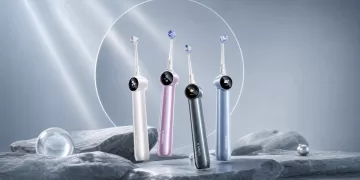





Conventional electric toothbrushes operate on a single principle: mechanical abrasion via bristle-to-enamel contact. While effective on accessible tooth surfaces, this mechanism encounters a fundamental geometric limitation — bristles cannot physically enter interdental spaces narrower than their own diameter.
Abstract
Conventional electric toothbrushes operate on a single principle: mechanical abrasion via bristle-to-enamel contact. While effective on accessible tooth surfaces, this mechanism encounters a fundamental geometric limitation — bristles cannot physically enter interdental spaces narrower than their own diameter. Given that over 80% of dental caries originate in these very spaces, the industry’s reliance on bristle-based cleaning represents a significant and unaddressed design constraint. AirJet 2.0 resolves this limitation by introducing a fluid-dynamic cleaning layer that operates independently of bristle contact, achieving Grade 1 cleaning efficiency while simultaneously enabling a low-frequency operating profile suitable for users requiring an electric toothbrush for gum care.
1. The Bristle Ceiling: A Category-Wide Design Limitation
To understand the significance of AirJet 2.0, one must first recognize the architectural constraint shared by all conventional electric toothbrush systems — sonic, oscillating-rotating, and magnetic-levitation alike.
A standard toothbrush bristle measures approximately 0.12 to 0.20 mm in diameter at its tip. An interdental space — the gap between adjacent teeth — can measure as narrow as 0.05 mm at the contact point and 0.10 mm at the gingival margin. The consequence is straightforward and inescapable: in any interdental space narrower than the bristle diameter of the brush in use, cleaning by mechanical contact cannot occur.
This is not a failure of motor power, vibration frequency, or brush head geometry. It is a first-principles limitation of the contact-cleaning paradigm itself. No amount of engineering optimization within that paradigm can overcome the geometric reality that a 0.15 mm bristle cannot enter a 0.10 mm gap.
Clinical data corroborates this analysis. Epidemiological studies consistently report that over 80% of carious lesions initiate in interproximal surfaces — precisely the sites where bristle access is geometrically excluded. The American Dental Association recognizes interdental cleaning as an essential component of oral hygiene for this reason, recommending adjunctive tools such as floss and interdental brushes that fewer than 30% of adults use daily and fewer than 12% use with correct technique.

The market has responded to this deficit with water flossers — devices that direct pressurized water streams into interdental spaces. While effective at debris displacement, water flossers operate on hydraulic force, delivering pressures that can cause discomfort in users with gingival sensitivity. More critically, they represent an additional device, an additional step, and an additional barrier to compliance.
AirJet 2.0 was developed to address this gap within a single, integrated brushing device — not by making bristles smaller, but by changing the cleaning medium entirely.
2. System Architecture: The AirJet 2.0 Platform
AirJet 2.0 comprises two integrated subsystems: the Boosted Bubble Chamber, housed within the toothbrush handle, and the Coanda Bubble Brush Head, the detachable end-effector that delivers bubble-infused fluid to the dentition.
2.1 Boosted Bubble Chamber
The Boosted Bubble Chamber is a dedicated pressurization and aeration cavity located in the proximal section of the AirJet X5 handle. During operation, the chamber draws in a metered water-toothpaste mixture and subjects it to controlled aeration under positive pressure. The process generates a continuous output stream of microbubbles — gas-in-liquid dispersions with bubble diameters in the range of 10 to 100 micrometers — suspended in the liquid phase.
Key performance parameters include:
- Maximum volumetric flow rate: 1,000 ml/min (Bubble and Whitening modes)
- Moderate flow rate: 800 ml/min (Clean mode)
- Minimum flow rate: 500 ml/min (Sensitive mode)
- Bubble size distribution: Optimized for cavitation-induced biofilm disruption and interproximal penetration
The microbubble population serves two functions. First, bubbles in the sub-100 μm range are geometrically capable of entering interdental spaces that exclude solid bristles. Second, upon reaching confined geometries — such as the narrow channels between teeth — these bubbles undergo spontaneous cavitation collapse, generating localized micro-jets with sufficient kinetic energy to disrupt plaque biofilm matrices without the thermal or mechanical trauma associated with macroscopic pressure systems.
2.2 Coanda Bubble Brush Head
The Coanda Bubble Brush Head is named for the Coanda effect — the tendency of a fluid jet to attach to and follow a convex surface. First documented by Romanian aerodynamicist Henri Coandă in 1910, the principle describes how a stream of fluid emerging from a nozzle will, under appropriate conditions, adhere to a nearby curved surface rather than continuing in a straight trajectory.
In the context of the AirJet X5, the Coanda effect is harnessed to direct bubble-laden fluid flow along the three-dimensional contours of the dentition. The brush head geometry incorporates a flow-channel surface profile that induces attachment of the microbubble stream to tooth surfaces. Once attached, the fluid follows anatomical curvature — flowing around the convex buccal and lingual surfaces, descending into the concave interproximal regions, and reaching subgingival margins — without requiring the user to employ any specialized brushing technique.
This represents a significant departure from conventional brush head design. In a traditional system, the user must manually position bristles at a 45° angle (the Bass technique) and direct the brush into each interdental space individually — a technique that fewer than one in five adults execute correctly according to clinical observation studies. The Coanda brush head automates fluid delivery along the correct anatomical path, independent of user skill.
3. Gum Protection Architecture
A defining characteristic of the AirJet 2.0 platform is that cleaning efficacy does not depend on high-frequency mechanical oscillation. This decoupling of cleaning from vibration intensity enables a gum-protective operating profile that would be incompatible with conventional bristle-dependent systems.
3.1 Low-Frequency Operating Envelope
The AirJet X5 operates within a frequency range of 15,600 to 21,600 strokes per minute (130 to 180 Hz) , depending on mode selection. This places the device in the lower quartile of electric toothbrush operating frequencies, significantly below the 31,000 to 62,000 strokes per minute typical of premium sonic brushes.
The rationale is grounded in periodontal biomechanics. Gingival tissue subjected to repeated mechanical perturbation responds with cumulative inflammatory changes that, over time, can contribute to recession of the gingival margin. Higher operating frequencies amplify both the number of perturbation events per brushing session and the difficulty of maintaining precise brush head positioning. At 40,000 strokes per minute, the brush head completes 667 oscillation cycles per second; a positional deviation of even 1–2 mm — within normal human motor variability — results in repeated impact events on soft tissue.
By operating at approximately half the frequency of high-end competitors while maintaining cleaning efficacy through the fluid-dynamic bubble mechanism, the AirJet X5 reduces cumulative mechanical loading on gingival tissue without compromising plaque removal outcomes.
3.2 12° Micro-Oscillating Sweep
The brush head sweep angle is constrained to 12 degrees of arc — approximately 40–60% of the sweep angle employed by leading oscillating-rotating systems (typically 20–30°). The narrower sweep confines bristle motion to a controlled zone centered on the target tooth surface, minimizing the probability of the brush head edge crossing the gingival margin during normal use.

3.3 Bristle Engineering
Each bristle filament on the AirJet X5 brush head features a tip diameter of 0.01 mm and a manufacturer-verified end-rounding rate of 99.99% . End-rounding — the process of smoothing the cut tip of each synthetic bristle filament into a hemispherical profile — is a critical quality parameter in brush head manufacturing. Unrounded or partially rounded bristle tips present sharp, irregular edges at the microscopic scale. Repeated contact between such edges and gingival epithelium produces cumulative microtrauma that contributes to inflammation and recession.
The 99.99% end-rounding rate — verified by microscopic batch inspection — represents a level of quality control that exceeds the industry norm by a substantial margin. Combined with the 0.01 mm tip diameter, the result is a bristle array that interacts with soft tissue with minimal abrasive potential.
3.4 Impact Damping
The brush head dorsal surface incorporates a thermoplastic elastomer (TPE) overmold layer that functions as a mechanical impedance mismatch. During incidental contact between the brush head back and non-target teeth — an occurrence inherent to all electric toothbrush use — the elastomer layer absorbs and dissipates kinetic energy that would otherwise be transmitted as a high-frequency impulse through enamel to the periodontal ligament. The subjective result is the elimination of the “chattering” sensation familiar to electric toothbrush users, with objective reduction in transmitted impact force.
4. Performance Data
4.1 Cleaning Efficacy
- Plaque removal rate: 97% (manufacturer-claimed, based on modified Bass technique protocol)
- Cleaning efficiency classification: Grade 1 (highest classification tier)
- Interproximal cleaning mechanism: Microbubble cavitation + Coanda-directed fluid flow
4.2 Operating Modes
| Mode | Frequency (strokes/min) | Flow Rate (ml/min) | Amplitude (mm) |
| Bubble | 15,600 (130 Hz) | 1,000 | 1.2–2.5 |
| Sensitive | 15,600 (130 Hz) | 500 | 3.0–4.5 |
| Clean | 21,600 (180 Hz) | 800 | 0.5–2.2 |
| Whitening | 18,500 (130/180 Hz) | 1,000 | 2.5–4.5 |
4.3 Physical Specifications
- Battery: 1,600 mAh lithium-ion (5.92 Wh)
- Operational endurance: Up to 39 days (twice-daily, two-minute sessions)
- Charging time: 6 hours (0–100%)
- Charging interface: USB-C (wired) + Qi-compatible wireless (via magnetic wall mount)
- Noise emission: ≤65 dB(A) across all modes
- Ingress protection: IPX7 (handle)
- Mass: 153 g (handle with brush head)
5. Hygiene Engineering
The AirJet X5 handle exterior is treated with a silicon carbide (SiC) anti-microbial coating that has received Grade 0 certification under GB/T 24128-2018 mold-resistance testing standards. Grade 0 represents the highest classification, indicating no mold growth observed under standardized accelerated-testing conditions.
The coating operates through a physical micro-structuring of the surface rather than through leachable chemical biocides, providing durable anti-microbial performance that does not diminish with use or cleaning.
The included magnetic wall mount integrates Qi-compatible wireless charging and positions the brush in free-air suspension, eliminating the standing-water accumulation at the brush-handle interface that characterizes conventional charging bases and represents a recognized vector for bacterial biofilm formation.
6. Conclusion
AirJet 2.0 represents a meaningful departure from the contact-cleaning paradigm that has defined electric toothbrush design for decades. By introducing a fluid-dynamic microbubble mechanism that operates independently of bristle penetration depth, the platform resolves the geometric interdental-access limitation inherent to all conventional bristle-based systems. Simultaneously, the decoupling of cleaning efficacy from vibration frequency enables a low-frequency, gum-protective operating profile that makes the AirJet X5 a technically grounded electric toothbrush for gum care — not as a marketing designation, but as an engineering outcome.
RANVOO holds 20 authorized patents across bubble-generation technology, brush head fluid dynamics, and anti-microbial material formulations. All performance data cited reflects manufacturer-stated specifications and internal testing protocols. Clinical results may vary based on individual brushing technique and frequency of use.

