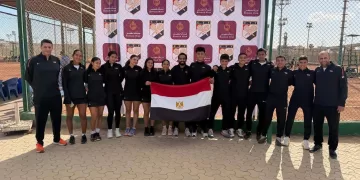






Rising stars redefining Egyptian tennis
The Egyptian junior tennis team has cemented its status as a rising powerhouse on the continent, clinching the overall shield at the African Junior Tennis Championships (J200).
Held at the Grand Plaza Club courts, near Cairo, with 14 African nations in attendance, the tournament showcased the depth of Egypt’s young talent.
Under the guidance of coaches Sherif Adel and Mahmoud Abdel-Mobdi, along with fitness coach Moamen El-Badry, the Pharaohs secured the top spot this past week by accumulating the highest total points across both singles and doubles categories.
The team’s victory was a collective effort, highlighted by Rahaf Mostafa’s impressive second-place finish in the girls’ singles.
Mostafa maintained her success in the doubles, taking second place alongside Sara Saad, while the duo Iyad Ezzat and Saif Samehmirrored that achievement in the boys’ doubles.
The podium was further crowded with Egyptian talent as Judy El-Tawil, Sara Saad, Marwan Ehab, and Yassin Wagih all secured crucial third and fourth-place finishes.
This consistent performance across the board ensured that the overall shield remained in Cairo, even as South Africa’s Jahini Vanzelland Nigeria’s Ogunskin claimed the individual singles titles.
Beyond the scores, the tournament served as a testament to the resilience of the Egyptian Tennis Federation.
When heavy rains threatened to cancel the event by damaging the clay courts, the Federation, in coordination with Grand Plaza Club officials and the tournament’s director,restored the surfaces in record time.
This logistical feat allowed all matches to proceed, earning praise from international delegations for maintaining court quality under pressure.
The presence of Federation President Ismail El-Shafei and Vice President Ayman Azmythroughout the matches further underscored the national commitment to nurturing these young athletes.
Strength and Conditioning Coach of the Egyptian national team Moamen El-Badry said this victory is the result of a highly structured, professional approach to junior development.
“The competition was intense, lasting five consecutive days,” El-Badry told The Egyptian Gazette.
Each junior player, he added, now operates with a dedicated support team, including a personal fitness coach, mental coach, and nutritionist.
“Every athlete undergoes a rigorous preseason training phase to master essential physical conditioning and skills before they step onto the court for a major tournament,” El-Badrysaid.
He referred to the team’s mental toughness during the weather crisis.
Even when stormy weather forced the courts to close, El-Badry said, the players remained focused, adapting to training in confined spaces to maintain their momentum.
El-Badry also confirmed that while injuries did occur, the staff was responsible for the daily recovery and conditioning of 12 players, a task he described as “difficult”, but “essential”, given the back-to-back match schedule.
“The spirit of Egyptian juniors remained incredibly high throughout the ordeal,” El-Badry said, noting that they were ready to compete under any circumstances.
El-Badry said this is only the beginning of what he described as a “new era” for the sport in Egypt.
He revealed that the Egyptian Tennis Federation has established a comprehensive year-round tournament plan to prepare players for international stages beyond the African continent.
The success seen in the last five years, specifically with players like Mohamed Genedy, he said, proves that Egyptian juniors can reach elite global levels.
El-Badry noted that his primary advice to clubs and the federation is to maintain this unwavering focus on the junior ranks.
“These junior ranks are the true future of the game,” El-Badry said. “They are the key to Egypt eventually dominating the international tennis circuit.”
He unveiled plans by the Federation to organize specialized courses for coaches, expecting them to improve the overall quality of the sport nationwide.

