





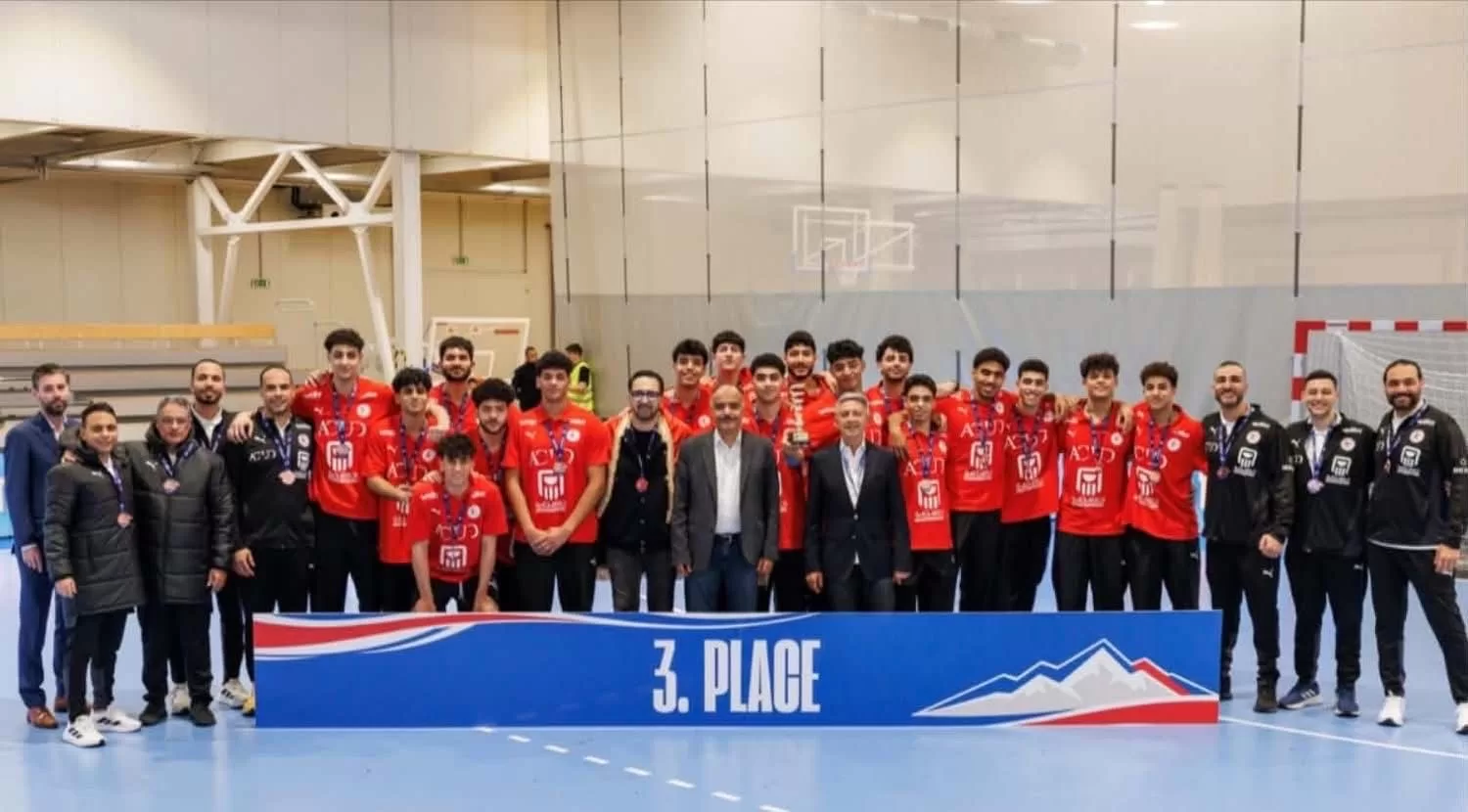
Fresh off a high-stakes campaign in Slovakia, the Egyptian 2008-born National Handball Team has officially solidified its place as a rising power in the sport.
The young Pharaohs’ bronze medal win in the Mediterranean Handball Championship last week serves as a podium finish. It is also a clear declaration of the talent within Egypt’s youth ranks.
For the Egyptian Handball Federation (EHF), this victory concludes a successful European tour while simultaneously launching the long-term preparation phase for the upcoming African Championship and the next World Cup.
Success in Slovakia
The journey to the bronze medal was defined by a series of high-intensity matches that showcased the tactical maturity of the Egyptian squad.
The Pharaohs began their campaign with an explosive 34–12 victory over Greece, followed by a hard-fought 25–23 win against Macedonia.
Their momentum only grew as they moved through the group stages, overwhelming Kosovo 32–9, Montenegro 26–15, and Romania 22–14.
The team’s only setback came during a razor-thin 24–26 loss to Spain in the semi-finals. Despite the defeat, the match was widely praised by technical observers, as the Egyptian players pushed the Spanish Matadors to their limit.
The squad showed immense psychological resilience by rebounding quickly for the third-place play-off.
In that final game, the Pharaohs utilised a disciplined defensive wall and a fast-break offense to defeat the host nation, Slovakia, securing their place on the podium and ending the tournament on a high note.
Vision
EHF President Khaled Fathi was among the first to greet the delegation upon their arrival in Cairo.
In his official statement, he praised the players for their fighting spirit and discipline, noting that this generation represents the future of the sport in Egypt.
However, he was quick to point out that the Mediterranean bronze is not the final destination.
“Winning the Mediterranean bronze medal is just the beginning of a long journey,” Fathi stated.
“We prepare them to win the African Championship and be top-tier contenders in the World Championships. We treated this tournament in Slovakia as a vital preparation phase to expose our players to European playing styles, ensuring they are ready for the pressure of global competition,” he added.
EHF board member and head of the delegation in Slovakia, Dr Amr El-Adl, expressed similar sentiments.
He revealed that while the team had originally set their sights on the gold medal, the experience gained was worth its weight in gold.
The federation, he said, provides every possible resource to ensure this generation transitions successfully into elite international ranks, mirroring the success of the senior national team.
Individual talent
The excellence of the Egyptian handball system was further confirmed by the individual accolades handed out at the end of the tournament.
Two Egyptian stars were selected for the Mediterranean Games All-Star Team, proving that Egypt is producing some of the finest young talent in the world.
Zain Abdel Warith was honoured as the Best Playmaker for his exceptional vision and his ability to orchestrate the team’s offense under pressure.
Meanwhile, Youssef Amr was crowned the Best Right Back for his consistent scoring ability and his defensive contributions.
These individual honours, combined with the team’s collective success, highlight the deep pool of talent available to the coaching staff as they look towardsfuture rosters.
Bright future
The success of the 2008 generation is a testament to the leadership of Head Coach Mohamed Ibrahim, specialists said.
Ibrahim expressed immense pride in his players, noting that they lived up to the responsibility placed on them by the federation and the fans.
This group, he said, already has a history of success, having previously secured a silver medal at the last World Championship, which further cements their status as a Golden Generation.
Ibrahim explained that the handball system in Egypt moves in the right direction, thanks to the continuous support of the federation leadership, including Captain Moamen Safa and President Khaled Fathi.
The focus remains on creating a sustainable pipeline of talent that can maintain Egypt’s position at the pinnacle of African handball, while closing the gap with the world’s leading European teams, Ibrahim said.
Preparations
As the players return to their local clubs and training camps, the focus pivots immediately to the 2026-2027 international calendar.
The EHF has designed a rigorous roadmap that includes several international friendlies and specialized training camps to build on the lessons learned in Slovakia.
The upcoming African Championship serves as the next major hurdle, where Egypt will look to assert its continental dominance, Fathi said.
Beyond that, he added, the ultimate target remains the World Cup.
He noted that the technical staff believes that by consistently competing against high-level opponents, such as the ones faced in the Mediterranean Games, the 2008 generation will be physically and mentally prepared to challenge for the world title.
This achievement is a reminder of the steady progress Egyptian handball has made over the last decade.
By focusing on youth development and international exposure, the federation has ensured that the national team remains a source of pride for the country.
The Mediterranean bronze medal is a symbol of this progress, but for the players and coaching staff, it is also a reminder of the work that still needs to be done.
With the combined efforts of the players’ dedication, the coaching staff’s tactical expertise, and the federation’s strategic planning, the path towards the African and World titles looks more promising than ever.
“For the 2008 Pharaohs, the journey has only just begun,” Fathi said.

