


By Mohamed Attia
The Holding Company for Airports and Air Navigation has reaffirmed its commitment to building smart, sustainable airport infrastructure, as part of a wider digital transformation strategy aligned with global aviation standards.
Speaking during the 7th edition of the Future of Digital Countries (FDC) Summit, held under the auspices of Egypt’s Ministry of Communications and Information Technology at the Egypt International Exhibition Center, Chairman Eng. Ayman Fawzy Arab said the company is determined to integrate cutting-edge operational technologies, artificial intelligence, cloud computing, and enhanced cybersecurity to boost efficiency and ensure long-term sustainability.
Participating in a panel discussion titled “Digital Runway: Securing Aviation Infrastructure for a Safer Future,” Arab noted that digital transformation is being rolled out across both administrative and operational levels of Egypt’s airports.
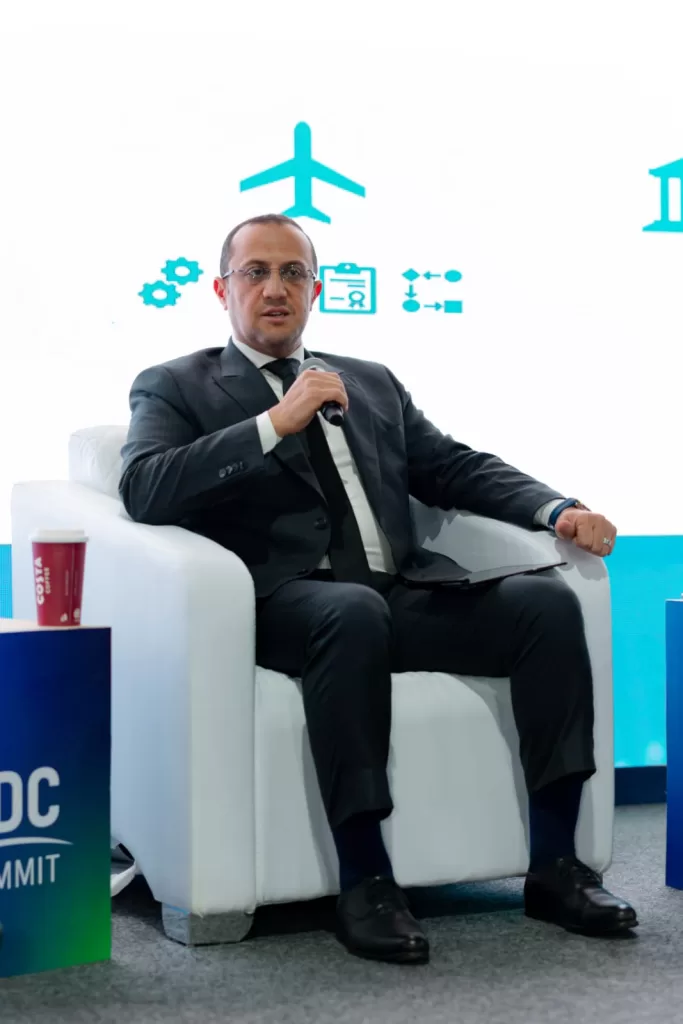
“We are working toward a paperless office environment through digital archiving, while modernising airport systems and operations — including infrastructure, equipment, and cybersecurity,” Arab said. “Our goal is to achieve global benchmarks in operational efficiency while reducing environmental impact.”
He added that the company has drawn up a clear roadmap for document management across airports and subsidiaries in preparation for a significant reduction in paper usage. This transformation includes the implementation of smart systems such as biometric gates using facial or fingerprint recognition, which require coordination with multiple government entities including passport control and civil registry offices.
Describing airports as “miniature cities,” Arab stressed the complexity of deploying integrated digital systems in such dynamic and security-sensitive environments.
In a presentation following the panel, Arab outlined the company’s vision for developing next-generation smart airports that offer seamless technological integration, high performance, and low energy consumption. A key highlight of this plan is the construction of Terminal 4 at Cairo International Airport, which is set to become the region’s first carbon-neutral, eco-friendly terminal.
“We aim to turn Cairo Airport into a preferred hub for transit passengers,” Arab said, noting that the new terminal will benefit from lessons learned at Borg El Arab Airport, which has pioneered the use of electric ground service equipment.
The summit appearance aligns with directives from Civil Aviation Minister Sameh El Hefny, who has prioritised digitalisation and innovation as key pillars in Egypt’s aviation sector strategy, in line with the country’s broader vision for a modern and sustainable future.

