



The geopolitical clock in the Middle East has entered a frantic “red zone”. The US and Iran are locked in a high-stakes game of chicken, where the price of miscalculation is no longer measured in diplomatic cables, but in carrier strike groups and ballistic trajectories.
With President Donald Trump’s self-imposed 10 to 15-day ultimatum nearing its midpoint, the region stands at its most dangerous crossroads since the 1979 Revolution.
The strategic context in the region is defined by a massive, purposeful “surge” of American hardware.
The arrival of the USS Gerald R. Ford, the world’s largest aircraft carrier to the Eastern Mediterranean to join the USS Abraham Lincoln is not merely a rotation of assets.
Combined with over 100 aerial refuelling tankers and specialised electronic warfare aircraft, the Pentagon has established the infrastructure for a sustained, high-intensity air campaign.
Former Marine Captain Matthew Hoh notes that this build-up is “not for show”. The sheer volume of command-and-control assets suggests a plan that extends far beyond a symbolic “pinprick” strike.
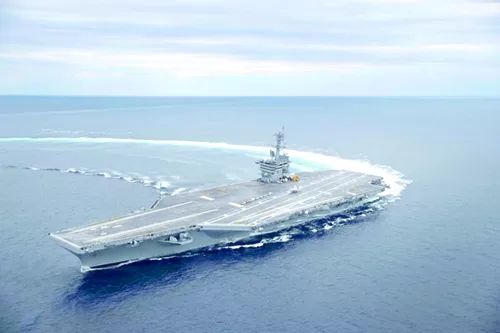
Washington’s objective is clear: use the credible threat of regime-toppling force to extract a permanent end to Iran’s nuclear enrichment.
From strikes to “total war”
While the White House maintains that “only President Trump knows what he will do”, military planners and regional analysts see three distinct paths: a limited attack on military sites or government buildings to shock Tehran back to the negotiating table, a multi-week operation, involving Israel to dismantle the Fordow and Natanz enrichment sites, and the targeting of the Islamic Revolutionary Guard Corps (IRGC) to leverage the domestic instability seen in Iran’s recent anti-regime protests.
Regional, global shockwaves
The fallout of a kinetic exchange would immediately spill over Iran’s borders.
Tehran has already signalled its “active defence” by conducting live-fire drills with Russia in the Strait of Hormuz.
Brent crude has already spiked past $71/barrel on the mere rumour of a strike. A sustained conflict could see prices hit $120, triggering a global inflationary wave that would destabilise the EU and emerging markets.
While groups like Hezbollah and the Houthis have been battered by recent regional shifts, their ability to target US bases in Qatar and Kuwait or launch “swarm” attacks on shipping remains a potent deterrent.
Israel is no longer a silent partner. With over 200 combat aircraft on standby, Israel is prepared for a “joint strike”, a move that would almost certainly invite direct Iranian missile retaliation on Israeli urban centres.
“Deal” vs. “deep state”
The paradox of the current crisis is that both sides claim to want a “fast deal”. Iranian Foreign Minister Abbas Araghchi has promised a draft agreement within 48 hours.
However, the gap remains wide. Washington demands a total end to enrichment and the dismantling of the “Axis of Resistance”. Tehran, still reeling from the 2018 US withdrawal from the previous nuclear pact, views “zero enrichment” as surrender of national sovereignty.
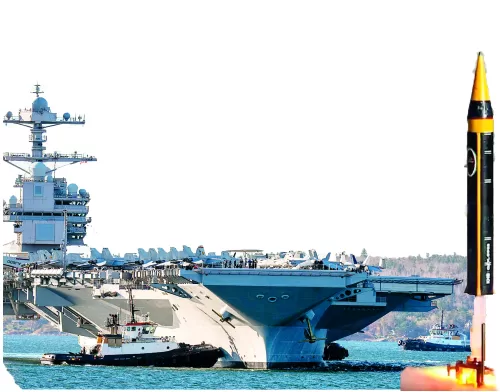
Domestic pressures are the “X-factor”. In Washington, the “Board of Peace” meeting reflects a president who wants a legacy-defining bargain. In Tehran, the Supreme Leader faces a population that recently flooded the streets in protest. A war might serve as a tool for internal repression, or it could be the final spark that ignites a revolution.
Plausible trajectory
The most likely outcome in the coming 72 hours is a final, frantic diplomatic push centred on the “Witkoff-Araghchi” channel.
However, the movement of the USS Gerald R. Ford into striking range by Monday suggests that if a breakthrough is not reached by early next week, we are likely to see a “demonstration of force” in the form of a limited strike intended to prove that the 10-day clock was never a bluff.
The world is no longer watching for a deal. It is rather watching the horizon for the first signs of an afterburner.
Mohamed Fahmy is the editor-in-chief of The Egyptian Gazette and
Egyptian Mail newspapers

