






By Ahmed Sallam
On January 26, 1880, in the heart of Alexandria, The Egyptian Gazette was launched, marking the birth of the first English-language daily newspaper in Egypt and the Middle East. Founded by five British expatriates and led by its first editor, Andrew Philip, the publication began as a four-page weekly. It soon evolved into a daily, eventually relocating to Cairo in 1898 to be closer to the nation’s centres of power.
From its inception, the Gazette played a pivotal role in projecting Egypt’s image to the West. Staffed by prominent British journalists and correspondents, it earned a prestigious status among diplomatic circles and foreign communities. Its historical significance is rooted in two primary roles: first, as a pillar of diplomatic documentation, serving as the premier source for foreigners to understand Egyptian affairs; and second, as a mirror of cultural diversity. Particularly prior to the 1952 July Revolution, the paper reflected the cosmopolitan nature of Egyptian society, serving both foreign residents and the Egyptian intelligentsia.
In today’s digital age, one might question the relevance of an English print newspaper in Egypt. The answer lies in its historical credibility. The Egyptian Gazette does not merely report news; it transmits the official and elite Egyptian perspective to the international arena, addressing tourists, investors, academic researchers, and foreign embassies. Its survival for nearly a century and a half is a testament to the resilience of Egyptian press institutions and their ability to adapt to global political shifts.
A witness to seismic events
The pages of the Gazette have documented monumental events that shaped international public opinion, including:
The Denshawai incident (1906): Coverage reflected the profound tension between British colonial authorities and the Egyptian people, serving as a primary reference for foreign correspondents.
The 1919 Revolution: Editorials sought to balance British policy with the fervor of Egyptian popular uprising, providing modern historians with a rich look into the British administrative mindset of the era.
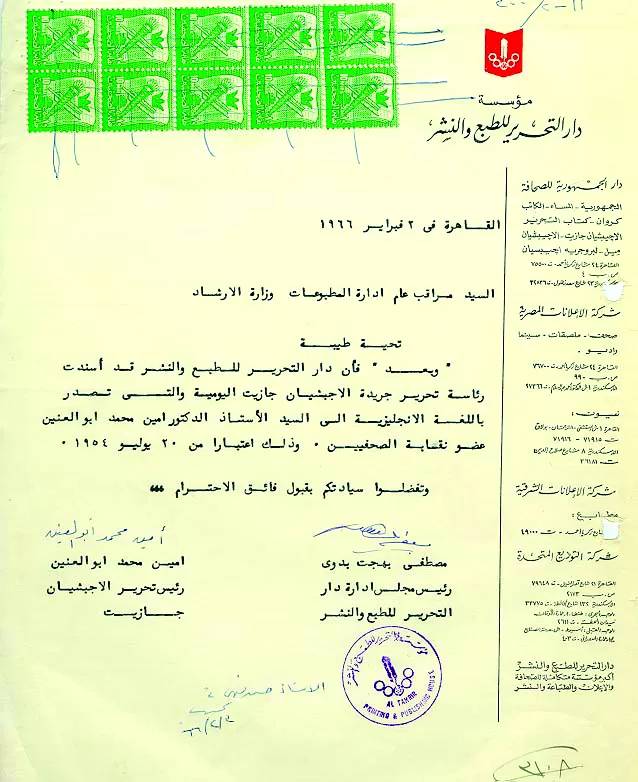
Following the 1952 Revolution, the newspaper underwent a transformative shift with its Egyptianisation in 1954. Ownership transferred to the ‘Dar Al-Tahrir for Printing and Publishing,’ turning the paper into the English-language voice of the Egyptian state. It remained a witness to the nation’s major transitions, continuing through the post-June 2013 era and the founding of the modern national state.
Inside the living archive
Recently, I had the exceptional opportunity to visit the headquarters of this venerable newspaper and examine its priceless paper archives. Browsing these yellowed pages was not merely an act of reading; it was a direct encounter with history written in the collective ink of the state and society.
The preserved files contain more than just news reports. They house official correspondence, publishing permits, and letters exchanged between the newspaper’s management and government departments most notably the Ministry of Interior and the Press Department. Here, the superficial notion of an “alien” newspaper vanishes, replaced by the reality of a publication deeply embedded within the fabric of the Egyptian state, governed by its laws and documenting its daily pulse.
The archive reveals a period when the Egyptian press spoke to a global audience in both English and French, expressing a civilisation where Cairo and Alexandria were cultural crossroads between Europe, Asia, and Africa. Notably, the value of this archive extends to international relations. My research into the coverage of China since the 1950s revealed meticulous, professional reporting on the rise of the People’s Republic. It documents Egypt’s role as the first Arab and African nation to recognise the New China, proving the Gazette was an Egyptian window to the world, not just a passive recipient of foreign news.
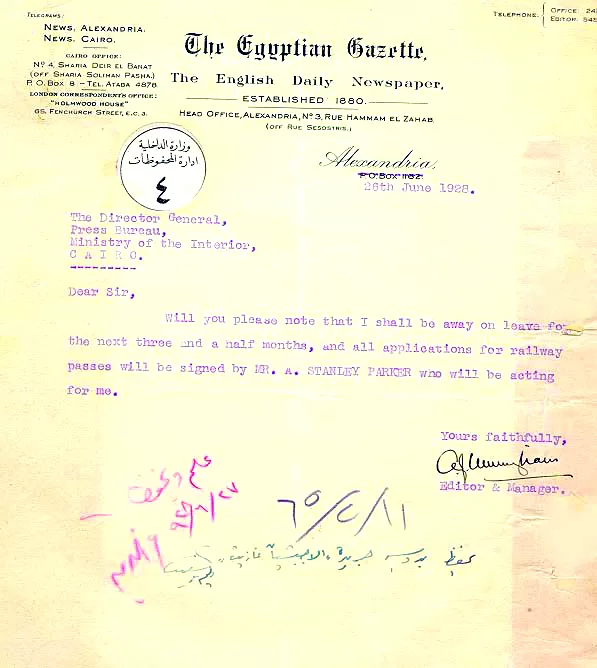
Digitising national memory
The experience was a journey through time, holding reports of the Orabi Revolt, the inauguration of major national projects, and the details of a social life defined by coexistence. The Egyptian Gazette was not just a news carrier; it was a shaper of foreign opinion and a cultural bridge spanning from the era of Khedive Tawfiq to the New Republic.
However, my visit also revealed a looming threat. These documents, carrying 150 years of history, are endangered by time and humidity. Preserving this heritage is not a cultural luxury; it is a national duty to ensure future generations can access their history from original sources.
I call for a national project to digitise The Egyptian Gazette, modeled after the successful digitisation of the “Egypt Cinematic Journal” by the State Information Service. Converting these issues since 1880 into a searchable, interactive digital archive will ensure that Egypt’s bright window to the world never closes.
Ahmed Sallam is a former undersecretary of the State Information Service and member of the Egyptian Council for Foreign Affairs

