



Dr Catherine Faragallah
Specialist in International Relations
At a highly sensitive regional moment, the visit of Egyptian Prime Minister Dr Moustafa Madbouli to Lebanon came to reaffirm the constants of Egypt’s policy towards the Lebanese state and to consolidate Cairo’s role as a key pillar of regional stability. The visit underscores Egypt’s diplomatic efforts aimed at defusing crises in the region and halting escalation, foremost among them the repeated Israeli escalation on the Lebanese arena.
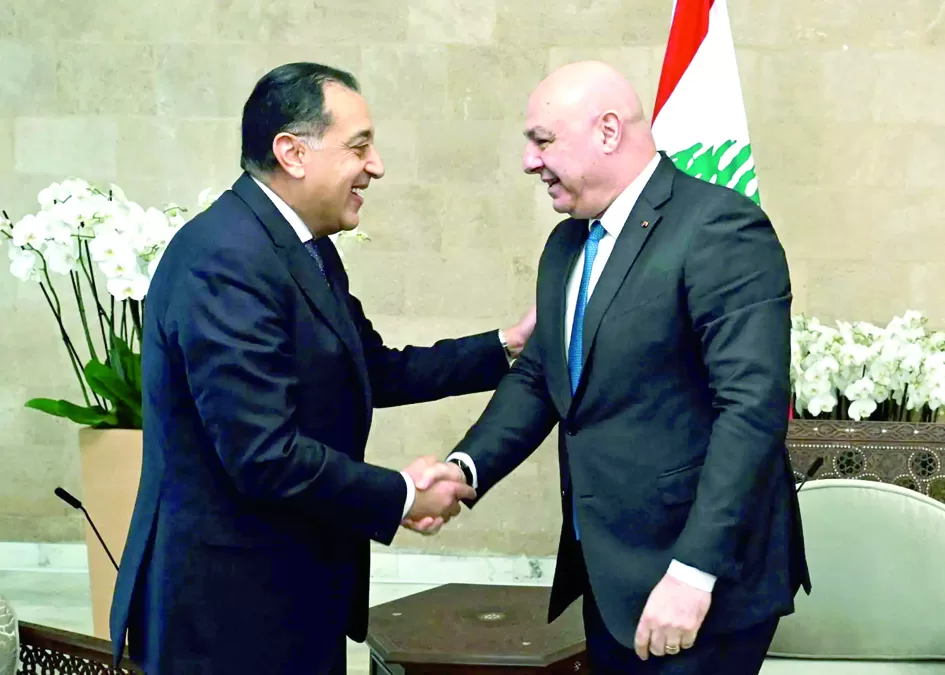
The visit carries important political implications, as it reflects Egypt’s keenness to support Lebanese state institutions and preserve Lebanon’s sovereignty and territorial unity, amid complex security and economic challenges facing the country. It also conveys the message that Lebanon’s stability is an integral part of Arab national security, and that any threat to its security negatively impacts the entire region. This aligns with Egypt’s broader efforts to safeguard Arab national security and uphold the sovereignty of Arab states.
During his meetings with senior Lebanese officials, the Prime Minister emphasised Egypt’s firm and unwavering position in support of Lebanon – state and people – and highlighted the importance of strengthening joint Arab action to confront current challenges. Egypt also reiterated its categorical rejection of any Israeli attacks on Lebanese territory, warning of the grave dangers of expanding the circle of conflict and the serious regional and humanitarian repercussions that could result.
Egyptian efforts towards Lebanon come within the framework of a balanced diplomatic approach based on de-escalation and adherence to international law and international legitimacy resolutions, foremost among them respect for state sovereignty and non-interference in internal affairs. Egypt has intensified its contacts with key regional and international actors in an effort to halt Israeli escalation and prevent the situation from sliding into an open confrontation that would threaten the security and stability of the region.
The visit also included economic and humanitarian dimensions, as Egypt affirmed its readiness to support Lebanon’s path towards economic recovery, exchange expertise, and enhance co-operation in the fields of energy and reconstruction. Such cooperation would help alleviate the burdens on the Lebanese people, who continue to bear the heavy cost of accumulated crises and ongoing conflicts.
Dr Moustafa Madbouli’s visit to Beirut reflects the continuity of Egypt’s historic role in supporting Arab causes and confirms that Cairo consistently places the interests and stability of Arab peoples at the top of its priorities. In light of the current Israeli escalation, Egypt stands out as a trusted mediator with a balanced political vision, seeking to protect Lebanon from the specter of war and to entrench a path of de-escalation and political solutions.
The visit sends a clear message that Egypt will remain a steadfast supporter of Lebanon and a diplomatic bulwark against attempts to undermine its stability, and that it will continue its efforts to stop Israeli escalation, firmly believing that peace and stability are the only viable options capable of saving the region from further chaos and suffering.
These diplomatic efforts come at a time when Lebanon stands on the brink of an unprecedented crisis. The country faces a severe test of its institutions’ ability to assert state authority and protect civil peace, amid strenuous international efforts to contain escalation and control the borders. This is taking place as the Lebanese state’s options appear limited in the face of intertwined regional and international power balances – particularly in light of an unprecedented Israeli escalation and the looming prospect of war, as the deadline set by US President Donald Trump approaches for confining weapons exclusively to the hands of the state.
This comes amid Hezbollah’s insistence on retaining its weapons and the continuation of Israeli escalation, which could at any moment turn into a direct confrontation, given the ongoing strikes on the northern and southern borders and the growing internal political tensions. Among the international efforts in this context are those led by France, which hosted an international conference in Paris to support the Lebanese Army and contain armed manifestations, and formed a trilateral working group to prepare for an international conference to support the Lebanese Armed Forces and Internal Security Forces in February 2026.
Despite these Egyptian and international efforts, Israeli media report that the Israeli army has completed plans to launch a wide-scale attack against Hezbollah-affiliated sites should the Lebanese government and army fail to fulfill their commitments to dismantle the group’s weapons before the end of the current year.

