








Islam Made Simple
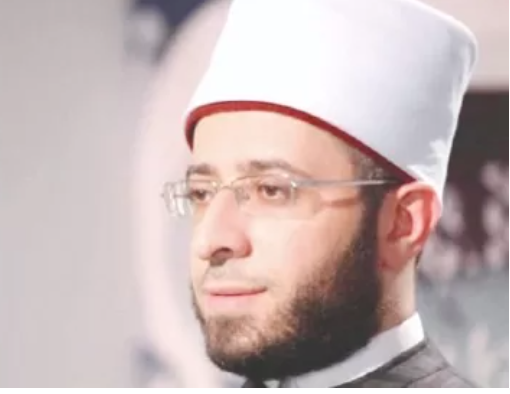
Dr Osama Al-Azhari, Minister of Awqaf (Charitable Endowments)
Ladies and gentlemen, esteemed readers in Egypt and across the Arab and Muslim world, welcome to a new journey with the Ever-Glorious Qur’an. Here we dive into the depths of the sixteenth part of the Ever-Glorious Qur’an, drawing pearls from its treasures, guidance from its lights, and timeless values and principles from its eloquent discourse that Allah Almighty has embedded within it.
Today I have selected for you some lessons and verses from this magnificent part, by which we are illuminated in the darkness of life, and by which we are guided on the paths of goodness and truth. Within it are delicate meanings and wisdom, precise divine indications, elevated meanings, and moral and educational treasures worthy of contemplation and reflection.
The first Reflection we pause at is in the noble verse: “They said, “O Thul Qarnayn! Surely Ya’juj and M’ajuj are corruptors in the earth; so shall we make for you a tribute on condition that you make a barrier between us and them?” (Literally: between us and between them), He said, “That wherein my Lord has established me is more charitable; (i.e., what I have from my lord is better than your tribute) so help me with (your) power, so that I will make up a rampart between you and between them.” [Qur’an 18: 94-95]
You are of course familiar with the context of these verses, as we recite Surah al-Kahf every Friday, and we know the story of Thul Qarnayn, the great traveller to whom Allah granted the means that enabled him to establish himself on earth. He traversed its regions and dealt with civilisations and peoples. He was possessed of great knowledge and experience, and was a righteous servant beloved by Allah.
He journeyed until he reached a people living between two mountains, who were suffering from the corruption of Gog and Ma’gug. They sought his help, and he replied: “So help me with (your) power.” Here we pause at the word “power”. Then we leave Surah al-Kahf and advance to Surah Maryam, where we find the saying of Allah to our master Yahya (PBUH): “O Yahya, (John) take the Book powerfully.” [Qur’an 19: 12].
Notice the verbal similarity between the two verses: “»o help me with (your) power,” and “take the Book powerfully.” But what is the difference between these two types of power?
The first type of power is material and tangible encompassing industry, technology, and practical expertise. This is what occurred when they prepared iron, melted copper, and constructed the fortification. It is a power necessary for the building and protection of nations.
The second type is intellectual and scientific, linked to the Book: “Take the Book powerfully.” It means take knowledge with diligence, effort, and consciousness. We desire for Egypt and for our Arab and Muslim nations both types of strength: the material and the intellectual.
It is noteworthy that our illustrious teacher, Sheikh Rifa’a al-Tahtawi, made this verse a pedagogical motto that the Egyptian Ministry of Education once upheld. He wrote: “Seek knowledge and read, and you shall gain the honour of prophethood, for Allah said to Yahya: take the Book powerfully.”
The second Reflection in this part is at the beginning of Surah Maryam, is in the Noble verse: “He said, “Lord! Make for me (some) sign.” He said, “Your sign is that you shall not speak to (any of) mankind, though being in perfect shape, (i.e. being without fault, or defect; literally: in “perfect” mold) three nights.” [Qur’an 19: 10].
Our master Zakariyya (PBUH) refrained from speech not due to illness or disease, but while he was sound and healthy so this abstention became a sign and a miracle. Then Allah says: “So he went out to his people from the Chamber, then he signified (Literally: revealed) to them, “Extol (your Lord) before sunrise and at nightfall.” [Qur’an 19: 11].
Consider the wording: “he went out to his people,” rather than “he went to his people.” What is the significance of this distinction?
The preposition “to” suggests a routine or ordinary movement towards others. In contrast, “went out” conveys a more emphatic and noteworthy emergence, implying prominence, distinction, and a heightened sense of presence or visibility.
As Allah said regarding Qur’an: “So he went out to his people in his adornment.” [Qur’an 28: 79] And regarding Yusuf (PBUH): “So, as soon as they saw him, they were greatly (amazed) at him and cut their hands severely (The Arabic verb form implies something done repeatedly or to a high degree or great extent) and said,” Allah forbid! (i.e. Allah forbid that Yûsuf could have ever solicited her!) In no way is this a mortal; decidedly this is nothing else except an honourable angel.” 32. She said, “Then that is (the affair) you blamed me for; and indeed I readily solicited him, yet he safeguarded (his chastity); and indeed in case he does not (perform) what I command him, indeed he will definitely be imprisoned, and indeed he will (really) be of the ones belittled.” [Qur’an 12: 31-32]
In this context, the expression “Go out to them” is understood to indicate an emergence marked by grace, dignity, and authority. Similarly, the emergence of Zakariya (PBUH) is presented as both miraculous and dignified, which is reflected in the wording: “So he went out to his people.” This illustrates a subtle and elevated rhetorical lesson, within a magnificent language that is the key to understanding the Ever-Glorious Qur’an and a safeguard against atheism and deviation.
We now move to a third reflection in this blessed part, the words of our master ‘Isa (PBUH) as he spoke in the cradle: “He said, “Surely I am the bondman of Allah. He has brought me the Book and made me a Prophet. 31. And He has made me blessed wherever I may be, and He has enjoined upon me prayer and Zakat as long as I am alive.” [Qur’an 19: 30-31].
Reflect on the verse: ‘And He has made me blessed wherever I may be.’ It is truly remarkable for a person to carry blessings and to be blessed wherever he goes. It is a noble station and a lofty aspiration! When you enter a house, bring blessing to it. When you visit a land, light becomes widespread in it. When you sit in an assembly, tranquillity and peace are spread within it.
Do not be a source of misery to people; rather, be a healer, kind, and a reconciler. I recall that during a journey to Australia, I supplicated: “O Allah, make me blessed wherever I am.” One of the brothers there later told me how deeply affected he was by this supplication, and how it remained engraved in his heart.
The next reflection with the words of Allah: “Surely the ones who have believed and done deeds of righteousness, for them The All-Merciful will soon show (Literally: make for them) affection.” [Qur’an 19: 96] What a magnificent verse! That Allah grants a servant acceptance among people that people love you, rejoice in your company, and bear deep affection for you in their hearts.
This corresponds with Allah’s words to Musa (PBUH): “And I cast on you belovedness from Me, and to be worked out under My Eye (i.e., to be chosen for my Revelation).” [Qur’an 20: 39] It is also affirmed in the authentic hadith narrated by al-Bukhari and Muslim, in which the Prophet (PBUH) said: “If Allah loves a servant, He calls upon Gabriel, saying, ‘O Gabriel, surely I love so-and-so, so love him.’ Then Gabriel loves him, and he proclaims in the heaven, ‘Surely Allah loves so-and-so, so love him.’ Then the inhabitants of the heaven love him, and acceptance is granted for him on earth.”
In conclusion, we ask Allah Almighty to grant us true affection and love, to cast His love upon us, and to make us beloved in the heavens and on earth.
Until we meet again, stay noble; stay safe.

