


Pearls and Coral: Treasures from the Qur’an (2)
By Dr Osama Al-Azhari
Minister of Awqaf (Charitable Endowments)
To the esteemed readers in Egypt, Arab and Muslim nations, to every human, and to every atom in this universe: May you be divinely blessed with all goodness, your souls with serenity, and your minds with enlightened understanding.
Welcome to a new exploration of the Ever-Glorious Qur’an. In this journey, we are going to seek the pearls of wisdom and profound lessons embedded in the sacred text, beginning with the second part of the Qur’an.

Reflecting on the verses of Allah, the Almighty and Exalted, unveils the magnificence of the Ever-Glorious Qur’an in its eloquence, structure, legislation, and profound values. In every verse, there is what invites you to extract a ruling, and a piece of advice, and to reflect and contemplate.
As we delve into this part of the Qur’an, we encounter a variety of important matters and noble values. This part begins with the change of the Qiblah (prayer’s direction), then moves on to Allah’s honour which he bestowed upon us through sending a noble Prophet, whom Allah taught the Book and wisdom. It also encompasses a range of higher objectives, including cultivating and developing the earth, then proceeds to the verses on fasting, and further includes the rulings of Hajj (pilgrimage), before turning to the rulings on alimony, divorce, menstruation, and breastfeeding.
The second juz’ (part) concludes with the story of Saul (ṭālūṭ). All of this unfolds with perfect harmony in composition, smooth transitions, and a rich density of meanings and values from which those who seek guidance and right direction, and those who yearn to learn and gain certainty, may continually draw. I ask Allah to make me and the noble reader among them.
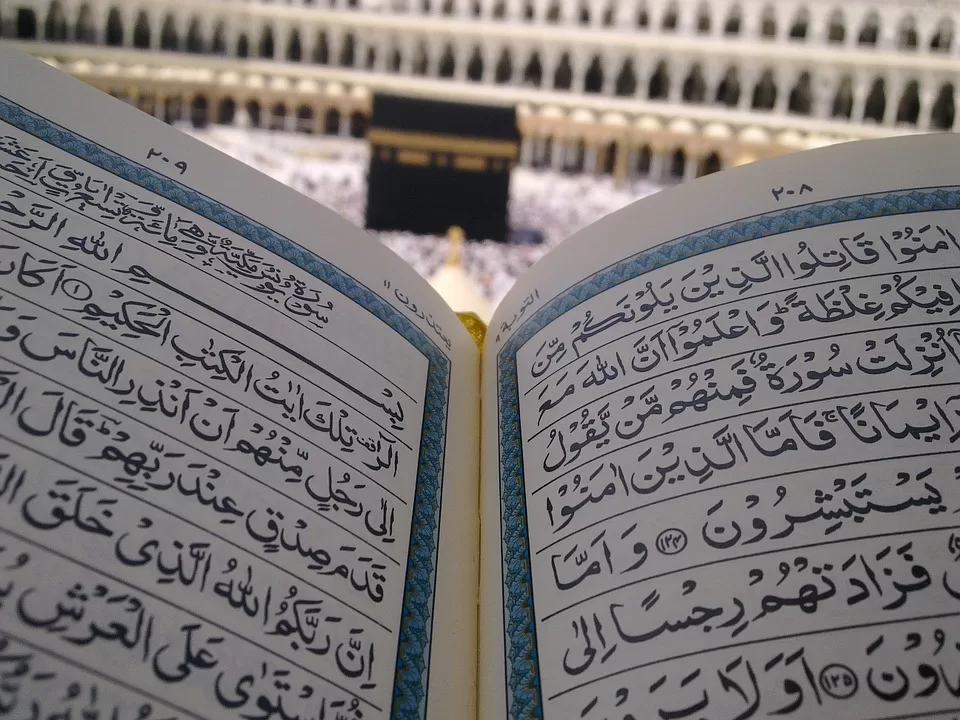
Our first point of reflection in the second part of the Qur’an is a semantic, preaching-oriented, and intellectual one. It is about the words of Allah, Almighty and Exalted: “And thus We have made you a middle nation.” [Qur’an 2: 143]. This verse indicates that the Muhammadan ummah (nation; specifically, the true followers of Prophet Muhammad) is a community of moderation and balance, rejecting both extremism and takfīr (labeling someone a disbeliever). This single phrase represents the slogan and the core identity of the Muhammadan ummah and constitutes as a strong safeguard against the forces of terrorism and extremism, which have plagued the community since the time of the Khawārij (Kharijites) and continue to affect modern radical movements. These values – rooted in justice, balance, and mercy – are among the supreme values that characterize Islam and by which the Qur’an responds to its opponents and those who repeatedly seek to distort the image of Islam, to tamper with its message, to attack its followers, and to abuse its sacred symbols.
It is worth noting that the building of this “middle nation” is achieved through knowledge, the Qur’an, and wisdom. Allah- Almighty- says: “Just as We have sent among you a Messenger of yourselves, to recite Our ayat (Signs, verses) to you, and to cleanse you, and to teach you the Book and (the) Wisdom, and to teach you that which you did not know.” [Qur’an 2: 151]. It is crucial to understand the meaning of ‘the Book.’ Allah – Almighty – commands: “O Yahya, (John) take the Book powerfully.” [Qur’an19: 12]. Moreover, the very first revelation of the Qur’an was: “Read: In the Name of your Lord Who created;” [Qur’an 96: 1], affirming that ‘the Book’ refers to knowledge, understanding, light, and guidance. Therefore, scholars always emphasise the importance of seeking knowledge, as Sheikh Rifā’ah al-Ṭahṭāwī beautifully stated:
Learn wisdom, read, and rise in honoured grace,
To share the pride of prophets’ sacred place.
For God proclaimed to John in words of might:
“Hold fast the Book, and grasp it with your full strength.”
However, knowledge alone is not enough! It must be paired with the remembrance of Allah. Allah, Almighty and Exalted, says immediately thereafter: “So, remember Me, (and) I will remember you; and give thanks to Me; and do not disbelieve Me.” [Qur’an 2:152]. Thus, the “nation of moderation” is built upon knowledge, the Book, wisdom, and the constant remembrance of Allah. This is how they become contributing to every noble value and achievement in this world.
Now, I draw the reader’s attention to the second point of reflection in this part, which highlights the blessings of Allah -Almighty- upon His servants in facilitating their work, sustenance, and well-being. Allah says: “Surely in the creation of the heavens and the earth and the alternation of the night and the day-time, and the ships that run in the sea with whatever profits mankind, and whatever water Allah sends down from the heaven – so therewith He gives life to the earth after its death and disseminates therein all kinds of beast – and the (constant) turning about of the winds, and the clouds subjected between the heaven and the earth, (these) are indeed signs for people who consider.” [Qur’an 2: 164].
Here the Qur’an highlights the benefits of the ships that sail the seas for what benefits people. It contains deep wisdom and secrets concerning urban development, trade, and economy. The seas link nations to one another and transport goods and resources from one place to another, thereby contributing to the flourishing of commerce and the rise of civilizations.
Modern science likewise bears witness to the virtually limitless capacities of seas and oceans in generating resources, providing abundant food, producing energy, extracting wealth, and other divine gifts embedded in these creations. Today, we even read well-documented studies that speak of the “blue economy,” that is, an economy fundamentally based on aquatic and marine resources.
The third point of reflection in the second part of the Qur’an invites us to reflect on the words of Allah, Almighty and Exalted: “The month of Ramadan (is the month) in which the Qur’an (All-Supreme Reading) was sent down: a guidance to mankind.” [Qur’an 2: 185]. Here the Qur’an makes it clear that guidance is not restricted to the believers alone; rather, it is guidance for all of humanity.
For this reason, scholars have asked: why does Allah say at the beginning of the surah, “a guidance to the pious.” [Qur’an 2:2], while here He says, “a guidance to mankind” [Qur’an 2: 185]? The answer is that the Qur’an carries levels of guidance: there is guidance that is specific to the pious people, and there is guidance that is directed to humanity at large.
We now move to the fourth point of reflection in this part of the Ever-Glorious Qur’an. It is a contemplative pause aimed at spiritual refinement and stirring the hearts, and at clarifying the rank of remembrance and attachment to Allah, Almighty and Exalted, in every moment and deed. This reflection is found in Allah’s words in the verses of fasting: “And when My bondmen ask you concerning Me, then, surely I am near; I answer the invocation of the invoker when he invokes Me; so let them respond (to) Me, and let them believe in Me, so that possibly they would respond right-mindedly.” [Qur’an 2: 186].
We must understand and observe the link between this and the verses that follow: “so when you press on from Arafat, then remember Allah at the Inviolable Emblem, and remember Him as He has guided you,” [Qur’an 2: 198]; “So, when you have accomplished your (holy) rituals, then remember Allah” [Qur’an 2: 200]; and “And remember Allah during a (prescribed) number of days.” [Qur’an 2: 203]. This all points to the importance of abundant remembrance and frequent supplication, for the remembrance of Allah is the one act of worship that is not restricted by time or place; it spans almost all times and places.
The fifth point of reflection focuses on good conduct, proper manners, and gracious companionship, as well as gentleness in all matters, even at the most difficult circumstances. This is clearly emphasised in the words of Allah, Almighty and Exalted: “Divorce is twice; then retention with beneficence or release in fairness.” [Qur’an 2: 229]. Allah commands us to act with benevolence, even at the most intense moments of separation and dispute. He also reminds us: “And do not forget the (virtue of) grace among yourselves.” [Qur’an 2: 237]. The believer does not deal merely on the basis of strict justice, but rises to the level of graciousness, which is the highest degree of moral character.
From this we understand that the Qur’an urges us to moderation in all affairs of life, to holding fast to the gentle teachings of Islam in every circumstance, to avoid all forms of deviation, corruption, or extremism. It encourages us to seek knowledge, wisdom, engage in reflection, and constantly remember Allah Almighty. The Qur’an also stresses the importance of maintaining good companionship and treating others with kindness. The true Muslim is a source of safety and peace for people and the all universe; how could it be otherwise, when our master al-Muṣṭafā (Muhammad, PBUH) is the ultimate example of mercy.

