


The true heart of China-Egypt ties
By Mao Lei
On a warm Cairo afternoon, I was walking through a narrow side street when a group of schoolchildren spotted me. “Ni Hao!” One of them shouted the Chinese greeting, half-shy, half-excited. In no time, others joined in, all wearing big smiles.
Moments like this no longer surprise me. Since arriving in Egypt two years ago, I have lost count of such encounters. Nonetheless, I am still moved – and increasingly so – by the sense of familiarity, and by the fact that it runs both ways. Many Egyptian journalists, scholars, and officials have described the same feeling. An Egyptian professor once told me that his years in Beijing felt more like returning to a longlost cousin than visiting a distant civilisation.
After many years working across continents, I understand this shared warmth is no accident. Rather, it is the human face of the deep ties between our nations. As China and Egypt prepare to celebrate the 70th anniversary of diplomatic relations in 2026, that familiarity fills me with firmer confidence about the future, even as the world grows more turbulent.
When I think of international relations, a Chinese proverb usually comes to mind: “Time reveals a person’s true heart.” That holds for nations, too. What, then, comprises the true heart of China-Egypt relations?
My thoughts first return to the 1950s. On May 30, 1956, Egypt became the first Arab and African nation to recognise the People’s Republic of China (PRC), a bold move in defiance of Cold War pressures. Later that year, when Anglo-French-Israeli forces invaded Egypt during the Suez Crisis, China stood firmly with Cairo and provided financial aid, with no strings attached, despite being impoverished itself.
Then in 1971, Egypt helped rally developing countries behind UN General Assembly Resolution 2758, which recognised the PRC as China’s only legitimate representative. And as the birthplace of the Cairo Declaration, Egypt has steadfastly upheld the one-China principle. Meanwhile, China has always supported Egypt’s sovereignty at crucial junctures, and used its global influence to temper unwarranted outside pressure. In those historical moments, I find the first chamber of this relationship’s heart: staunch political solidarity.
As important as political solidarity is, what ordinary people in both countries care about most is whether abstract promises in communiques can deliver tangible benefits on the ground, such as better infrastructure, decent jobs, and clean water. Here, China-Egypt co-operation is already bearing rich fruit.
East of Cairo, the new Administrative Capital is rising from desert sand, where Chinese contractors have completed Africa’s tallest skyscraper. Near the Suez Canal, the China-Egypt TEDA Suez Economic and Trade Co-operation Zone has transformed wasteland into a bustling industrial park. Over 160 Chinese companies operate there, providing some 70,000 local jobs. In southern Egypt and the Sinai Peninsula, joint teams have drilled over 680 deep wells in recent years, bringing clean water to communities that once seemed resigned to hardship.
The more places I visit in Egypt, the more I realise that the China-Egypt relationship is embedded in steel and concrete, in electricity coursing through new grids, and in clean water flowing from new pumps. In these construction sites, factories, and wells, I locate the second chamber: mutually beneficial practical co-operation.
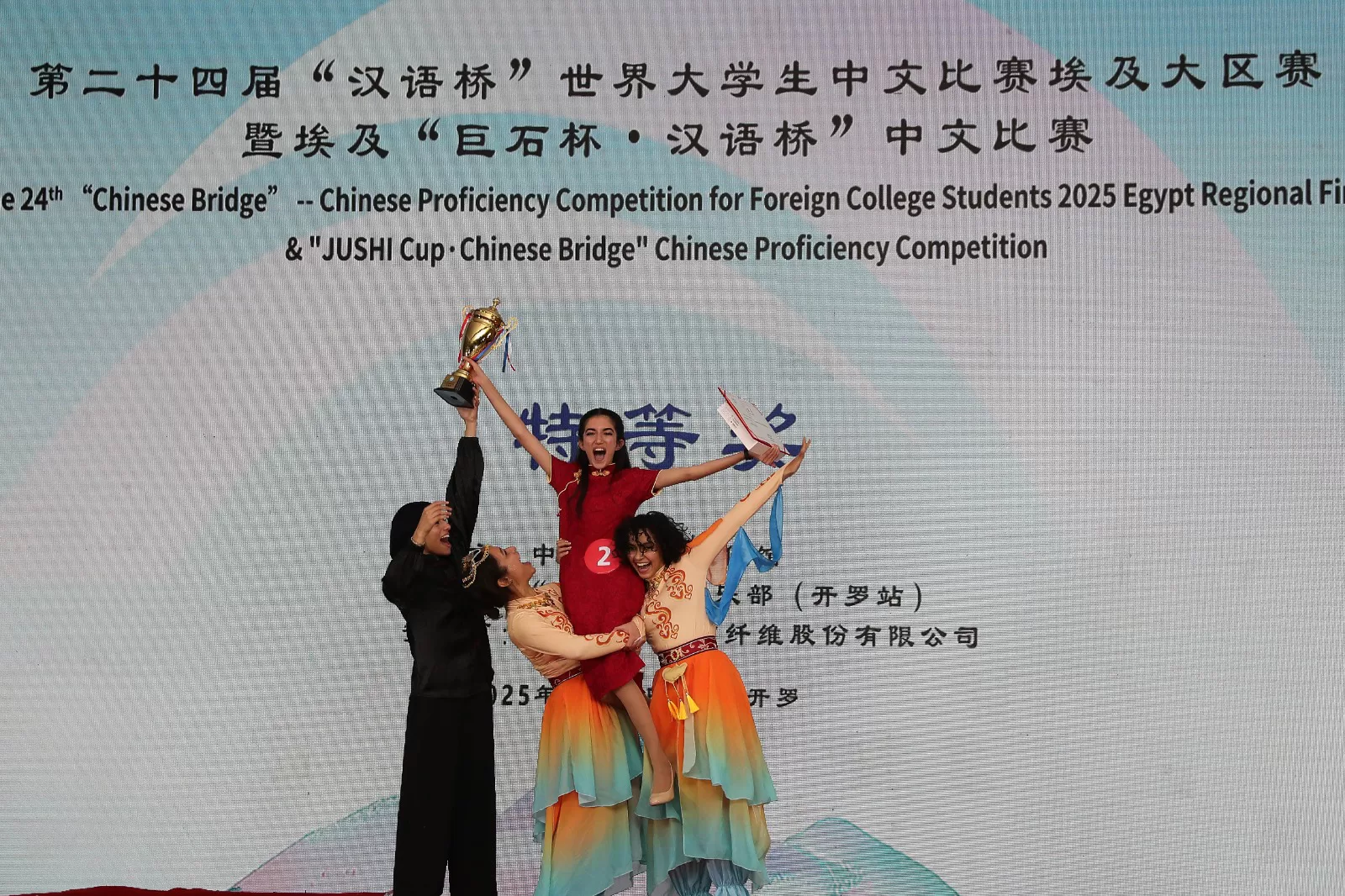
Beneath both political solidarity and practical co-operation lies the true foundation: a strong and still deepening bond between our peoples. The ancient Silk Road linked our civilisations thousands of years ago, but bilateral interaction has never been as close as it is today. Chinese now travel, live, work, and study throughout Egypt, while more young Egyptians learn Chinese in college or pursue degrees in China. Such exchanges build mutual understanding and prevent prejudice. Repeated polls have shown that an absolute majority of Egyptians view China as a partner or friend. Thus, the third chamber: people-to-people amity.
Also guiding the relationship forward is a convergent worldview – the fourth heart chamber. Both our nations are heirs to splendid ancient civilisations that endured foreign domination in modern times. Neither takes independence for granted, and both agree that all countries deserve the right to determine their own destiny. Regarding the recent Gaza war and the broader Palestinian question, as on many other international issues, China and Egypt share similar positions. The alignment has now extended to global governance: Both are leading voices for the Global South and advocate for a multipolar world where developing countries have greater say.
As the new year approaches, the heart of China-Egypt relations beats more strongly than ever. China is striving to achieve national rejuvenation through Chinese modernisation, and its priorities for the 15th Five-Year Plan (2026-2030) has recently been outlined. Egypt, for its part, is pushing ahead with its Vision 2030 national development agenda, determined to attain sustainable development in all fields. Both plans mean great potential remains untapped in bilateral relations. The upcoming 70th anniversary, along with the second China-Arab States Summit, also scheduled for 2026, will provide a golden opportunity to shape the relationship and ensure it continues to thrive.
Here in Egypt, a popular saying goes: “People are the true wealth.” Indeed. The true wealth of China-Egypt relations lies not in trade balances or grand projects but, fundamentally, in the trust and friendship between our peoples. That’s why those spontaneous “Ni Hao” greetings in Cairo’s alleys, and those schoolchildren’s smiles, will always keep me warm and confident.
Mao Lei is the director of the Middle East Regional Bureau of China’s Xinhua News Agency and a senior researcher at Xinhua Institute.

