


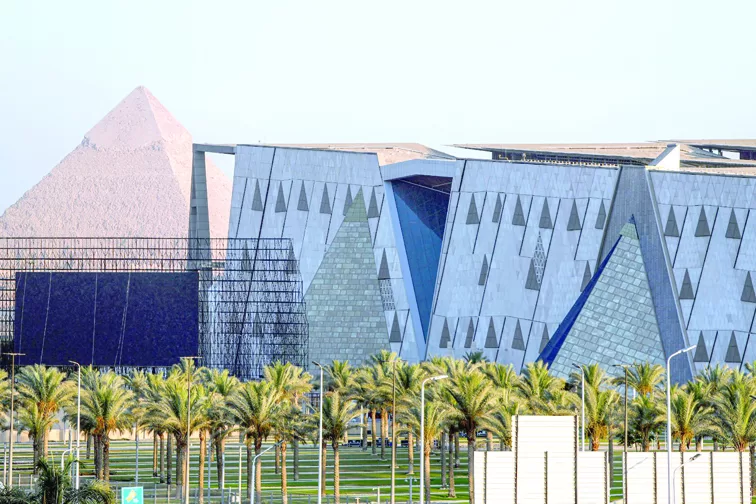
Shared code of success: What China’s blueprint, Egypt’s museum have in common
By Deng Yushan, Zhao Wencai
Egypt is no stranger to wonders. Just about two kilometres from the majestic Pyramids of Giza, a structure of modern splendor has risen from the desert – the Grand Egyptian Museum (GEM).
Since its long-awaited opening early this month, a wave of pride and joy has swept across the country, with eager visitors from around the world flocking to see the new icon of this ancient civilisation. As President Abdel Fattah El Sisi declared at the grand opening ceremony, the GEM, the largest museum on the planet dedicated to a single civilisation, is a “gift from Egypt to the world.”
We share our Egyptian friends’ excitement. The museum crowns two decades of determined efforts and attests to the persistence of the Egyptian government and people.
Meanwhile, we have been fascinated by a deeper parallel between Egypt and China, something our two ancient civilisations share in their modern national temperament: perseverance. It is the capacity to stay the course through shifting times and changing circumstances and carry a vision across generations.
About two weeks before the GEM’s opening, a landmark conference in Beijing also captured the gaze of the entire international community, because it would shape the development trajectory and global engagement of the world’s second-largest economy for years to come.
The fourth plenary session of the 20th Central Committee of the Communist Party of China approved recommendations for the country’s 15th Five-Year Plan for National Economic and Social Development, laying out a clear roadmap for China to further advance its cause of modernisation by promoting high-quality growth and high-level opening up from 2026 to 2030.
What merits no less attention is the practice behind it – the long-standing tradition of strategic planning that reflects China’s commitment to pursuing long-term development goals. Since the founding of the People’s Republic in 1949, China has formulated and implemented 14 five-year plans, each building on the achievements of the last.
That rhythm of planning and implementation has worked like a national heartbeat, powering China’s transformation from an impoverished country with bare-bones infrastructure into a major engine of the global economy, with its per capita GDP climbing from under $100 in the 1950s to more than $13,000 in 2024.
Take the goal of building a “moderately prosperous society in all aspects” as an example. It was first proposed in the 1980s, and following nearly four decades of unrelenting efforts, China declared victory in 2021 after eradicating absolute poverty in the country, which accounts for nearly one-fifth of the world’s population. That was no sprint; it was a generational marathon.
The same is true of the vision of “Chinese modernisation,” first articulated decades ago and still pursued with unbroken focus today. Given China’s modern record of uniting its people behind common goals and seeing them through with unwavering commitment, its plan to build a modern socialist country that is prosperous, strong, democratic, culturally advanced, and harmonious by 2049 is bound to be accomplished.
Now, we see Egypt advancing on a similar path. Guided by its Vision 2030 national strategy, including the Decent Life initiative, the country is also taking bold steps towards modernisation, inclusion, and national renewal. These endeavors rest on the same philosophy: lasting progress grows not from quick fixes, but from shared purposes, collective efforts, and dogged perseverance.
And we are glad to learn that Egypt Vision 2030 has notched steady progress, and the Decent Life drive has already delivered tangible benefits to some 18 million people so far in Phase One, and is expected to reach another 21 million in the second phase. As regards tourism, Cairo has set a target of 30 million visitors by 2030. We are confident that the GEM will help with its big magnetic pull.
So while the world marvels at Egypt’s grand museum and China’s enterprising blueprint, we – the Egyptian and Chinese peoples – truly know the story behind it. It is one of perseverance, of consistency and continuity, and of generations laying one brick after another in the determined pursuit of a common dream.
That spirit runs deep in the veins of both Chinese and Egyptian civilisations. It is the same force that raised our ancient wonders, and we believe it will continue to shape our future.
Now with the world undergoing profound changes, it is the moment for our two nations to draw on their civilisational strengths, deepen mutual learning and co-operation, and create new wonders, both in their respective causes of rejuvenation and in their shared pursuit of a better world.
• Deng Yushan is the deputy director
of the Middle East Regional Bureau of China’s Xinhua News Agency and a
reaearcher of Xinhua Institute
• Zhao Wencai is an editor of Xinhua’s Middle East Regional Bureau and
a reaearcher of Xinhua Institute

