


Shared vision for Gaza, Sudan, and Red Sea security
In the complex theatre of Middle East geopolitics, relations between Egypt and Saudi Arabia have long transcended diplomatic proximity. These relations serve, in fact, as an essential cornerstone of regional stability.
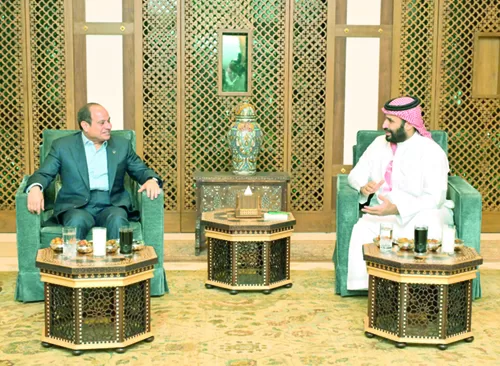
The recent high-level meeting between President, Abdel Fattah El Sisi, and Saudi Crown Prince, Mohammed bin Salman, in Jeddah serves as a powerful reaffirmation of this strategic bond.
The encounter, characterised by the Egyptian Presidency as a “brotherly visit”, reflects a historical depth that persists, despite the shifting tides of international alliances.
As the two largest Arab powers, Cairo and Riyadh represent a combined demographic, economic, and military weight that effectively anchors the Arab world.
This partnership is not merely transactional but is rooted in a shared vision for a regional order defined by the sovereignty of nation-states and the containment of non-state actors that threaten to destabilise the status quo.
Diplomacy at a critical juncture
The Jeddah meeting occurred at a moment of unprecedented volatility. The Middle East currently faces a “perfect storm” of security challenges, ranging from the humanitarian catastrophe in Gaza to the institutional collapse in Sudan and the rising maritime threats in the Red Sea.
In this climate, the “closed meeting” and subsequent Iftar banquet hosted by the Crown Prince were more than ceremonial. They signalled a unified front at a time when external pressures and internal regional fractures demand a high degree of coordination.
The timing is particularly significant as the international community looks for regional “anchors” capable of mediating conflicts and providing a pragmatic path towards de-escalation.
Key strategic messages
The discussions in Jeddah conveyed three primary messages to both regional players and the international community. Crown Prince Mohammed affirmed the “pivotal nature” and “centrality” of the relationship, signalling that Saudi Arabia views Egypt as its primary strategic partner in managing Arab affairs.
Both leaders emphasised the “significant development” in fraternal ties and the necessity of advancing co-operation across “various fields”.
For Egypt, this implies continued Saudi support. For Saudi Arabia, it reinforces the importance of a stable, economically viable Egypt as a market and a security partner.
A critical outcome was the firm, unified rejection of any attempts to displace the Palestinian people from their land. This message is a direct warning against policies that could lead to regional spill-over or the permanent liquidation of the Palestinian cause.
Gaza crisis and two-state solution
Central to the leaders’ agenda was the current situation in the Gaza Strip. The analysis of their joint statement reveals a highly coordinated stance on the path forward.
Both sides stressed the urgent necessity for all parties to adhere to a war-stopping agreement. Notably, they signalled a pragmatic openness to international frameworks, mentioning the importance of implementing the peace plan proposed by US President, Donald Trump, as a basis for movement.
The leaders called for an immediate and “unimpeded” increase in humanitarian aid delivery to the enclave.
Both Egypt and Saudi Arabia reiterated that regional peace is unattainable without a comprehensive political process leading to a two-state solution.
This underscores their role as advocates for international law and institutionalised peace over perpetual conflict.
Sudan and defence of state institutions
While Gaza dominated headlines, the situation in Sudan represents a shared existential concern for Cairo and Riyadh.
Although the official communiqué focused on “respect for the sovereignty, unity, and territorial integrity of states”, the strategic subtext regarding Sudan is clear.
Egypt and Saudi Arabia share a profound interest in preventing the total collapse of the Sudanese state. A collapsed Sudan would facilitate a vacuum for extremist elements and trigger massive refugee flows towards Egypt’s borders, while simultaneously destabilising Saudi Arabia’s “Vision 2030” ambitions for the Red Sea coast.
The Jeddah meeting reinforces their commitment to supporting peaceful solutions through dialogue and strengthening Arab solidarity to preserve the institutions of the state against fragmentation.
Red Sea moderation anchors
The meeting’s emphasis on “avoiding escalation and tension” speaks directly to the security of the Red Sea.
As a vital artery for global trade, the Red Sea is currently a flashpoint for geopolitical manoeuvring. By emphasising “non-interference in internal affairs” and “territorial integrity”, Cairo and Riyadh are positioning themselves as the primary guardians of this waterway, favouring regional diplomatic solutions over increased international militarisation.
Furthermore, the presence of high-ranking intelligence and foreign affairs officials, including Egyptian Foreign Minister, Badr Abdel-Aati, and his Saudi counterpart, Prince Faisal bin Farhan, indicates that the coordination discussed is deeply operational.
This “pragmatic diplomacy” aims to create a buffer against the escalating “tit-for-tat” cycles involving regional and extra-regional powers.
Balance of power
The Egyptian-Saudi partnership is evolving from a traditional alliance into a sophisticated mechanism for regional crisis management.
The decision to “continue and enhance political consultation and coordination” suggests that the Jeddah meeting was not a one-off event, but part of a sustained strategic pivot.
As the Middle East navigates a period of profound transition, the Cairo-Riyadh axis will remain the definitive arbiter of the regional balance of power.
By prioritising the stability of the nation-state and the economic prosperity of their peoples, President Sisi and Crown Prince Mohammed are charting a course towards a more predictable and moderate regional order.
For international policymakers, the message is clear: the road to a stable Middle East invariably passes through the coordination of these two historical anchors.
Mohamed Fahmy is the Editor-in-Chief of The Egyptian Gazette and
Egyptian Mail newspapers

