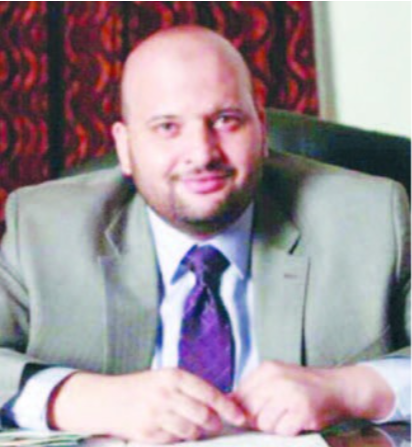





By Ibrahim Negm
The region today is not only living through wars of bullets and bombs; it is living through wars of predictions. In the age of so‑called fourth‑generation warfare, the real battleground is the human mind. Conflicts are increasingly waged not by invading armies but by invading narratives: carefully designed messages that prime whole societies to expect a particular future — and to surrender to it before it even arrives.
At the heart of this new landscape lies a sinister tool: manufactured “prophecies”. These are not accidental forecasts or sincere strategic analyses. They are pre‑packaged scenarios, dressed up as visions of the unseen, “signals” of what is to come, or the inevitable unfolding of destiny. They circulate on satellite channels, social media feeds, and even religious platforms, blurring the line between faith and manipulation.
The mechanism is simple and dangerous. First, an audience is saturated with messages that “the region is heading towards an inevitable explosion”, that “a great change is coming”, that “an empire will fall” or “a caliphate will return”. The language is suggestive, emotional, and often wrapped in religious symbols. The point is not to inform, but to prepare – to normalise in advance what certain actors are planning to try.
When the crisis arrives – a coup attempt, a street revolt, a sudden economic shock, a regional war – the public is told: “Didn’t we tell you this would happen?” The “prediction” is retroactively converted into proof of spiritual insight or superior access to hidden information. The result is paralysis. If events were “meant to be”, why resist? Why question who actually engineered them, who funded them, and who is benefiting?
This is the logic of psychological warfare: shift people from being agents of history to being spectators of fate.
In the Arab context, movements like the Muslim Brotherhood have long understood the power of this psychological terrain. For nearly a century, the idea of restoring the Caliphate has been a central pillar of their symbolic universe. It is not only a political project; it is sold as a historic inevitability and a religious duty at once.
During the Arab uprisings, this discourse went into overdrive. You could hear riffs of the same theme across speeches, statements, and media appearances: “The region is being prepared for something great.” “The tyrants will fall.” “The Ummah is on the verge of a civilisational rebirth.” The uprisings were portrayed not merely as political movements, but as the first tremors of a divinely scripted return of Islamic rule.
What is happening here is subtle but profound. Instead of saying “We have a political programme we want to convince you of,” the message becomes: “We are simply reading what God and history have already decreed.” Their opponents are then not just political adversaries but obstacles to destiny. Disagreement with the project can be painted – implicitly or explicitly – as a form of betrayal of the faith.
That shift matters. It lowers the threshold for dangerous political adventurism. It makes reckless gambles appear as acts of piety. And it turns ordinary believers into foot soldiers of a narrative they did not design, but have been taught to feel guilty for questioning.
On the other side of the Mediterranean, a parallel dynamic unfolds in a very different key. Large segments of the Christian Zionist movement in the United States also read the Middle East through the lens of prophecy — not Islamic, but biblical.
This theology has real-world consequences. Christian Zionist organisations pour money and political lobbying into expanding settlements, strengthening Israeli hardliners, and torpedoing serious peace efforts. Supporting maximalist Israeli policies is not framed as a matter of strategic calculation, but as obedience to divine script. Any call for restraint can be dismissed as standing in the way of God’s plan.
For societies like Egypt, where religious sentiment is genuine and deep, this is more than a question of media literacy. It is a question of spiritual security. When popular faith is strong but critical awareness is weak, it becomes an attractive target: a source of legitimacy waiting to be hijacked.
Islam’s own theological stance on the unseen is, in fact, remarkably clear and protective. Knowledge of the future in the absolute sense belongs to God alone. Any human claim to specific, esoteric access to the unseen – beyond the realm of sound expertise, probability, or transparent analysis – should immediately raise a red flag. The same is true of Christian and Jewish traditions when they are read soberly rather than through the lens of apocalyptic sensationalism.
The problem is not that believers take their scriptures seriously. The problem is that political and ideological actors take believers’ trust and weaponise it. They translate spiritual hope into a tool for strategic mobilisation. They turn eschatology into policy.
The casualties of this prophetic theatre are not the strategists, the think‑tankers, or the ideologues. They are ordinary people: the citizen who postpones investing in his small business because he is convinced collapse is around the corner; the young woman who loses faith in any political process because she has been taught that only a sudden, cataclysmic change “fits the prophecy”; the family that tolerates creeping chaos because “things must get worse before they get better”.
In such an atmosphere, the middle ground disappears. Gradual reform looks unheroic. Negotiation feels like betrayal. Compromise becomes almost sinful. And those who profit from permanent instability – whether they sit in secretive movement councils or in foreign war rooms – enjoy exactly the environment they need.
What, then, is the way forward?
First, we need to name the game honestly. Not every “analysis” is analysis. Not every “dream” circulated online is innocent. Not every “bashara” or “sign of the times” is evidence of spiritual sensitivity. Many are calculated interventions in a psychological battlefield.
Second, there is a civic responsibility on media, schools, and religious institutions to teach people how these games work. Explaining the mechanisms of bias, fear, and groupthink is not a luxury. It is national security. Showing how both Islamists and Christian Zionists have used prophecy as a political tool does not attack faith; it protects it from exploitation.
Third, each of us has to cultivate a simple discipline: before forwarding that viral “vision”, that thunderous prediction, that clip promising that “something great is about to happen” – ask: Who benefits if I believe this? Who is made weaker? Who is made stronger? And what verifiable facts, if any, stand behind these grand words?
The choice facing our region is not between faith and reason, between religion and realism. It is between being subjects of our own history, or extras in somebody else’s script.
Real faith does not ask us to suspend our minds, nor to outsource our moral and political judgement to self‑appointed interpreters of destiny. Real citizenship does not require us to deny the unseen, but to refuse its commercialisation.
The most subversive act in an age of manufactured prophecies is also the simplest: to insist that the future is, under God, shaped by human responsibility – by decisions taken in parliaments and boardrooms, on picket lines and in polling stations, in classrooms and at dinner tables. Not in the studios of “political astrologers”, and not in the apocalyptic fantasies of those who dream of a holy war they will watch from a safe distance.
In a region saturated with predictions, perhaps the most revolutionary sentence we can say is: Nothing is inevitable – except the accountability of those who tried to make us believe it was.
Senior Advisor to
the Grand Mufti of Egypt

