



Egypt emerges as key stabiliser in regional diplomacy
Humanitarian crises deepen, global stability erodes
Endless wars, diplomatic deadlocks
Mohamed Fahmy
It is becoming increasingly clear that 2025 will be remembered as one of the most politically and economically turbulent in recent history. Rather than merely extending earlier volatility, 2025 dismantled lingering assumptions about the durability of the post-Cold War international order. Prolonged wars, compounding economic shocks, and intensifying political polarisation pushed the world towards a phase of deep structural transformation whose consequences will reverberate for decades.
What defined 2025 was not a single, decisive crisis, but the convergence of multiple global and regional pressures that fed into one another, creating a pervasive sense of exhaustion. Conflicts endured not because victory was attainable, but because the mechanisms capable of resolving them had steadily eroded.
The year opened with a geopolitical shock: Donald Trump’s return to the White House following an electoral victory that defied most forecasts. Internationally, his inauguration was treated not as a routine democratic transition, but as a geostrategic turning point. Within weeks, a wave of executive decisions on trade, immigration, and foreign policy reshaped expectations in Washington and beyond.
US domestic politics could no longer be viewed in isolation. American policy once again became the primary lens through which the world interpreted itself. Protectionist trade measures and sweeping tariffs accelerated the retreat from free trade, undermining an international system built on economic interdependence. The resulting shockwaves rippled through global markets, intensifying inflationary pressures and deepening uncertainty. Populism gained renewed momentum, particularly in Europe, where a newly-assertive right increasingly presented itself as the final bulwark against what it portrayed as a civilisational threat.
China, for its part, responded with strategic patience. Supported by a massive trade surplus, Beijing continued to expand its influence across the Global South while preparing for a prolonged rivalry with Washington. The world is increasingly divided between two competing visions: one anticipating the early stages of a new Cold War between US- and China-led blocs, and another expecting a series of transactional arrangements that would carve the globe into American, Chinese, and Russian spheres of influence.
The paralysis of the international system was most visible in Ukraine. The war dragged into another year without decisive breakthroughs, marked instead by incremental battlefield shifts and mounting economic and human costs. NATO unity remained strained, as disagreements between Washington and European capitals resurfaced over strategy, burden-sharing, and the long-term sustainability of support for Kyiv.
Ukraine came to symbolise a broader global condition: conflicts that could neither be resolved nor conclusively ended. This pattern of prolonged confrontation without closure became one of the defining features of 2025.
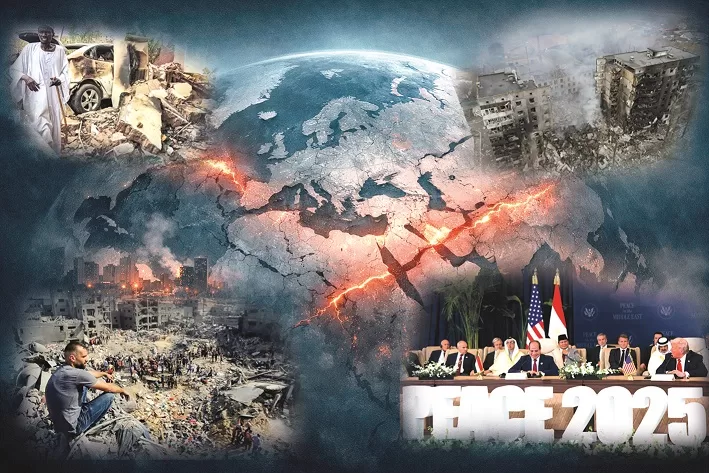
Instability deepened further in the Middle East. The war in Gaza remained the central fault line, fuelling regional tension and global outrage. Repeated promises of an early end to the conflict failed to materialise, while humanitarian suffering reached catastrophic levels. Growing suspicion surrounded the absence of a political horizon, with fears that Gaza’s future was being reshaped without addressing the rights and aspirations of its people.
The situation was further complicated by the Israeli-Iranian war, following a dangerous cycle of escalation that began the previous summer. Although a full-scale regional war was narrowly avoided, the confrontation marked a qualitative shift from proxy warfare to direct engagement. Iran’s regional network was weakened, altering the balance of power, yet the fundamental drivers of confrontation remained unresolved.
Against this backdrop, Egypt emerged as a critical stabilising force. Cairo played a decisive role in mediating a ceasefire in Gaza, using its unique position and established channels with all parties. While the agreement fell short of comprehensive peace, it prevented a slide into uncontrollable escalation and reaffirmed Egypt’s central role in regional diplomacy. The October Sharm el-Sheikh summit went beyond a temporary ceasefire, even as it exposed the limits of international resolve to impose a lasting settlement.
Egypt’s diplomatic engagement extended beyond Gaza. Throughout 2025, Cairo worked to de-escalate the crisis in Sudan, where conflict threatened state collapse and wider regional destabilisation. Combining political mediation, humanitarian coordination, and firm advocacy for Sudan’s unity and sovereignty, Egypt stood out in a year dominated by unilateralism and great-power rivalry.
By containing crises rather than exploiting them, Egypt reinforced its position as a key anchor of regional stability at a moment when the international order itself was under unprecedented strain.
Economically, 2025 was marked by deepening anxiety. Trade wars, disrupted supply chains, and rising protectionism compounded earlier shocks. Restrictive migration policies intensified social tensions across Western societies, exposing a central contradiction: hostility towards “outsiders” alongside an inability to articulate a coherent alternative to the values the West claims to defend.
The year ended without resolution, but with a sense of suspended motion a world caught between an order that no longer functions and a future that has yet to take shape. The challenge ahead is not simply to manage crises, but to confront the profound transformations now unmistakably under way.

