










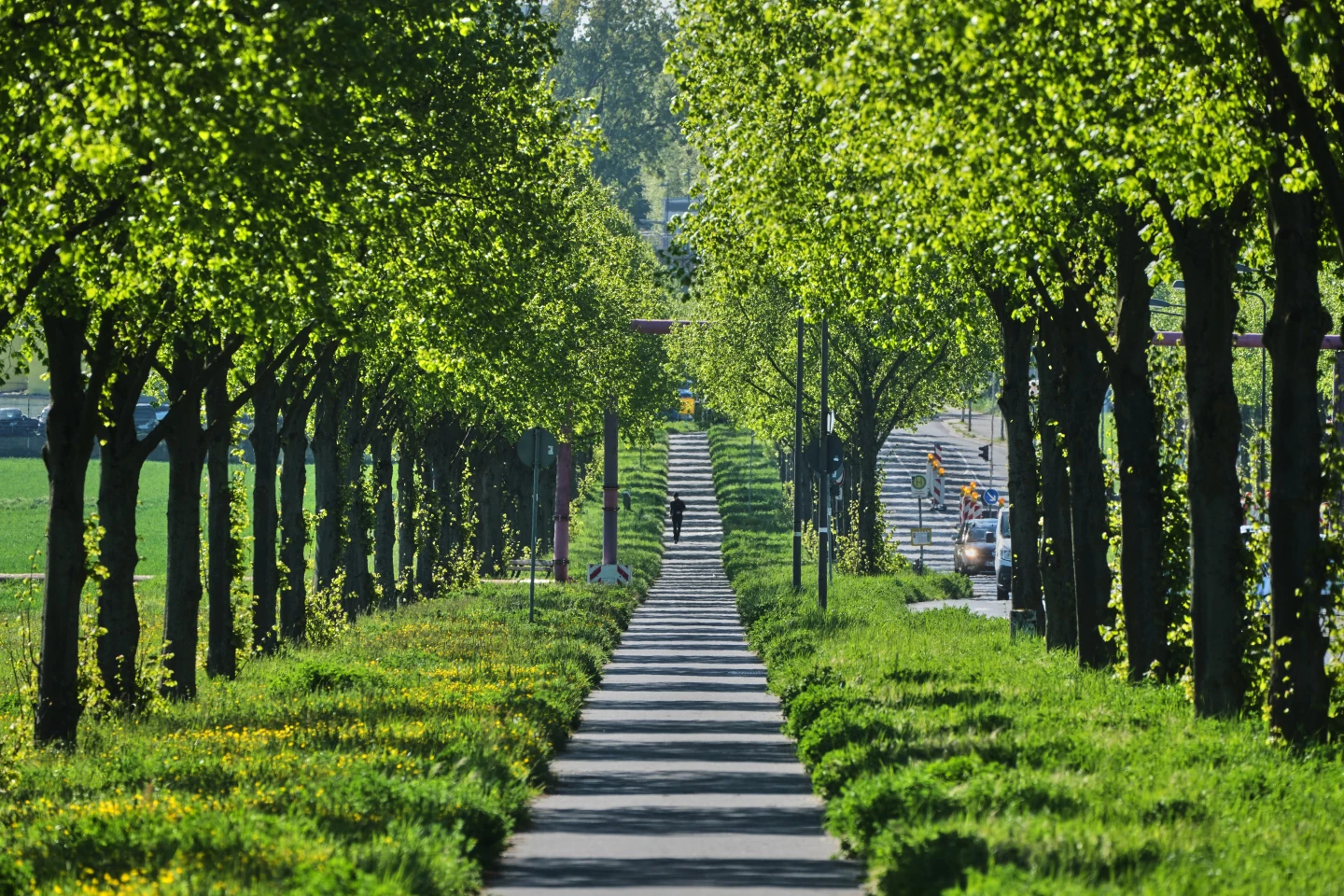
Trees are countering nearly half the urban heating from pavement and buildings in the world’s cities, but they’re not doing enough cooling in hotter, poorer cities where it’s needed the most as the world warms, a new study found.
When averaged out over all the world’s cities, tree cover — by giving shade and releasing water vapor — cools an average of 0.27 degrees Fahrenheit (0.15 degrees Celsius), according to a study in Wednesday’s Nature Communications.
Without those trees, the world cities would warm on average by 0.56 degrees Fahrenheit (0.31 degrees Celsius) due to the urban heat island effect, where dark roofs and pavement absorb heat. The human-caused warming mechanism is distinct from climate change caused by the burning of fossil fuels.
Researchers built their analysis of Earth’s nearly 9,000 large cities by measuring temperatures for segments of about 150 city blocks each. That allowed them to capture cooling effects for cities and neighborhoods so that trees in New York’s Central Park, for example, weren’t credited for cooling more built-up areas miles away in the Bronx.
About 185 million people living in 31 of the larger cities already feel an average cooling from tree cover of at least half a degree Fahrenheit (.3 degrees Celsius). But study lead author Rob McDonald, a scientist at the Nature Conservancy, said poorer and hotter large urban centers that need it the most aren’t getting as much relief from higher heat, which can kill by confusing the brain, shutting down organs and overworking the heart.
Meteorologists measure the temperature difference between a city center and nearby rural area to find the urban heat island effect. Scientists in this study used a combination of weather station measurements, satellite data and computer models to see the cooling trees provided.
In 20 cities with at least 3 million people, residents feel less a tenth of a degree Fahrenheit (.05 degrees Celsius) from cooling trees. In four cities — Dakar, Senegal; Jeddah, Saudi Arabia; Kuwait City and Amman, Jordan — there’s such minimal tree cover that the more than 15 million people who live there get essentially no cooling from trees.
On the other end of the spectrum, McDonald looked at cities where tree cover cools at least .45 degrees Fahrenheit (0.25 degrees Celsius). Nearly 40% of cities in wealthy nations get that much cooling, but just under 9% in the poorest countries have that amount of tree relief, the study said.
The list of places that cool the most is topped by Berlin and includes Atlanta, Moscow, Washington, Seattle and Sydney, which have more trees. For example, Atlanta has 64% of its land area under tree canopy, McDonald said. Wealthy areas in North America have larger lot sizes, individual ownership and residents with more political clout, all of which contribute to more trees growing and providing larger cover, said Chris Greene of the University of Dalhousie in Canada, who wasn’t part of the study.
“There’s this inequality,” McDonald said. “When you look at cities globally, there are many, many cities, especially in developing countries, that have very low tree cover, and so I think the air temperature cooling number was a little less than we expected.”

