




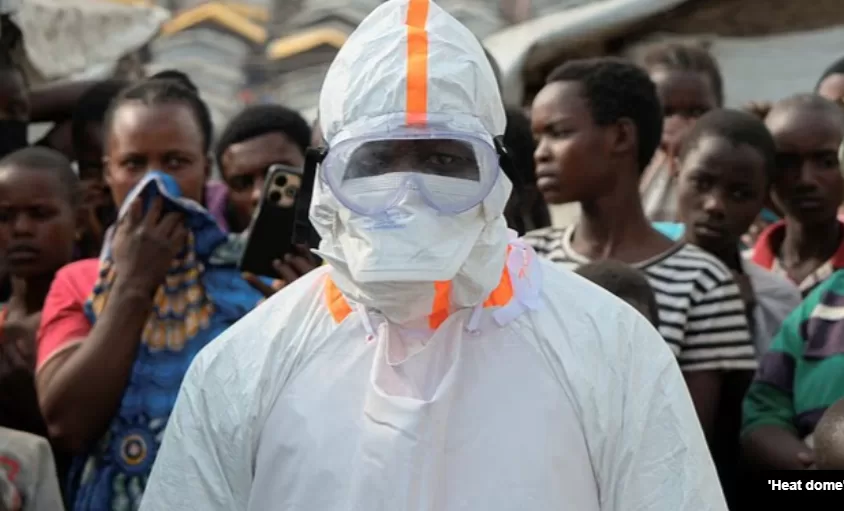
France has confirmed its first Ebola case linked to the current outbreak after a doctor tested positive for the deadly virus.
Health officials said the medic had returned from a humanitarian mission in the Democratic Republic of Congo (DRC) – which has been the epicentre of the current outbreak – before the positive test.
The patient, who is in mainland France, is said to be in a stable condition but has been isolated to prevent a spread of the virus – caused by the rare Bundibugyo strain – that has killed close to 300 people since May.
Officials maintain that the risk to the general European population is low, however contact tracing efforts are underway as they scramble to identify anyone who may have been exposed through contact with the doctor.
The outbreak in the DRC was declared an international health emergency by the World Health Organisation on May 17.
Since then, this is the second time a patient has been treated for the virus in Europe, after an American doctor who contracted Ebola in the DRC was flown to Berlin for treatment in May.
The spread has been largely restricted to the DRC and neighbouring Uganda, with official figures showing there have been more than 1,000 cases and more than 260 deaths recorded.
However Oxfam warned last week the true scale of the outbreak could be far greater than these numbers suggest amid fears the virus is spreading ‘undetected’.
While the exact numbers remain disputed, the charity said that a lack of resource in Ituri – the region in northwestern DRC with one of the highest number of cases in the outbreak – may be allowing the virus to spread without detection.
The current outbreak is one of the fastest-spreading since the 2014 outbreak which was linked to more than 28,000 cases and 11,000 deaths across West Africa.
WHO director-general Dr Tedros Adhanom Ghebreyesus warned last month that the health response was not keeping pace with the speed of the outbreak.
He said: ‘We are urgently scaling up operations, but at the moment the epidemic is outpacing us.’
The first case was detected in May but there are fears that it may have been circulating for months beforehand.
All flights to and from Bunia, the capital of the Ituri region, have been grounded, though travel in and out of some other parts of the DRC is still permitted.
The Foreign Office advises against travelling to large parts of the DRC, particularly eastern provinces – such as Ituri – affected by the Ebola outbreak and conflict which has raged since 2022.
Experts believe the virus may have already spread to other nearby nations, such as South Sudan, though there have been no official cases reported.
In previous Ebola outbreaks, the virus has killed more than half of those infected, many of whom died due to internal bleeding and organ failure.
It is feared that the Bundibugyo strain, which currently has no vaccine, can kill at a similar rate. Experts have warned that without protection, the virus will almost certainly continue to spread and kill.
Oxfam warned just one in five health facilities in Ituri has access to the necessary amount of clean water, which is ‘the first line of defence against transmission’ of the virus.
Oxfam said this raises ‘fears that the true scale of the outbreak is underestimated’.
On top of this, they claimed frontline health workers also cannot access ‘basic protective equipment’ – adding that these ‘conditions are hampering efforts to contain the spread of the virus’.
Manel Rebordosa, a field response coordinator for Oxfam in Ituri, said: ‘Water – the absolute first line of defense in any public health emergency – is simply not available.’
Oxfam’s concerns also stretched to the lack of contact tracing in the region. In the current outbreak, contact tracing is reaching just 43 per cent of known contacts, almost half the rate of the 2018 to 2020 Ebola outbreak in the same region.
There are also troubling statistics surrounding access to healthcare in eastern DRC. The charity claim that more than 70 facilities have been destroyed, leaving just 0.2 doctors for every 1,000 people.
Worryingly, the situation shows no signs of improving, as global funding to the DRC has been cut by almost half to around £1billion – the lowest figure in a decade.
For weeks there have been concerns that the virus could become a global issue.
Before the case was recorded in France, fears were sparked when suspected cases appeared in Brazil, Italy and Austria in recent weeks – though those tests ultimately came back negative.
The US’s health protection agency declared that the current outbreak could become the largest on record, while NHS staff have also been told to prepare for a potential outbreak on British shores.

