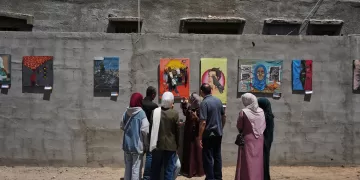







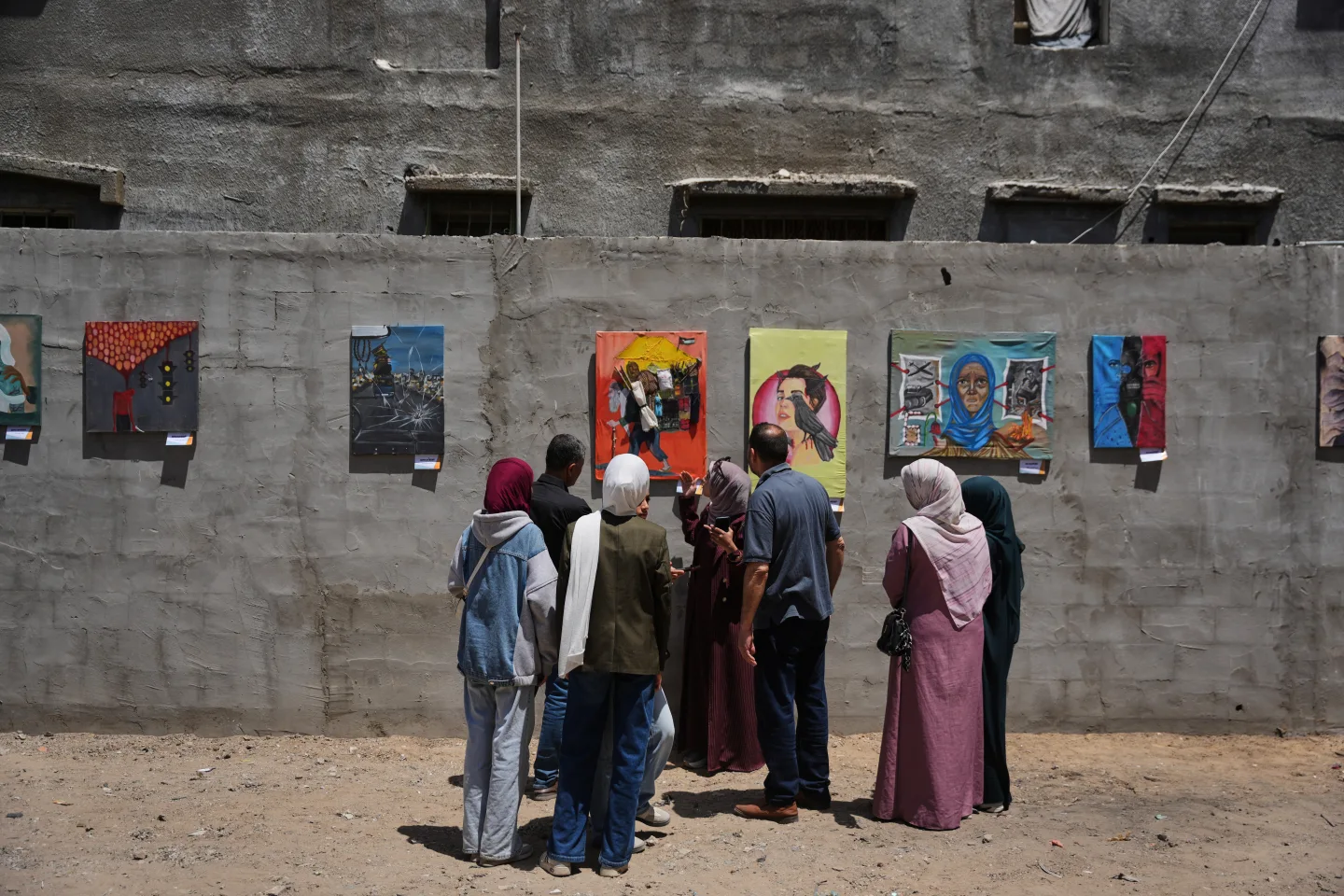
Young Palestinian artists in Gaza staged an impromptu exhibit, seeking another way to show the world what has happened during the war and the fragile ceasefire.
The row of paintings, like much of Gaza life itself, was displayed outdoors, open to the weather and curious stares. There was a painting of a dove, a bullet hole, a person’s silhouette in a territory where the war between Israel and Hamas has killed well over 70,000 people.
It was a sunny day in Bureij in central Gaza. Children shouted and played as admirers of the paintings took photos and reflected.
“They painted their feelings, their ambitions, their hopes, their visions, over four months during a continuous workshop in my studio,” said Ghanem Al-Din, who organised the exhibit of dozens of paintings.
Obay Al-Qarshali, 21, was one of the artists. He said he fled his home in Gaza City in late 2023 after the war began. He took only what he could in his hurry, leaving over 30 of his paintings behind.
They are now lost in the bombing and destruction, he said.
His painting on display showed broken glass, cars topped with mattresses and other belongings and the debris of buildings. All are too familiar for him and hundreds of thousands of fellow Palestinians who have been displaced, often more than once.
Al-Qarshali said he had changed locations at least seven times in the war.
“Because of how much we were displaced and suffered in moving and carrying our belongings, the tents, the crowds, and so much more, I wanted to express something that deeply troubled me: that we left our homes and our safe places, forced to flee, scatter, and change our location. This piece expresses so much,” he said.
The timing of next steps in Gaza’s ceasefire is unclear. The disarming of Hamas is a major challenge before the territory’s shift in governance, stabilisation and reconstruction can begin in earnest.
“Critical demilitarisation talks with Hamas are continuing,” former British prime minister Tony Blair, a key member of the US-created Board of Peace meant to focus on Gaza, told a UN Security Council meeting.
Reconstruction likely will cost over $70 billion and take a decade, a report by the United Nations and the European Union said last week.
It said Gaza’s economy has contracted by 84%. More than 371,000 housing units have been destroyed. Over half of Gaza’s hospitals are “non-functional.” Nearly all schools are destroyed or damaged in the territory of over 2 million people.
In a report on Tuesday, Doctors Without Borders said Israel has destroyed or damaged about 90% of Gaza’s water and sanitation infrastructure. And a Mercy Corps study found only 7% of Gaza’s agricultural infrastructure remains functional.

