


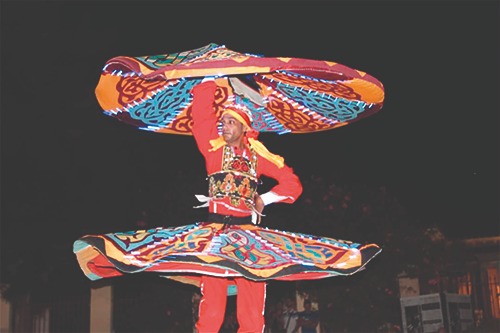
CAIRO – With the Tanoura (an ornate and colourful skirt) around his waist, the dancer starts to spin around in a certain direction, with his right hand pointing to the sky, and the other to earth, as if establishing a connection between both. The audience is excited with their eyes tied to him, and may even feel they are spinning around with him, stunted with his performance.
Fully concentrating on in his dance, the Tanoura dancer seems to have detached himself thoroughly from earth, embarking on a spiritual journey.
“I’m in love with the Tanoura, not just the dance,” Haitham Ahmed, 35, told the Egyptian Mail.
“15 years ago, I saw the Tanoura dance for the first time in a popular event in Qena, Upper Egypt, and since then I felt it became my passion,” he added.
“I decided to train myself on the dance, then I sought help to a trainer who helped me to be a ‘Tanourgy’ (the one who dances with the Tanoura),” Ahmed said. “I then worked in a folklore band,” Ahmed said.
The Tanoura dance appeared for the first time in the 13th century with the Sufi poet Jalal el Din al Roummi, he said. It was developed by al Roummi for religious nights in his hospice that used to receive the poor, strangers and passers-by, he explained.
Ahmed founded his own troupe, with 62 dancers who performed several kinds of folkloric dances, from different countries.
In Egypt, the folkloric Tanoura dance was mainly based the Sufi whirling, a form of physically active meditation that emerged among certain Sufi groups centuries ago, and is still practised today, seeking to reach the source of all perfection, or the karma.
This is sought through abandoning one’s nafs (ego or personal desires), by listening to music and spinning one’s body in repetitive circles, seen by some as a symbolic imitation of planets in the Solar System orbiting the sun.
Egyptians added several changes, making the Tanoura dance more appealing and exciting, and it became a popular one for entertaining people, on various occasions, not only as a religious aspect. The Tanoura attracts many foreign tourists.
“A dancer would spin anti-clockwise, opposite to the blood circulation to avoid dizziness,” Ahmed said. Spinning the other direction, one would soon fall dizzy.
“This is the trick the dancers should get trained on, and training could only take a week only. The key thing for a Tanoura dancer is to train on how to avoid dizziness, so that one can spin around 10 minutes to hours,” he added. Tanoura is made of special fabrics to help it rise up.
Dancers usually wear two or more layers of Tanoura. When they spin, the dancer raises one to form an umbrella, and a lantern from the other.
Many Tanoura dancers believe in the Sufian philosophy of the dance, namely the movement in the universe starts and ends at the same point. Therefore they perform circular movements to reach a sublime stage of spiritual serenity.
“The two layers of Tanoura that separate during wrapping are the sky and Earth, the beginning of the dance means the world before the Earth separated from the sky,” Ahmed said.
When the rhythm rises, the whirling increases and a dancer starts to take off Tanouras, gradually, one after the other, making of the last one a form that appears like a newborn baby, indicating the beginning of creation.
The spiritual philosophy is more felt when the dance is performed during a religious occasion such as al-Mouled el-Nabawwi (Prophet Mohammed’s birthday), and not in social ones like in wedding or birthday parties, for instance, Ahmed said.
Ahmed performed the Tanoura dance in several countries where he and his troups represented Egypt.
“I danced with the Tanoura for an hour and 36 minutes in a competition in Oman. It was a record time that won me first prize,” he recalled with a strong sense or pride.


Discussion about this post