


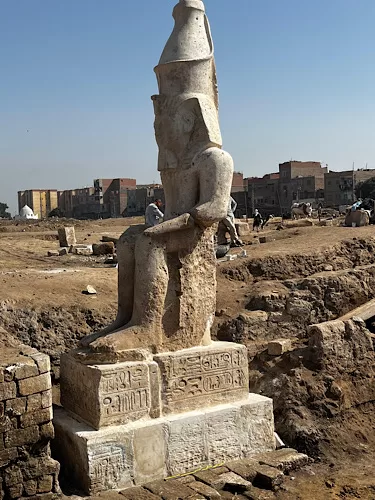
A joint Egyptian-American archaeological mission has successfully completed the restoration and reinstallation of a statue of King Ramses II in the Ashmunein area of Minya Governorate, Upper Egypt.
The project followed the discovery of the statue’s upper part in February 2024, which was then carefully matched and reassembled with its lower segment in its original location at the entrance of the ancient temple’s northern side.
Minister of Tourism and Antiquities, Sherif Fathy, highlighted that this achievement reflects Egypt’s commitment to preserving its rich heritage following the highest international scientific standards.
Secretary-General of the Supreme Council of Antiquities (SCA), Hesham El-Leithy, said that the project highlights the expertise of Egyptian restorers and their application of advanced scientific techniques to protect and sustain monumental heritage for future generations.
The fully restored limestone statue now stands at approximately 6.7 metres tall and weighs over 40 tons.
It consists of four main pieces, the upper and lower parts of the statue, plus its three massive inscribed base stones, laid upon uncarved foundation blocks.
The statue is one of two known royal monuments from the northern part of the ancient Ashmunein temple and depicts Ramses II seated, representing the grandeur of ancient Egyptian art.
The joint mission began work at Ashmunein in 2023, led by Bassam Gihad of the SCA and Yvona Trnka of the University of Colorado, US, carrying out extensive studies and excavations at the site.
The upper portion of the statue, measuring about 3.7 metres and weighing 12 tons, was unearthed in layers dating to later periods.
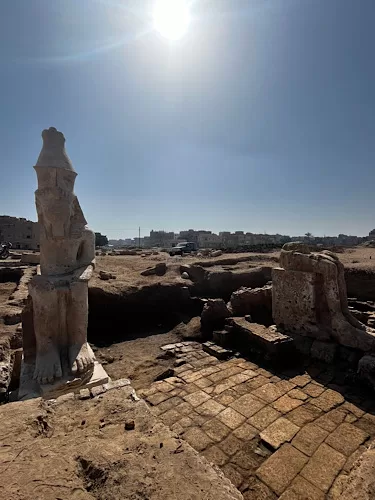
The detailed research confirmed the fit between the newly found upper section and the lower part uncovered in 1930. The team undertook thorough digital documentation, condition assessments, and structural analyses to ensure stability, then implemented a carefully approved conservation plan.

